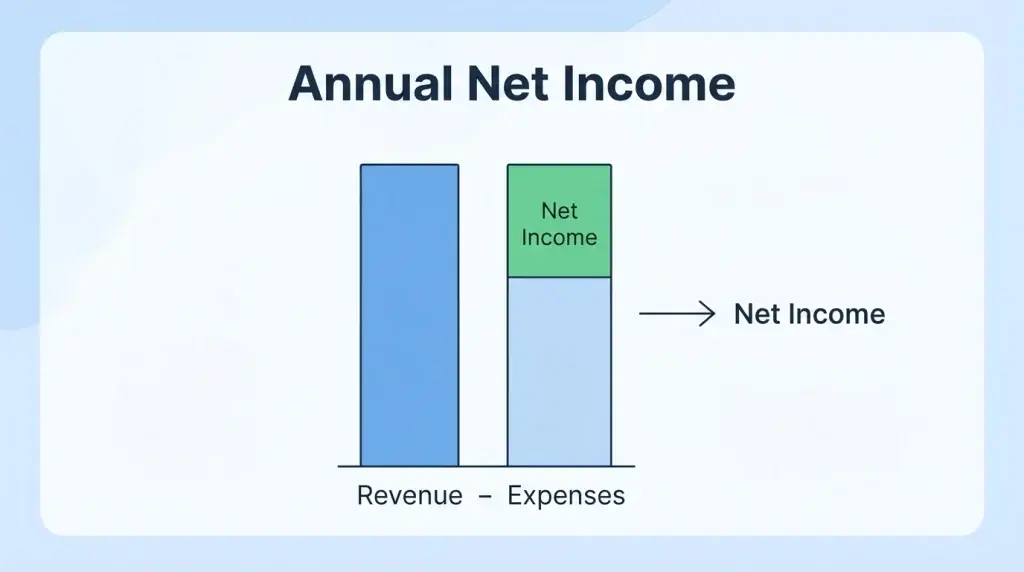
Have you ever looked at a company’s report and wondered how much money it really kept? Or maybe you saw “net income” on a tax form and felt lost. You are not alone. Plenty of people search for the annual net income meaning every year.
Here is the short answer. Annual net income is the money left over after you subtract all your costs, taxes, and interest from everything you earned in one year. It is often called the bottom line.
In this guide, you will learn what annual net income means for businesses and for people. You will see the formula, a real example, common mistakes, and easy tips. By the end, you will read any income report with confidence.
Quick Answer: Annual Net Income Meaning
Annual net income is the total profit a person or business has left after paying every cost over twelve months. It starts with all the money coming in. Then it takes away expenses, interest, and taxes. What remains is net income.
Think of a lemonade stand. You sell lemonade all summer and collect $1,000. You spent $300 on lemons, sugar, and cups. You also paid $100 to rent a spot. Your net income is $600. That is what you actually get to keep.
Some people call it net profit, net earnings, or the bottom line. The last name comes from where it sits on an income statement. It is the very last number on the page. If the number is negative, it is called a net loss.
The Simple Formula Behind Net Income
The math is not hard. The basic formula looks like this:
Net Income = Total Revenue − Total Expenses
Total revenue is all the money earned from sales or services. Total expenses include everything it cost to run the business or earn that money. That covers the cost of goods, wages, rent, utilities, advertising, interest on loans, and taxes.
The word “annual” just means you are looking at a full year. Some businesses use the calendar year, from January 1 to December 31. Others use a fiscal year that starts in a different month. A store might end its year in January, after the holiday rush. Either way, the time frame is twelve months.
You can also work out net income in steps. This helps you see where the money goes. Businesses often start with revenue, take away the cost of making the product, then take away running costs, and finally subtract interest and taxes. Each step has a name, and we will look at them soon.
A Step-by-Step Business Example
Numbers make ideas easier to grasp. Let’s say a small bakery earns $500,000 in one year. Here is how the bakery gets to its annual net income.
| Line Item | Amount | What It Means |
| Revenue | $500,000 | All sales for the year |
| Cost of goods sold | $200,000 | Flour, sugar, butter, packaging |
| Gross profit | $300,000 | Revenue minus cost of goods |
| Operating expenses | $150,000 | Rent, wages, power, marketing |
| Operating income | $150,000 | Profit from the main business |
| Interest expense | $10,000 | Cost of a bakery loan |
| Income before taxes | $140,000 | What is left before the tax bill |
| Income taxes (21%) | $29,400 | Simple federal rate used here |
| Annual net income | $110,600 | What the bakery keeps |
This example is simplified. Real businesses may pay state taxes, use different tax rates, and have more line items. Still, the pattern is the same. You start big at the top and shrink the number as you subtract each cost.
The bakery’s net profit margin is about 22 percent. You get that by dividing net income by revenue. In plain words, the bakery keeps roughly 22 cents of every dollar it sells. Margin is a handy way to compare businesses of different sizes.
Annual Net Income for Individuals
Net income is not only for companies. It also applies to people, but the meaning shifts a little depending on how you earn money.
If you work a regular job, your gross income is your pay before anything is taken out. Your net income is what is left after taxes and deductions. Most people call that take-home pay. Deductions may include federal and state income tax, Social Security, Medicare, and health insurance.
Here is a quick example. Say someone earns $60,000 a year before deductions. After all the usual deductions, they might take home around $48,000. That $48,000 would be their annual net income. The exact amount depends on where they live, their tax filing status, and their benefits.
If you are self-employed, it works differently. Your net income is your business earnings minus your business expenses. A freelance designer might earn $80,000 from clients. If she spent $12,000 on software, equipment, and a home office, her net business income is $68,000. She would then owe taxes on that amount, including self-employment tax.
One more thing to know. Lenders and landlords often ask for your net income or proof of income. The word can mean slightly different things in different forms. Always read the instructions so you report the right number.
Gross Income vs. Net Income vs. Operating Income
These three terms get mixed up all the time. They sound alike, but they measure different things. The table below shows how they differ.
| Term | What It Measures | Taxes and Interest Included? |
| Gross income (or gross profit) | Money earned before most costs are removed | No |
| Operating income | Profit from running the main business | No |
| Net income | Final profit after all costs, interest, and taxes | Yes |
Gross income is the biggest number and the least complete picture. It tells you how much came in, but not how much stayed. Operating income is a middle step. It shows how well the core business works before debt and taxes enter the story.
Net income is the full picture. A company can look strong at the top of its income statement and still end up with a small net income. This happens when heavy debt payments or high taxes eat up the profit. That is why smart readers always check the bottom line.
Where to Find Annual Net Income
If you want to find annual net income for a company, look at its income statement. This report is also called a profit and loss statement, or P&L. Net income is usually the last line.
For public companies in the United States, the numbers are in the annual report, known as the Form 10-K. These reports are filed with the Securities and Exchange Commission, or SEC. Anyone can read them for free on the SEC’s EDGAR database. Many company websites also post them in an investor section.
For your own small business, your accounting software can build an income statement in a few clicks. Your tax return also shows net profit. Sole proprietors report it on Schedule C, which is part of the personal tax return.
For your own pay as an employee, check your pay stubs and your W-2 form. Your last pay stub of the year shows year-to-date gross pay and the amounts taken out. Add things up, and you can estimate your annual net income.
Why Annual Net Income Matters
Net income is one of the most watched numbers in money and business. It answers a basic question: is this making money or not?
For business owners, it shows If the business is healthy. A steady, growing net income suggests the company is doing well. A falling net income is a warning sign, even when sales are going up. It may mean costs are growing faster than revenue.
For investors, net income is the starting point for earnings per share, or EPS. EPS equals net income divided by the number of shares. It helps people judge a stock. Net income also feeds into ratios such as net profit margin and return on equity.
For lenders, net income shows If a borrower can repay a loan. A bank wants to see that there is enough profit to cover payments. For people applying for a mortgage or car loan, the lender may look at net income to see what monthly payment is safe.
For everyday budgeting, your personal net income tells you what you can truly spend and save. Planning around gross pay is a common trap. You can’t spend money that never reaches your bank account.
Net Income vs. Cash Flow
Here is a point that surprises many people. Net income is not the same as cash in the bank. A company can show a profit and still run low on cash. It can also have positive cash and a net loss.
Why does this happen? Accounting rules often record sales and costs when they happen, not when money moves. Imagine a company that sells $50,000 of goods in December but gets paid in February. The sale counts as revenue now, so it raises net income. The cash arrives later.
Depreciation is another reason. It spreads the cost of big items, like a delivery truck, over many years. It lowers net income each year, but no cash leaves the account in that year. Also, paying back the main amount of a loan does not reduce net income, but it does reduce cash.
This is why careful owners track both. Net income tells you about profit. The cash flow statement tells you about the money you can actually use this week. You need both views to run a business well.
Common Mistakes to Avoid
Even smart people slip up with net income. Watch out for these errors.
The first mistake is mixing up gross and net. If someone says they “made $100,000,” ask If that is before or after costs. The gap can be huge.
The second mistake is leaving out expenses. Small business owners sometimes forget items like software, insurance, or the cost of their own time. Missing expenses makes net income look bigger than it is, and that can lead to bad choices.
Third, some people treat one-time events as normal. If a company sells a building and books a big gain, net income may jump for one year only. That does not mean the business suddenly got better. Look at the story behind the number.
Fourth, people forget about taxes. A business owner may see a $100,000 profit and spend it all, then get hit with a tax bill. Net income reported before taxes is not the same as what you can keep. It is smart to set money aside during the year.
Finally, don’t compare net income across companies without thinking about size. A $1 million profit is great for a corner shop and tiny for a national chain. Use margins to compare fairly.
Tips for Using and Improving Net Income

Understanding the number is step one. Using it well is step two. Here are some practical ideas.
Review your income statement every month, not only once a year. Spotting a problem in March is far better than finding it in December. Small fixes add up over twelve months.
Track your expenses by category. When you can see that marketing, rent, or supplies are growing fast, you can decide what to trim. Even a small cut in costs raises net income dollar for dollar.
Look at pricing, too. Many small businesses charge too little. A modest price increase can lift profit more than a big jump in sales. Always test carefully so you do not lose customers.
Plan for taxes early. Talk with a tax professional or a certified public accountant, or CPA, about deductions you may qualify for. Legal deductions can lower your tax bill and raise your net income. Never guess or cut corners with the IRS.
For personal finances, build your budget around take-home pay. Set aside money for savings and emergencies first. Then divide the rest among bills and fun. If your income changes from month to month, base your budget on your lowest typical month.
FAQs
What is the annual net income meaning in simple words?
It is the money you or a business keep after paying all costs, interest, and taxes during one year. It is the final profit number.
Is annual net income the same as salary?
Not exactly. Salary is usually your pay before taxes and deductions, which is gross income. Your net income as an employee is what is left after those are taken out, often called take-home pay.
Is net income before or after taxes?
Net income is after taxes. If you see a number before taxes, it is usually called pre-tax income or income before taxes. Always check the label.
Can annual net income be negative?
Yes. If expenses are bigger than revenue, the result is a net loss. Many new businesses have a net loss in their first year or two while they grow.
How do I calculate annual net income for my small business?
Add up all your revenue for the year. Then subtract every expense, including cost of goods, wages, rent, supplies, interest, and taxes. What remains is your net income. Accounting software can do this for you.
Is net income the same as profit?
Most of the time, yes. People often use net income, net profit, and net earnings to mean the same thing. “Profit” can also mean gross profit or operating profit, so check which one is being discussed.
Conclusion
The annual net income meaning comes down to one idea: it is what you keep after everything is paid. Revenue shows what came in. Expenses, interest, and taxes show what went out. Net income is the true result at the end of the year.
Remember that net income applies to both businesses and people. For a company, it shows health and growth. For a worker, it shows real take-home money. And while it is a powerful number, it is not the same as cash in the bank, so check both.
Here is some practical advice. Make a habit of looking at your net income often, not only at tax time. Track your costs, plan for taxes, and use margins to judge progress. When in doubt about a big money decision, ask a qualified accountant. A little knowledge goes a long way.

Hi, I’m Elias Monroe. I enjoy writing meaningful prayer content that helps people feel calm, hopeful, and spiritually strong. My goal is to share words that bring comfort during both joyful and difficult times.