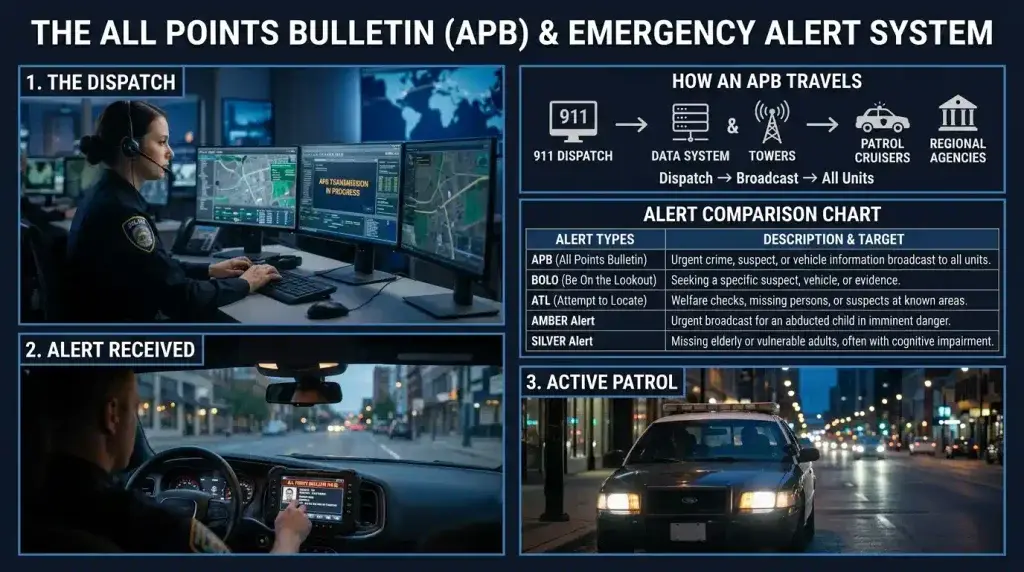
You hear it in cop shows all the time. An officer grabs the radio and says, “Put out an APB!” But what does it really mean, and does it work the way TV shows it?
The APB meaning in police work is simple. APB stands for “all points bulletin.” It is a message sent to many officers at once, asking them to look for a person, a car, or something else tied to a crime or an emergency.
In this guide, you will learn what an APB says, who sends it, and how it spreads. You will also see how it differs from a BOLO and an Amber Alert. Along the way, we will clear up a few common myths. By the end, you will know exactly what people mean when they say it.
Quick Answer: APB Meaning in Police
APB means “all points bulletin.” It is an urgent message that police send to other officers and agencies. The message asks them to watch for a certain person or vehicle. Officers who get it keep the details in mind while they work their normal shifts.
Think of it like a group text for law enforcement, only much more serious. One agency learns something important. It then shares that news widely so many sets of eyes can help.
Here is a quick snapshot:
| Question | Short Answer |
| What does APB stand for? | All Points Bulletin |
| Who sends it? | Police, sheriffs, and other law enforcement agencies |
| Who gets it? | Officers and nearby agencies, sometimes a wide area |
| What is it for? | Finding a suspect, a vehicle, or a missing person |
| Is it public? | Usually not, but some alerts are shared with the public |
What the Words “All Points Bulletin” Really Mean
Let’s take the three words one at a time.
“All points” means every place where officers might be. Picture a map with many dots on it. Each dot is a police car, a station, or a checkpoint. An “all points” message goes out to all of those dots, not just one.
“Bulletin” is an old word for a short news notice. It is a quick update, not a long report. That is why an APB is usually brief. It gives the key facts and nothing extra.
Put them together, and you get a fast news flash for officers everywhere in an area. The idea behind it is simple. More eyes on the street means a better chance of finding someone quickly.
You may also hear people say “put out an APB.” That just means “send the alert.” In real life, many agencies now use other names or computer systems. But the term “APB” is still well known. People use it in everyday speech, too, even outside of police work.
How an APB Works, Step by Step
Every agency has its own rules, so the exact steps can differ. Still, most APBs follow a pattern like this.
First, something happens. A crime is reported, a person goes missing, or an officer spots a stolen car. The officer or a dispatcher decides that more help is needed to find someone or something.
Next, someone writes the message. Dispatchers often handle this. They gather the facts and keep the message short and clear. They try to include only details that help officers act.
Then the message is sent. In the past, this happened by radio or teletype. Today, it often goes through computer systems, car computers, and email-style alerts. The alert reaches officers on duty in the chosen area.
After that, officers keep watch. They do not drop everything. They go on with their normal work, but they remember the details. If one of them sees a match, they can act or call for backup.
Finally, the alert ends. Once the person is found or the case changes, the agency cancels or updates the APB. This step matters a lot. If an old alert stays active, officers might waste time or stop the wrong person.
What Information Goes Into an APB
A good APB is clear and easy to use under stress. Officers may hear it while driving, so it needs to be quick to understand. Here is the kind of information that is often included.
| Type of Detail | Examples |
| Person details | Height, build, hair color, clothing, name if known |
| Vehicle details | Make, model, color, license plate, damage |
| Last known location | Street, area, or direction of travel |
| Time | When the person or car was last seen |
| Reason for alert | Type of incident, such as theft, missing person, or other |
| Safety notes | If the person may be dangerous or needs medical help |
| Contact info | Who to call if the person or car is found |
Why does each detail matter? Because small facts can sort out the right person from the wrong one. “A red car” could be thousands of vehicles. “A red four-door sedan with a cracked back window, heading north on Main Street ten minutes ago” is much more useful.
Accuracy matters too. A wrong detail can send officers in the wrong direction. It can also put an innocent person in an awkward spot. That is why dispatchers and officers try to double-check facts when they can.
APB vs. BOLO and Other Police Alerts
APB is not the only alert police use. You may also hear terms like BOLO, ATL, Amber Alert, and Silver Alert. They sound alike, but they are not exactly the same. Some agencies even use them in different ways.
Here is a simple comparison.
| Term | Stands For | Common Use |
| APB | All Points Bulletin | Wide alert to officers about a suspect, vehicle, or missing person |
| BOLO | Be On the Lookout | Similar to an APB; often used for a specific person or car |
| ATL | Attempt to Locate | Asking officers to find someone, often a missing person |
| Amber Alert | America’s Missing: Broadcast Emergency Response | Public alert for a child believed to be in serious danger |
| Silver Alert | Not an acronym | Public alert for a missing older adult or a person with memory problems |
So how do you tell an APB and a BOLO apart? In daily use, they are very close. Many officers use them almost the same way. Some departments say “APB” for a larger area or a more urgent case. Others say “BOLO” for smaller, local alerts. There is no single rule that every agency follows. When in doubt, the local department’s own policy decides.
The biggest difference is often the audience. APBs and BOLOs usually go to police only. Amber and Silver Alerts go to the public. They can show up on phones, road signs, and the news. That is because the public can help spot a child or a vulnerable adult. A named alert like Amber also has special rules about when it can be used.
A Short Look at the History of the APB
Where did the term come from? The honest answer is that no one can point to one exact date or inventor. Reliable records on the first-ever use are hard to find, so it is best not to guess.
What we do know is that the idea grew alongside police technology. Early officers walked a beat and had few ways to share news fast. Then came the two-way radio in patrol cars. After that, teletype machines let agencies send written messages to each other across long distances. These tools made wide alerts possible.
Later, national systems helped agencies share information. One well-known example is the FBI’s National Crime Information Center, often called NCIC. It started in 1967 and lets agencies look up records about stolen vehicles, wanted persons, and missing persons. It is not the same thing as an APB. But it shows how police moved from simple radio calls to shared databases.
Today, the old phrase has stayed even as the tools changed. Many officers still say “APB” out of habit, even when the message travels through a computer screen instead of a radio.
Real-Life Examples of How an APB Might Be Used
Note that the examples below are made up for teaching. They show how the idea works. They are not real cases.
Example one: a stolen car. A man reports that his blue pickup truck was taken from a parking lot. The dispatcher sends out the make, color, plate number, and the time it disappeared. An officer across town later sees a truck that matches. She checks the plate, confirms it, and calls for help. The truck is returned to its owner.
Example two: a missing person. An older woman with memory trouble walks away from her home. Her family calls the police. Officers share her photo, clothing, and the direction she might be walking. A patrol officer notices her near a bus stop and checks on her. She is taken home safely.
Example three: a suspect on the run. After a robbery, a witness describes the person and the car they left in. Dispatch shares the details with nearby agencies. Because the alert went out wide, a neighboring department’s officer spots the car a few miles away.
In all three cases, the pattern is the same. A short message shares key facts. Many officers stay alert. And that teamwork raises the odds of a safe, quick result.
How APBs Work Today: Technology and Trends
Modern police work looks different from the old radio days. Many agencies now use computer-aided dispatch, often called CAD. This is software that helps dispatchers track calls, officers, and alerts all in one place.
Patrol cars often have computers called mobile data terminals. An alert can pop up right on the screen, so officers do not have to rely only on what they hear. This helps because radio traffic can be busy and loud.
License plate readers are another tool. These are cameras that scan plates and compare them with lists of vehicles of interest. If a plate matches, the system can alert officers. Policies on how long that data is kept and who can see it vary by place, and the topic is often debated in public.
Alerts also reach farther than before. Because agencies share systems, an alert in one town can reach another county quickly. And public alerts, like Amber Alerts, can go to cell phones.
Even with all this tech, people still make the final call. A human decides to send the alert, and a human decides how to act on it. Tools help, but good judgment is what keeps everyone safe.
Common Mistakes and Myths About APBs
Because of TV and movies, a few myths have stuck around. Let’s clear them up.
Myth: An APB means police can arrest anyone who looks similar. That is not true. Officers still need a legal reason to stop or arrest someone. An APB is a tip to watch for a match. It does not replace the rules about stops and arrests.
Myth: Every APB goes out to the whole country. Most do not. An APB usually covers the area that makes sense for the case. That may be one city, one county, or several nearby regions. Larger searches use other systems too.
Myth: Anyone can send an APB. Only trained people at law enforcement agencies send them, usually through dispatch or a supervisor. Regular people cannot issue one. If you have information, you should call the police.
Myth: APBs and Amber Alerts are the same. They are not. An APB mostly goes to officers. An Amber Alert goes to the public and has strict rules about when it can be used. The Amber Alert system was named after Amber Hagerman, a girl from Texas whose case led to its creation in 1996.
Mistake: Using “APB” for every kind of alert. In real conversation, people mix up terms. But if you are writing a report, a school paper, or a news story, it helps to use the right word for the right alert.
What to Do If You Think You Have Seen Someone From an Alert
Maybe you saw a news story or a post online about a missing person or a wanted car. Later, you think you spotted a match. What should you do?
First, stay calm and stay safe. Do not follow the person or car. Do not try to stop them. You might not know how risky the situation is.
Second, call the police. Use the local emergency number if it seems urgent, or the department’s non-emergency line if it does not. In the United States, 911 is the emergency number.
Third, share clear details. Tell them what you saw, where you saw it, and when. Mention the direction the person or car was heading. If you can safely note a plate number or clothing, that helps. But only share what you truly saw. Guessing can lead officers the wrong way.
Fourth, avoid spreading unverified claims online. Posting a guess can hurt innocent people or confuse the search. Let the police handle the response, and pass along official updates only.
APB in Movies, TV, and Pop Culture
Pop culture has made “APB” a famous phrase. In movies and TV shows, a detective shouts it, and a dozen cars rush out right away. It makes for exciting scenes.
Real life is calmer and more careful. Most alerts are sent quietly through dispatch. Officers do not always race off. They watch, listen, and wait for a real match.
The phrase has also made its way into daily talk. Someone might joke, “I’m putting out an APB for my missing keys.” That shows how common the term has become. There was even a video game named APB: All Points Bulletin, released in 2010, which used the police theme in its title.
Knowing the real meaning helps you enjoy the shows more. You can also tell which parts are drama and which parts are close to the truth.
FAQs About APB Meaning in Police
What does APB stand for in police terms?
APB stands for “all points bulletin.” It is a message sent to many officers asking them to watch for a certain person, vehicle, or item tied to a case or an emergency.
Is an APB the same as a BOLO?
They are very similar, and many officers use them in almost the same way. Some departments use APB for wider or more urgent alerts and BOLO for smaller local ones. The exact use depends on the agency.
Who can issue an APB?
Law enforcement agencies issue them, usually through dispatchers, officers, or supervisors. The public cannot send an APB. If you know something helpful, you should call the police instead.
Does an APB go out to the public?
Most do not. They are mainly shared with officers and other agencies. Public alerts, such as Amber Alerts and Silver Alerts, are separate systems made to reach everyday people.
How long does an APB last?
There is no one set time. An APB stays active until the person or vehicle is found, the case changes, or the agency cancels it. Good agencies update or cancel alerts quickly so officers have correct information.
Can police arrest someone just because of an APB?
Not by itself. An APB tells officers what to look for. They still need a lawful reason, such as probable cause, before they make an arrest. The rules can vary by situation and location.
Conclusion
The APB meaning in police work is easy to remember once you break it down. APB stands for “all points bulletin.” It is a quick, urgent message that helps many officers watch for the same person or vehicle at the same time.
You now know how an APB is written, what details it holds, and how it moves from dispatch to the street. You also learned how it differs from a BOLO, an Amber Alert, and a Silver Alert. And you can spot the myths that movies and TV have made popular.
Here is one last tip. If you ever see a missing person alert or a wanted vehicle notice, do not take action on your own. Stay safe, keep your distance, and call the police with clear facts. That small step can make a big difference.

Hi, I’m Sarah Mitchell. I love writing faith-based content that brings peace, hope, and encouragement to everyday life. Through prayers and devotionals, my goal is to help readers feel closer to God and stronger in faith.