Have you ever heard someone say “it’s turtles all the way down” and wondered what on earth they meant? You’re not alone. This quirky phrase pops up in science books, philosophy classes, and even casual conversations, yet it confuses a lot of people the first time they hear it.
The turtles all the way down meaning points to an old idea about infinite regress basically, something that keeps going back and back with no real starting point.
In this article, you’ll learn where the phrase came from, what it truly means, how people use it today, and why it still matters in modern conversations about science and belief.
Quick Answer
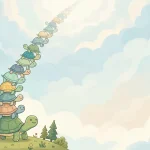
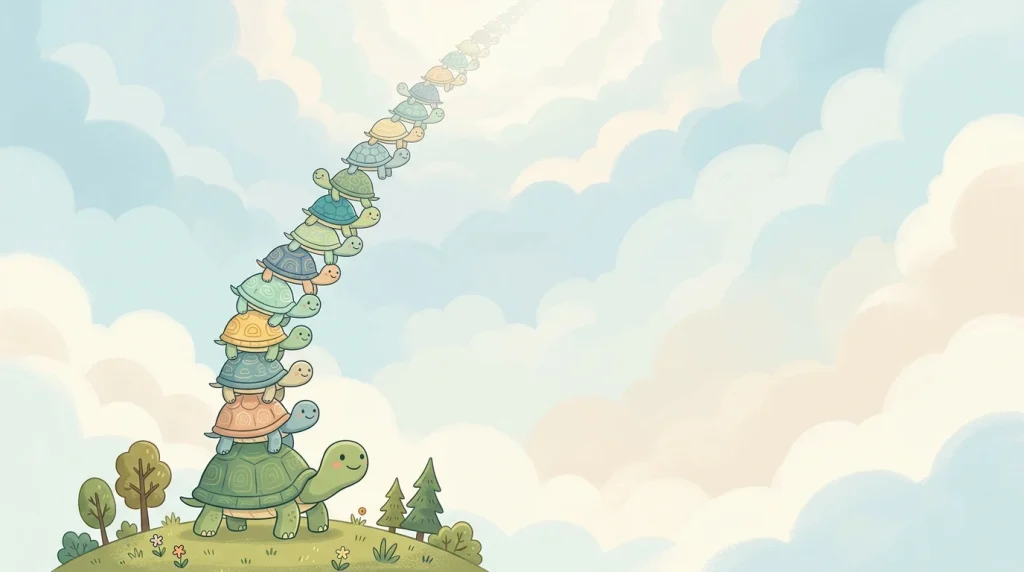
“Turtles all the way down” means an explanation that never actually reaches a final answer, because each answer just leads to another question, forever. It describes an infinite chain of causes stacked on top of each other, like turtles standing on the backs of other turtles, with no bottom turtle to stop the stack. People use this phrase to point out when someone’s explanation for something keeps pushing the real answer further away instead of solving it.
Meaning or Definition
At its core, this phrase is about a logical problem called infinite regress. Infinite regress happens when you try to explain something, but your explanation depends on another explanation, which depends on another one, and so on, without ever reaching a solid starting point.
Picture it this way: imagine someone asks what holds up the Earth. You might say “a giant turtle.” Then they ask, “What holds up the turtle?” You say, “Another turtle.” Then they ask again, and you say, “Another turtle.” This keeps happening forever, so the joke goes, “it’s turtles all the way down.”
The phrase works as a gentle jab at explanations that sound clever but don’t actually solve anything. It shows up in conversations about:
- Philosophy (what causes the first cause?)
- Science (what created the universe before the Big Bang?)
- Everyday arguments (what’s the reason behind the reason?)
Basically, whenever someone notices a chain of “but why?” questions that never ends, they might say the situation is “turtles all the way down.”
Origin or History
The exact origin of this phrase is a little fuzzy, and there’s no single confirmed source. However, it has been linked to old stories about a woman confronting a scientist after a lecture on astronomy. As one version of the story goes, the woman claimed the Earth rests on the back of a giant turtle. When the scientist asked what the turtle stands on, she reportedly replied, “It’s turtles all the way down.”
This story has been repeated by several famous thinkers over the years, including physicist Stephen Hawking, who mentioned a version of it in his book A Brief History of Time. Because the tale has been told so many times with slightly different details, historians can’t pin down exactly who said it first or when. Still, the phrase became widely known through these retellings, and it eventually became a common way to describe infinite regress in everyday language.
It’s worth noting that similar “world turtle” myths existed long before this story became popular. Some Hindu and Native American traditions include stories about the world being supported by a giant turtle or a similar creature. These older myths likely inspired the modern phrase, even if the “turtles all the way down” quote itself came later.
Real Life Examples
Understanding a phrase gets much easier when you see it used in real situations. Here are a few examples that show how people naturally use this expression.
Example 1 Science Conversation
“Some people ask what caused the Big Bang. But if something caused the Big Bang, what caused that thing? At some point, you have to wonder if it’s turtles all the way down.”
Example 2 Everyday Argument
“He kept blaming his bad mood on his boss, and his boss blamed corporate policy, and corporate blamed the economy. It felt like turtles all the way down nobody wanted to take responsibility.”
Example 3 Philosophy Class
“When trying to explain what creates our sense of self, philosophers sometimes joke that the explanation is turtles all the way down, since every theory leads to another unanswered question.”
Example 4 Computer Science
“In programming, if one function calls another function, which calls another, and it never stops, developers might jokingly call it turtles all the way down.”
These examples show the phrase isn’t just about turtles or mythology. It’s really about pointing out patterns where explanations loop endlessly instead of reaching a clear, final answer.
Common Mistakes
Even though the phrase is popular, people sometimes misuse or misunderstand it. Here’s a simple breakdown of common mix-ups.
| Common Mistake | Why It’s Incorrect | Correct Usage |
| Thinking it’s a literal belief about turtles | The phrase is symbolic, not a real scientific claim | Use it to describe infinite regress or endless explanations |
| Using it for anything repetitive | The phrase specifically refers to explanations with no final cause | Use it when a chain of reasoning never resolves |
| Confusing it with a paradox | It’s not a paradox; it’s a description of unresolved logic | Use it to highlight open-ended reasoning, not contradictions |
| Assuming it always applies to science | It also fits philosophy, humor, and daily conversations | Apply it broadly to any endless explanation chain |
Many people also mistakenly think the phrase originated with a specific ancient philosopher. In reality, most historians agree the modern version of the story is much more recent, even though older turtle-related myths do exist.
Current Usage or Trends
Today, “turtles all the way down” appears more often than you might expect. It’s popular in:
- Books and documentaries discussing science, especially cosmology and quantum physics
- Tech and coding communities, where infinite loops or recursive functions get compared to turtles stacking endlessly
- Social media discussions about conspiracy theories or arguments that go in circles
- Casual conversations when someone wants to humorously point out an unanswerable question
The phrase has even inspired book titles, YouTube video essays, and podcast episodes. Because it’s catchy and visual, people enjoy using it to simplify complicated ideas about causes, origins, and logic. It’s become a shorthand for saying, “this explanation doesn’t really explain anything, it just delays the real question.”
Tips or Best Practices
If you want to use this phrase correctly and naturally, here are some helpful tips:
- Use it when discussing chains of causes or explanations that never end.
- Avoid using it for simple repetition that isn’t related to logic or causation.
- Feel free to use it humorously; it works well in casual and academic settings.
- Pair it with a short explanation if your audience may not know the phrase yet.
- Remember it’s about the idea of infinite regress, not literal turtles.
Using the phrase this way keeps your communication clear while still sounding natural and clever.
FAQs
What does “turtles all the way down” mean in simple words?
It means an explanation that never really ends because each answer leads to another question, like an endless stack of turtles with no bottom one.
Where does the phrase “turtles all the way down” come from?
It comes from an old story, often linked to a conversation after a science lecture, where someone claimed the Earth rests on a turtle, and that turtle rests on another turtle, forever.
Is “turtles all the way down” a real scientific theory?
No, it’s not a real scientific theory. It’s a metaphor used to describe the logical problem of infinite regress in explanations.
Why do people use turtles instead of other animals?
The turtle symbolism comes from old world-supporting myths found in various cultures, which likely influenced the popular version of the story used today.
Can this phrase be used in everyday conversations?
Yes, it’s commonly used to describe situations where explanations, excuses, or blame keep getting passed along without reaching a clear answer.
Does Stephen Hawking’s book explain this phrase?
Yes, Stephen Hawking mentioned a version of the story in A Brief History of Time, which helped make the phrase more widely known.
Conclusion
The phrase “turtles all the way down” captures something we all experience at some point: explanations that keep leading to more questions instead of solid answers. If it’s used in science, philosophy, or everyday arguments, the phrase reminds us to think critically about If an explanation truly solves a problem or simply pushes it further away. Now that you understand the turtles all the way down meaning, you can use it confidently in conversations, essays, or even casual jokes. The next time someone gives you an explanation that just leads to more unanswered questions, you’ll know exactly what to call it.
Read More Article

Hi, I’m Sarah Mitchell. I love writing faith-based content that brings peace, hope, and encouragement to everyday life. Through prayers and devotionals, my goal is to help readers feel closer to God and stronger in faith.