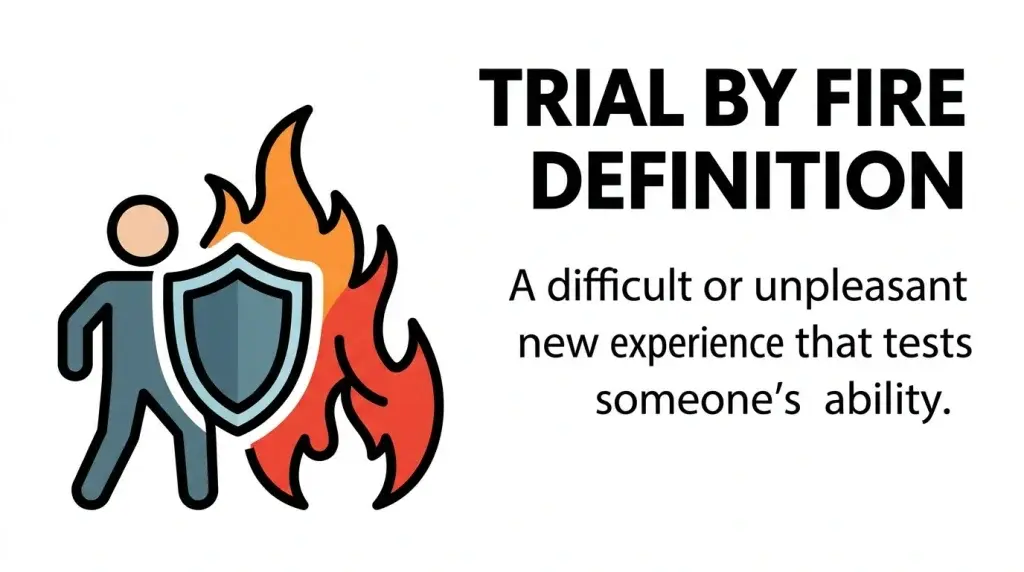
Have you ever heard someone say they went through a “trial by fire” at work or in life? This phrase pops up a lot, but many people aren’t sure exactly what it means or where it comes from. In simple terms, a trial by fire is a tough, difficult test that proves how strong or capable someone really is. It’s the kind of challenge that pushes you to your limits and shows what you’re made of.
In this article, you’ll learn the true meaning of this phrase, how to use it correctly, where it started, and how people use it in everyday conversation today.
By the end, you’ll be able to use this expression with confidence.
Quick Answer
A trial by fire means a hard test or difficult experience that teaches someone a skill quickly, often under pressure. It usually happens without much preparation. People say things like “she learned management skills through trial by fire” when someone had to figure things out fast during a tough situation, rather than through slow, easy training.
This phrase is almost always used in a positive or respectful way. It suggests that someone came out of a hard situation stronger, wiser, or more skilled than before.
Meaning or Definition
The phrase “trial by fire” describes a situation where a person learns something important the hard way. It’s not about literal fire. Instead, it’s a figure of speech, meaning it’s used to describe something without being literally true.
Think about a new employee who gets thrown into a big project on their very first week, with no training and a tight deadline. If they manage to succeed, people might say they went through a trial by fire. The experience was stressful and demanding, but it taught them valuable lessons fast.
Here are the core ideas behind this phrase:
- It involves a difficult or stressful test.
- The test often happens suddenly or without warning.
- The person usually comes out changed, stronger, or more skilled.
- It’s often unplanned rather than something scheduled like a final exam.
This expression works well when talking about jobs, relationships, parenting, sports, and even personal growth. Anytime someone faces a hard situation and learns from it quickly, this phrase fits.
Origin or History
The phrase “trial by fire” has a long and interesting history. It comes from an old legal practice used hundreds of years ago in parts of Europe, especially during the Middle Ages. Back then, courts sometimes used something called “trial by ordeal” to decide if a person was innocent or guilty.
In one version of this ordeal, a person accused of a crime had to hold a hot iron or walk across burning coals. People believed that if the person was innocent, God would protect them from serious injury. If their wounds healed quickly and cleanly, they were seen as innocent. If not, they were judged guilty.
This practice sounds shocking today, and thankfully, it’s no longer used anywhere in modern justice systems. But the phrase stuck around in the English language. Over time, it lost its literal meaning and became a metaphor for any difficult, high-pressure test of character or skill.
By the 1800s and 1900s, writers and everyday speakers used “trial by fire” to describe any tough challenge, especially one that happens suddenly. Today, nobody thinks about burning coals when they hear this phrase. Instead, they think about stressful job situations, emergencies, or major life challenges.
Grammar or Correct Usage
Using “trial by fire” correctly is simple once you understand the pattern. It’s typically used as a noun phrase, meaning it names a type of experience.
Here are common ways to use it in a sentence:
- “Her first year as a teacher was a real trial by fire.”
- “He learned to cook through trial by fire, since his boss threw him straight into the kitchen.”
- “The new manager faced a trial by fire during her first week.”
Notice that the phrase usually appears after words like “was,” “through,” “by,” or “faced.” It can act as the subject or object of a sentence, but it can’t be turned into a verb. You wouldn’t say “he trial-by-fired his way through the project.” That’s not correct grammar.
You can also use it as an adjective phrase before a noun, though this is less common:
- “It was a trial-by-fire experience.”
When used this way, add hyphens between the words to show they work together as one descriptive phrase.
Some people confuse this phrase with “baptism by fire,” which means almost the same thing. Both describe a sudden, difficult introduction to something new. You can use either phrase, and native English speakers will understand you clearly.
Common Mistakes
Even though this phrase is common, people sometimes misuse it. Here are a few mistakes to avoid.
Mistake 1: Using it for easy situations.
This phrase should only describe genuinely hard or stressful experiences. Saying “learning to make toast was a trial by fire” doesn’t make sense because toast isn’t difficult to make.
Mistake 2: Turning it into a verb.
As mentioned earlier, “trial by fire” is not a verb. Saying “she trial-by-fired her way to success” is grammatically incorrect. Instead, say “she succeeded after a trial by fire” or “she went through a trial by fire.”
Mistake 3: Confusing it with “trial and error.”
These two phrases sound a little similar but mean different things. “Trial and error” means testing different methods until one works, often through repeated attempts. “Trial by fire” means a single tough experience that teaches a lesson quickly, often without multiple attempts.
Mistake 4: Overusing it in writing.
Because this phrase is popular, some writers use it too often in the same piece of writing. This makes the writing feel repetitive. Save it for moments that truly deserve emphasis.
Here’s a table that shows the difference between these commonly confused phrases:
| Phrase | Meaning | Example |
| Trial by fire | A tough, sudden test that teaches skills quickly | “Leading the team during the crisis was a trial by fire.” |
| Trial and error | Testing different methods until one works | “She fixed the bug through trial and error.” |
| Baptism by fire | Nearly identical to trial by fire | “His first court case was a baptism by fire.” |
| Rite of passage | A ritual or experience marking a life stage | “Getting a driver’s license is a rite of passage.” |
Real-Life Examples
Seeing this phrase used in real situations makes it easier to understand and remember. Here are several examples from different areas of life.
At work: A junior nurse gets assigned to the emergency room during a night with far too few staff members. She has to make quick decisions with very little guidance. Afterward, coworkers say her first shift was a total trial by fire, and she came out of it far more confident.
In parenting: New parents often say the first few weeks with a newborn feel like a trial by fire. Nobody fully prepares them for sleepless nights, constant crying, and the steep learning curve. But most parents adapt quickly, learning skills they never expected to develop so fast.
In sports: A backup quarterback gets pushed into a championship game after the starting player gets injured. He has no time to prepare mentally. Sports commentators call this kind of moment a trial by fire, since the player must perform under intense pressure with almost no warning.
In business: A small business owner faces a sudden financial crisis during their first year. They have to learn how to manage cash flow, negotiate with vendors, and handle stress all at once. Later, they describe that first year as a trial by fire that shaped how they run their company today.
In everyday life: Someone moves to a new country where they don’t speak the language. They have to learn basic communication skills fast just to survive daily life. This kind of steep, forced learning experience is another perfect example of a trial by fire.
These examples show that the phrase fits almost any situation involving sudden pressure and rapid learning.
Current Usage or Trends
Today, “trial by fire” remains a popular phrase in both spoken and written English. It shows up often in news articles, workplace conversations, motivational speeches, and social media posts. People especially use it when discussing career growth, leadership challenges, and personal development.
Many career coaches and business leaders use this phrase to describe valuable, if difficult, learning experiences. Instead of framing a hard situation as purely negative, they highlight the growth that comes from it. This reflects a broader trend in modern communication: focusing on resilience and personal development, even in tough circumstances.
You’ll also see this phrase used in headlines about political leaders, athletes, and public figures who face their first major challenge in a new role. For example, a newly elected official facing an unexpected crisis during their first month in office might be described as facing a trial by fire.
Social media has also helped keep this phrase alive. People often use it in posts describing personal achievements after difficult experiences, such as finishing a tough semester, surviving a stressful job transition, or overcoming a personal setback.
Tips or Best Practices
If you want to use “trial by fire” naturally and correctly, keep these tips in mind.
- Use it only for genuinely difficult situations, not minor inconveniences.
- Pair it with real emotional or practical stakes, such as pressure, deadlines, or high expectations.
- Avoid using it as a verb; keep it as a noun phrase.
- Don’t overuse it in the same piece of writing or conversation.
- Use it to highlight personal growth, not just hardship. The phrase carries a positive undertone of overcoming challenges.
- When writing professionally, such as in a resume or interview, you can mention a “trial by fire” experience to show resilience and adaptability.
Here’s a simple table comparing weak versus strong usage of the phrase:
| Weak Usage | Strong Usage |
| “Doing my homework was a trial by fire.” | “Running the company alone during the merger was a trial by fire.” |
| “The short quiz felt like trial by fire.” | “Her first solo flight as a pilot was a genuine trial by fire.” |
| “Waiting in line was trial by fire.” | “Negotiating the deal with no prior experience was a trial by fire.” |
Following these tips will help your writing or speech sound natural, accurate, and impactful.
FAQs
What does “trial by fire” mean in simple words?
It means going through a hard, stressful experience that teaches you something important very quickly, often without much preparation.
Is “trial by fire” a good thing or a bad thing?
It’s usually seen as a positive experience overall, even though it feels hard at the time. People often become stronger, more skilled, or more confident afterward.
Where does the phrase “trial by fire” come from?
It comes from an old medieval practice where accused people had to endure fire-related tests to prove their innocence. Over time, it became a metaphor for any tough, character-testing experience.
Can “trial by fire” be used in professional writing, like a resume?
Yes, it can be used to describe a challenging work experience that helped you grow, such as leading a project with little guidance or handling a crisis early in your career.
What’s the difference between “trial by fire” and “trial and error”?
“Trial by fire” describes one intense, difficult experience that teaches a lesson quickly. “Trial and error” describes testing multiple methods over time until something works.
Is “baptism by fire” the same as “trial by fire”?
Yes, these two phrases mean almost the same thing. Both describe a sudden, difficult introduction to a new skill, role, or situation.
Conclusion
The phrase “trial by fire” describes a tough, often unexpected challenge that teaches valuable lessons fast. If it’s a new job, a sudden responsibility, or a personal hardship, this expression captures the idea of growing stronger through difficulty. Its roots trace back to medieval trials, but its meaning today focuses entirely on personal growth and resilience rather than literal fire.
Next time you face a hard, unplanned challenge and come out stronger on the other side, you’ll know exactly how to describe it.
Use this phrase thoughtfully, save it for truly difficult moments, and it will always add clarity and impact to your writing or conversation.

Hi, I’m Elias Monroe. I enjoy writing meaningful prayer content that helps people feel calm, hopeful, and spiritually strong. My goal is to share words that bring comfort during both joyful and difficult times.