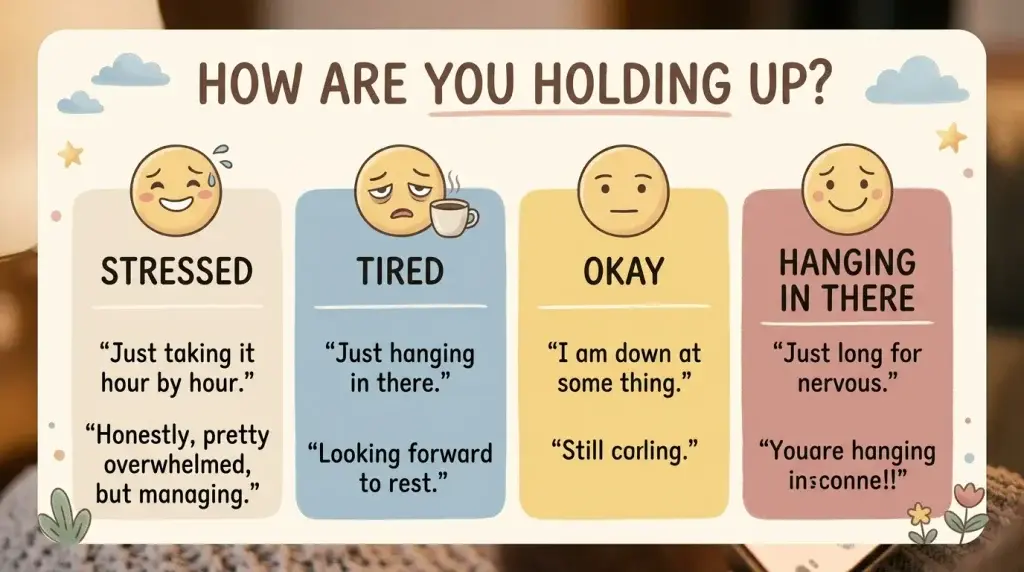
Someone asks, “How are you holding up?” and you pause. Is it a greeting? A real question? Do you say “fine” or tell the truth? You are not alone. Many people search for the how are you holding up meaning because the phrase sounds simple but feels heavy. It usually shows up when life is hard, and the person asking cares.
In this guide, you will learn what the phrase means, where people use it, and how to reply. You will also see common mistakes, helpful tips, and real examples you can use today.
Quick Answer: How Are You Holding Up Meaning in Simple Words
“How are you holding up?” means “How are you coping right now?” People ask it when you are going through something hard, like a loss, an illness, a job problem, or a stressful time. It is a kind way to check on your feelings and strength. It is not the same as “How are you?” because it points to a tough situation.
Meaning and Definition
The word “holding” comes from the verb “hold.” In this phrase, “holding up” means staying strong and standing steady while something heavy pushes on you. Think of a shelf with many books on it. If the shelf is holding up, it has not bent or broken. When you ask a person this question, you are asking if they are still standing, even though life is pressing hard.
The phrase has three parts of meaning. First, it shows that you know something difficult happened. Second, it asks about the person’s emotions and energy. Third, it tells the person that you care. That third part matters most. Many people say it because they do not know what else to say, but they want to show support.
Here is the key difference. A normal greeting like “How are you?” is often quick and automatic. “How are you holding up?” is slower and more personal. It invites a real answer, even if the person only gives a short one.
You will often hear it with a gentle voice. People may also add the person’s name or a kind word, like “Hey, how are you holding up, Sam?” The tone tells you a lot. If the voice is soft and the person is looking at you, the question is sincere.
Grammar and Correct Usage
Grammar-wise, the phrase is easy. “Are holding up” is the present continuous tense. It talks about what is happening right now. “Holding up” is a phrasal verb, which means a verb joined with a small word like “up” to make a new meaning.
You can change the pronoun to fit the person. Here are the common forms.
| Form | Who it is for | Example |
| How are you holding up? | One person | “How are you holding up after the move?” |
| How is she holding up? | A woman you are asking about | “How is she holding up since the surgery?” |
| How is he holding up? | A man you are asking about | “How is he holding up with all that work?” |
| How are they holding up? | A group or one person | “How are they holding up after the storm?” |
| How am I holding up? | Talking about yourself | “I wonder how I am holding up lately.” |
Notice the question mark. This phrase is nearly always a question. When you answer, you can use “I am holding up” or “I’m holding up,” which means you are doing okay under pressure.
You can also add small words to make it softer. “How are you holding up today?” feels light. “How are you really holding up?” invites a deeper answer. Both are fine. Pick the one that fits the moment.
Where the Phrase Comes From

The exact first use of “how are you holding up” is hard to prove, so it is best not to guess a date or a person. What we can say is clear, though. The phrase grows from the older meaning of “hold up,” which means to support something or keep it from falling. Over time, people used that idea for emotions and hard times. Saying someone is “holding up” became a way to say they are staying strong.
This is a common pattern in English. We often borrow words from the physical world to talk about feelings. We say someone is “carrying a heavy load,” “breaking down,” or “falling apart.” In the same way, “holding up” borrows from buildings, bridges, and shelves.
Real Life Examples of When People Say It
The phrase fits best when the other person is facing a clear challenge. You do not need to use it every day. Save it for moments when it will feel real. Here are common situations and what the phrase can sound like in each one.
| Situation | Example sentence |
| After a death in the family | “I heard about your grandmother. How are you holding up?” |
| During an illness | “Your cold has lasted two weeks. How are you holding up?” |
| After a job loss | “I’m sorry about the layoffs. How are you holding up?” |
| During a breakup | “I know things ended last week. How are you holding up?” |
| In a busy, stressful season | “Finals week is brutal. How are you holding up?” |
| After a bad storm or accident | “That was a scary night. How are you holding up?” |
Now picture a few short scenes. A coworker’s dad is in the hospital. You stop by her desk and say, “I’ve been thinking about you. How are you holding up?” She may sigh and say, “Tired, but I’m okay.” That small moment tells her someone noticed.
Or think about a neighbor whose house was damaged in a flood. You bring over a warm meal and ask, “How are you holding up?” He may talk for ten minutes. He may also just say thank you. Both answers are fine. The question gave him room.
The phrase also shows up in news stories and talk shows. A reporter might ask a family, “How are you holding up?” after a hard event. Even there, the meaning stays the same. It asks about coping.
How to Answer: Easy Replies for Any Mood
Many people freeze when they hear this question. The good news is that you have choices. You can match your reply to how you feel and how close you are to the other person. There is no single right answer.
If you feel okay, you can say, “I’m holding up, thanks for asking.” If you feel low, you can say, “Honestly, it’s been rough.” If you do not want to talk, you can say, “I’m hanging in there, but I’d rather not get into it.” That last reply is polite and sets a clear limit.
Here is a simple table to help you pick.
| How you feel | A simple reply |
| Doing fine | “I’m holding up well, thank you.” |
| Mixed feelings | “Some days are better than others.” |
| Very tired | “I’m tired, but I’m getting through it.” |
| Struggling | “Honestly, it’s been really hard.” |
| Not ready to talk | “I appreciate you asking. I’m not up to talking yet.” |
| Need help | “Not great. Could you help me with something?” |
Honesty is a gift, but you do not owe anyone a full story. You can share a little or a lot. If the person asking is a close friend or family member, you might open up more. If it is a coworker you barely know, a short answer is just fine.
Also, remember that you can say thank you. A kind question deserves kind thanks, even when your answer is not cheerful. It tells the person their care landed.
Other Meanings of “Hold Up”
The phrase “hold up” has more than one meaning, and that can cause mix-ups. In “how are you holding up,” the meaning is about coping. But in other sentences, “hold up” means something else. Look at the table.
| Meaning | Example |
| To cope or stay strong | “She is holding up well after the news.” |
| To support something | “Two poles hold up the tent.” |
| To last over time | “These boots have held up for years.” |
| To delay or slow down | “Traffic held us up for an hour.” |
| To stop and wait (“Hold up!”) | “Hold up, I forgot my keys.” |
| To rob someone with a threat | “The store was held up last night.” |
Context makes the meaning clear. If someone says “Hold up!” with a quick voice, they probably want you to wait. If someone says “How are you holding up?” with a soft voice, they care about your feelings. Pay attention to the tone and the situation, and you will rarely get confused.
Similar Phrases and Words
English has many phrases that sit close to this one. Some are nearly the same. Others are a bit different. Knowing them can help you sound natural and choose the right words.
“How are you coping?” is more direct and a little more formal. “How are you doing with all of this?” is gentle and common. “How are you hanging in there?” is casual and friendly. “How are you getting by?” often points to money or daily needs. “Are you okay?” is simple, but it can feel sharper, because it can sound like you expect bad news.
You can use the same words in your replies too. “Hanging in there” is a very common answer. So are “getting by” and “taking it one day at a time.” These phrases tell the listener that life is not perfect, but you are still moving forward.
British vs. American English
The phrase works the same way in both American and British English. Both groups use “holding up” for coping. You may hear small differences in nearby phrases. British speakers often say “How are you keeping?” which is close in feeling. Americans lean toward “hanging in there.” Still, “how are you holding up” is clear and kind in both places, so you can use it without worry.
Common Mistakes to Avoid

Even a kind phrase can go wrong if it is used at the wrong moment. Here are mistakes that happen often.
The first mistake is using it as a casual hello. If nothing hard is going on, “How are you holding up?” can feel odd or even alarming. The person may wonder, “What do you know that I don’t?” Use “How are you?” for everyday greetings.
The second mistake is asking and then walking away. If you ask a deep question, stay for the answer. Even thirty seconds of listening shows respect.
The third mistake is trying to fix everything. Many people hear a sad answer and jump into advice. Sometimes a person just needs someone to hear them. You can ask, “Do you want advice, or do you just want me to listen?”
The fourth mistake is saying “at least” after a hard answer. Lines like “At least it wasn’t worse” can make people feel unheard. A better reply is, “That sounds really hard.”
The fifth mistake is asking in a public place when the topic is private. If someone is dealing with a personal matter, ask quietly, in a text or one-on-one chat.
The last mistake is mixing up the meaning with “hold up” as a delay. Reading too fast can cause this. Remember that in this phrase, it is about strength, not waiting.
Tips for Asking the Question Well
Asking is a skill, and a small amount of care makes a big difference. Start by picking a good time. Try to ask when the person is not rushing or surrounded by a crowd. Then use a calm, warm voice.
It also helps to be specific. Instead of only asking, “How are you holding up?” you might add, “I know this week has been tough.” This shows you pay attention, and it makes the person feel seen.
Next, listen without a plan. You do not have to say the perfect thing. A simple “Thank you for telling me” works well. If the person gets quiet, let the silence sit. They may be searching for words.
You can also offer a small, real kind of help. “Can I bring dinner Thursday?” is better than “Let me know if you need anything.” The second line is kind, but it puts the work on the other person. A clear offer is easier to accept.
Finally, follow up. A second check-in a week later can mean more than the first one. Grief, stress, and illness do not end quickly. When you ask again, the person learns that your care is not a one-time thing.
If you are the one being asked, give yourself permission to answer in your own way. You can be short. You can be honest. You can say, “Ask me tomorrow.” All of those answers are okay.
FAQs
Is “how are you holding up” a normal greeting?
Not really. It is a caring question for hard times. For everyday hellos, “How are you?” or “How’s it going?” fits better.
What does “I’m holding up” mean?
It means you are coping and staying steady, even though things may be tough. It does not always mean you feel great. It often means “I’m managing.”
Is it rude to ask someone how they are holding up?
No. It is usually seen as kind. Just pick a good time and place, and be ready to listen. If the topic is very private, ask when you are alone with the person.
What is a good short answer?
“I’m hanging in there, thanks for asking” works in most cases. It is warm, honest, and does not force you to explain more than you want to.
What is the difference between “How are you?” and “How are you holding up?”
“How are you?” is a general question and is often a polite habit. “How are you holding up?” focuses on how you are handling a specific hard time, so it feels deeper and more caring.
Can I use this phrase in a text or email?
Yes. It works well in writing, especially when you cannot visit in person. A short message like “Thinking of you. How are you holding up?” can mean a lot, and the person can reply when they are ready.
Conclusion
Now you know how you are holding up meaning. It is a gentle question that asks how someone is coping during a hard time. It shows care, invites honesty, and gives the other person room to share as much or as little as they like. You also learned how to answer, which mistakes to avoid, and how the phrase differs from simple greetings and other meanings of “hold up.”
The big lesson is simple. Use the phrase when someone is truly going through something, and then listen. When someone asks you, answer in a way that feels safe and true. A small question, asked with care, can make a hard day feel a little lighter. So the next time you wonder how a friend is doing, ask. You may be the kind voice they needed.

Hi, I’m Sarah Mitchell. I love writing faith-based content that brings peace, hope, and encouragement to everyday life. Through prayers and devotionals, my goal is to help readers feel closer to God and stronger in faith.