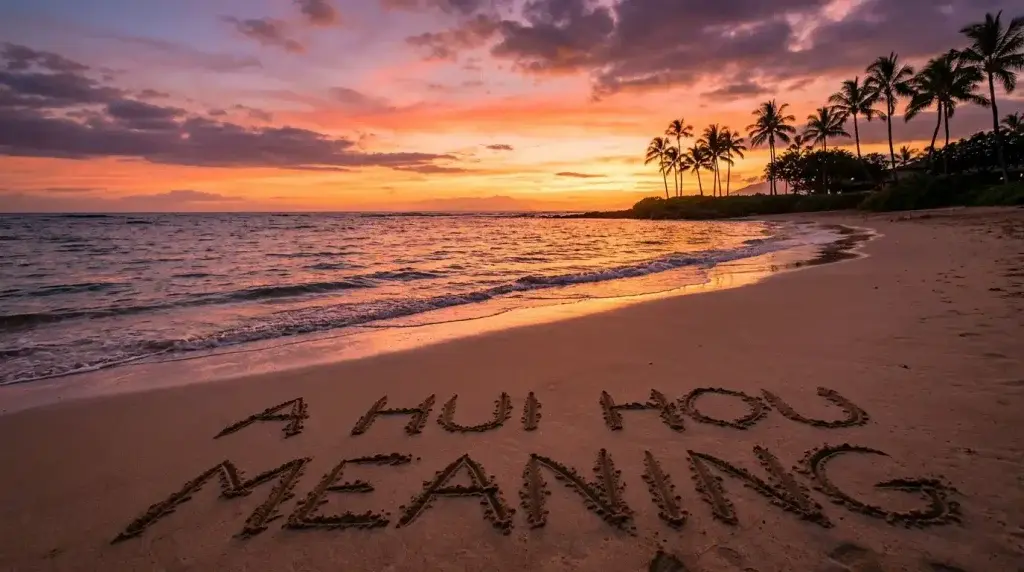
A hui hou meaning is simple: it is a Hawaiian phrase that means “until we meet again.” People use it as a warm goodbye, and it carries a hopeful promise that you will see each other later.
If you have visited Hawaiʻi, watched a hula show, or heard the phrase in a song, you may have wondered what the words really say. Many people search for it because it sounds friendly and sweet, but the meaning goes deeper than a quick wave.
In this guide, you will learn what each word means, how to say it, and how it differs from aloha. You will also see common mistakes, real-life examples, and answers to popular questions. Let’s start with the basics.
Quick Answer: What Does A Hui Hou Mean?
“A hui hou” means “until we meet again” in the Hawaiian language, called ʻŌlelo Hawaiʻi. You say it when you are leaving someone and expect to see them again.
Think of it as a cousin to “see you later” or “until next time.” It is a little softer and more heartfelt than those phrases. It does not close the door on a relationship the way a plain “goodbye” can. Instead, it leaves the door open.
You will often hear a hui hou at the end of conversations, songs, speeches, and radio shows in Hawaiʻi. Locals use it with family, friends, and neighbors. Visitors also use it, and most people smile when they hear it said with care.
Here is the short version in one table.
| Phrase | Language | Simple Meaning | When to Use It |
| A hui hou | Hawaiian | Until we meet again | When leaving someone you expect to see again |
| Hui hou | Hawaiian (short form) | Until again | Casual goodbyes with friends |
| See you later | English | Goodbye for now | Everyday talk |
Breaking Down the Words: A, Hui, and Hou
The phrase has three small words. Each one adds a piece to the full meaning, and when you put them together, the idea becomes clear.
The word “a” works like the English word “until.” It points toward a future moment. The word “hui” means to meet, to join, or to gather. You may also know “hui” as a word for a club or a group of people who come together. The word “hou” means “again” or “anew,” so it brings the idea of doing something one more time.
Put them together and you get “until meet again,” which in smooth English becomes “until we meet again.”
| Hawaiian Word | Basic Meaning | Role in the Phrase |
| A | Until | Points to a future time |
| Hui | To meet or join | The action of meeting |
| Hou | Again or anew | Says the meeting will happen once more |
Notice something else here. The words are short and plain, but together they say something kind. Hawaiian often works this way. A few simple words can carry a lot of feeling.
Also, notice that this phrase has no ʻokina (the little mark that looks like a backward apostrophe) and no kahakō (the bar over a vowel). That makes it easier to write than many other Hawaiian words, though you will see both marks in related phrases.
How to Say A Hui Hou the Right Way
Saying it well shows respect for the language. The good news is that Hawaiian sounds are quite regular, so once you learn the pattern, you can say the phrase with confidence.
A simple way to sound it out is ah HOO-ee HOH. The “a” sounds like the “a” in “father.” The “hui” has two parts that glide together: “hoo” and “ee,” almost like saying “hooey” quickly. The “hou” sounds like the word “hoe” in English, with a small glide at the end.
Hawaiian vowels are pronounced the same way each time. Here is a quick guide.
| Letter | Sounds Like | Example in the Phrase |
| A | “ah” as in “father” | A hui hou |
| U | “oo” as in “moon” | hui |
| I | “ee” as in “see” | hui |
| O | “oh” as in “go” | hou |
Try saying it slowly three times. Then speed up. Most people feel comfortable by the second or third try. If you want to hear it done well, listen to native Hawaiian speakers. Local radio, language apps, and university Hawaiian programs often share recordings.
One more tip: do not rush the stress. Give the phrase a calm, even rhythm. It should feel friendly, not hurried.
A Hui Hou vs. Aloha vs. Mahalo
Many people mix up Hawaiian phrases they hear on vacation. Aloha, mahalo, and a hui hou each have their own job, and learning the difference helps you use them well.
Aloha is the most famous Hawaiian word. It can mean hello, goodbye, and love. It also stands for a way of treating others with kindness and care. Mahalo means “thank you.” A hui hou, as you now know, means “until we meet again.”
The big difference is that aloha works as both a greeting and a farewell, but a hui hou only works for leaving. You would never say it when you walk into a room.
| Word | Meaning | Hello? | Goodbye? | Thank You? |
| Aloha | Hello, goodbye, love | Yes | Yes | No |
| Mahalo | Thank you | No | No | Yes |
| A hui hou | Until we meet again | No | Yes | No |
Many people combine them. For example, someone might say “Mahalo, a hui hou!” at the end of a visit. That means “Thank you, until we meet again.” It is polite, warm, and natural.
If you are unsure which to use, aloha is the safest choice. But if you want to say something a little more personal as you leave, a hui hou is a lovely pick.
Ways to Use A Hui Hou in Different Situations
The base phrase is only the beginning. Hawaiian speakers add small words to change who is included or which way the speaker is going. Here are the most common versions.
A hui hou kākou means “until we meet again, all of us.” The word “kākou” means “we” and includes everyone in the group, even the person you are talking to. It feels warm and community-minded. You will often hear it at the end of a gathering, a class, a ceremony, or a show.
A hui hou aku adds the word “aku,” which suggests movement away from the speaker. It can sound like “until we meet again as I go on my way.” It is a gentle goodbye when you are the one leaving.
Hui hou is the short, casual form. Friends often use it in texts or quick chats. It works much like saying “later” in English, only with more heart.
These small changes matter. Using “kākou” at a group event, for example, shows that you see everyone as part of the same circle. Using plain “hui hou” in a text keeps things light.
If you are a beginner, the full “a hui hou” is a safe place to start. As you learn more, you can try the other forms.
Why Hawaiians Say “Until We Meet Again” Instead of “Goodbye”
Words can shape how we think about people. In English, “goodbye” started as a short form of “God be with you.” Over time, it just became a way to end a talk. Hawaiian takes a different path.
A hui hou puts the focus on the next meeting, not on the parting. That fits a larger Hawaiian value: relationships matter. Family, friends, land, and community stay connected even when people are apart. Saying “until we meet again” reminds both people that the bond is still there.
This idea also shows up in the Hawaiian concept of ʻohana, which means family. In Hawaiian culture, ʻohana often goes beyond blood relatives. It can include close friends and neighbors. When you say a hui hou, you are saying, “You are part of my circle, and I look forward to seeing you.”
That is why the phrase feels so kind. It is not just a polite sign-off. It is a small act of care.
It also shows up in music. Hawaiian songs about leaving and farewell, such as the well-known “Aloha ʻOe” written by Queen Liliʻuokalani, carry a similar spirit of love in parting. If you want to learn more about the culture behind the phrase, listening to traditional Hawaiian music is a lovely place to begin.
A Short History of the Hawaiian Language and Why It Matters
To understand why a hui hou matters today, it helps to know a little about the language it comes from.
Hawaiian is a Polynesian language. It has only 13 letters when you count the ʻokina: five vowels and a small set of consonants. For centuries, it was the main language of the Hawaiian Islands. After the Hawaiian monarchy was overthrown in 1893, English began to take over in schools, and around 1896, a law made English the main language of instruction. Over the following decades, fewer and fewer children learned Hawaiian at home or in class.
By the 1980s, the number of native speakers had fallen very low. Then a revival began. Families, teachers, and community leaders opened Hawaiian-language preschools called Pūnana Leo. Later, immersion schools followed, where students learn their subjects in Hawaiian. In 1978, Hawaiian also became an official state language of Hawaiʻi, alongside English.
Today, more people are learning the language, and phrases like a hui hou are part of that story. When you use them with care, you are helping keep the language alive and respected.
I could not find a single, reliable source that tells exactly when the phrase “a hui hou” first came into common use, so I will not guess. What we can say is that it is a long-standing, widely used expression in modern Hawaiian speech.
Real Life Examples of A Hui Hou
Seeing the phrase in action makes it easier to remember. Here are some everyday ways people use it.
At the end of a trip, a hotel worker might smile and say, “Mahalo for visiting. A hui hou!” The guest might answer, “A hui hou!” and wave. It is a friendly, simple exchange.
After a class or workshop, a teacher may close with “A hui hou kākou,” meaning “until we meet again, everyone.” Students often repeat it back.
On a radio or video show, a host may sign off with “Aloha and a hui hou.” This gives viewers a warm feeling and hints that the show will return.
In a text message to a friend, you might write: “Had so much fun today. Hui hou!” It keeps things casual and kind.
In a letter or card, you could write: “Thank you for your hospitality. A hui hou until our next visit.” This is a thoughtful way to end a note to a host.
You can also use it at events like weddings, birthday parties, or family reunions. When guests say goodbye, a hui hou fits right in, because everyone hopes to meet again.
Common Mistakes to Avoid
Even a short phrase can trip people up. Here are the mistakes you will see most often.
The first mistake is using a hui hou as a greeting. Because aloha works both ways, some people assume a hui hou does too. It does not. Save it for leaving.
The second mistake is mixing up the words. Some people say “a hui hui” or “a hou hui.” The correct order is a hui hou. Keep the words in that order and say each one clearly.
The third is using it when you never plan to meet again. The phrase promises or hopes for another meeting. If you are ending a relationship, or if you truly will not see the person again, another phrase may fit better, and aloha is usually the gentler choice.
The fourth is using it in a joking or mocking way. Hawaiian is a living language, and many families fought hard to keep it. Using it as a punchline can feel disrespectful.
The fifth is spelling. Some people add marks where they do not belong. The standard written form is simply “a hui hou.” But when you write other Hawaiian words, learn where the ʻokina and kahakō go, because they can change the meaning.
Tips for Using A Hui Hou Respectfully
Using a new phrase well is about more than getting the sounds right. It is also about the spirit behind it.
Start by listening. Hear how locals and fluent speakers say it, and copy their pace and tone. Next, use it with sincerity. Say it when you truly hope to meet the person again, or when you want to leave on a warm note.
It also helps to learn a little about the culture. Read about Hawaiian history, listen to Hawaiian music, or take a beginner class. Many community colleges, libraries, and websites offer simple lessons. The more you know, the more natural and respectful your words will sound.
If you make a mistake, do not worry. Most people appreciate the effort, and they are often happy to help you improve. Just be humble and willing to learn.
Finally, remember that a hui hou is not a trendy slogan. It is part of a living language with a deep story. Treat it that way, and your goodbye will feel genuine.
FAQs About A Hui Hou
1. What does a hui hou mean in English?
It means “until we meet again.” People use it as a warm way to say goodbye when they expect to see someone again.
2. Is a hui hou the same as goodbye?
It works as a goodbye, but it has a softer meaning. Instead of ending the connection, it points to the next time you will meet. Many people think of it as “see you later” with extra heart.
3. How do you pronounce a hui hou?
Say it as “ah HOO-ee HOH.” Each vowel has one steady sound, and the words flow together smoothly.
4. What is the difference between aloha and a hui hou?
Aloha can mean hello, goodbye, or love. A hui hou only means “until we meet again,” so you use it only when leaving.
5. Can visitors and non-Hawaiians use a hui hou?
Yes. Visitors can use it, and many locals enjoy hearing it. The key is to say it with respect, use it in the right setting, and avoid joking or mocking tones.
6. What does a hui hou kākou mean?
It means “until we meet again, all of us.” The word “kākou” includes everyone in the group, so it is perfect for farewells at classes, events, and family gatherings.
Conclusion
The a hui hou meaning is “until we meet again,” and it is one of the kindest ways to say goodbye in Hawaiian. Its three small words, “a,” “hui,” and “hou,” join to make a promise of reunion. It looks ahead, not back, and it reflects the Hawaiian love of family, friends, and community.
You have now learned how to say it, how it differs from aloha and mahalo, and how forms like “a hui hou kākou” change the feeling. You have also seen common mistakes and simple ways to use the phrase with respect.
The best advice is to keep it sincere. Listen to native speakers, practice the sounds, and use the phrase when you truly hope to meet again. A hui hou!

Hi, I’m Elias Monroe. I enjoy writing meaningful prayer content that helps people feel calm, hopeful, and spiritually strong. My goal is to share words that bring comfort during both joyful and difficult times.