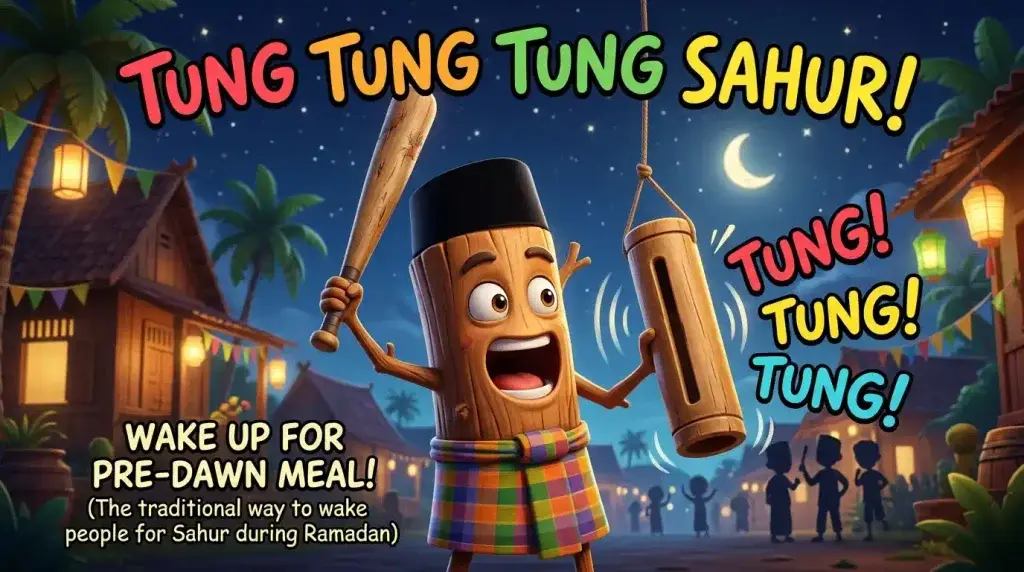
The tung tung tung sahur meaning in English is simple. It is a drum-beat sound followed by the word for the early meal Muslims eat before sunrise during Ramadan. In plain words, it means “Boom, boom, boom, time for the pre-dawn meal!”
Maybe you saw a wooden character with a baseball bat in a video. Maybe you spotted the phrase in a comment and felt lost. Many people search for it because the meme looks odd and funny, but few places explain it in plain language.
In this guide, you will learn what each word means, where the meme came from, who the character is, and how people use it today. We will keep everything short, clear, and easy to follow.
Quick Answer: Tung Tung Tung Sahur Meaning in English
“Tung tung tung sahur” means “knock, knock, knock, it’s time for sahur.” The “tung” part copies the sound of a drum or wooden instrument. The word “sahur” is the meal eaten in the dark hours before dawn, before a day of fasting begins.
A friendly English version could be “Boom, boom, boom, wake up and eat!” Another could be “Drum beats, breakfast time before sunrise!” None of these is the only right translation. The phrase is more of a sound-and-word mix than a regular sentence. That is why it feels fun to say out loud, and why it works so well in a meme.
Breaking Down Each Word
The phrase has only two parts, so it is easy to take apart. Looking at each piece helps you see why the whole thing makes sense. The table below shows the pieces side by side.
| Part | Language | Simple Meaning | Notes |
| Tung | Sound word (Indonesian style) | The sound of a drum or wood being hit | Like “boom” or “knock” in English |
| Tung tung tung | Repeated sound | A steady drumbeat | Repeating it makes it feel like a wake-up call |
| Sahur | Arabic origin, used in Indonesian | The meal before dawn in Ramadan | Also spelled “suhoor” in English |
| Whole phrase | Mixed | “Boom, boom, boom, time for the pre-dawn meal” | Used as a meme name and a catchphrase |
English has many sound words too, such as “tick tock,” “knock knock,” and “ding dong.” “Tung” belongs to the same family. It does not have a dictionary meaning of its own. It simply copies a noise. So when you see three “tung” words in a row, think of someone tapping a drum as they walk down a quiet street.
What Is Sahur, and Why Does It Matter?
To understand the meme, you need to know what sahur is. During Ramadan, the ninth month of the Islamic calendar, many Muslims fast from dawn until sunset. They do not eat or drink during daylight hours. Sahur is the meal they eat before the fast begins, usually in the dark, early part of the morning.
This meal is a big part of daily life during Ramadan. Families wake up while it is still night, share food, and get ready for the day. Many Muslims see sahur as a blessed habit, and it also gives the body energy for the long day ahead.
In English, the same meal is often written “suhoor.” Both spellings mean the same thing. So the word “sahur” in the meme is not a made-up word. It is a real, respected term with a deep meaning for millions of people. Knowing this helps you see the meme in its proper setting.
Why Do People Beat Drums Before Sahur?
Here is where the “tung” sounds come in. In Indonesia and some other places, there is a long custom of waking neighbors for sahur with noise. Before phones and alarm clocks were common, people needed a way to wake up in time. A person or a small group would walk through the streets at night, beating drums or wooden instruments.
One common tool is the kentongan, a hollow piece of wood that makes a deep knocking sound when struck. Large mosque drums, called bedug in Indonesia, are also part of the tradition. Some groups even call out cheerful reminders along with the drumming.
Today, many young people still enjoy this custom in a playful way, often called “sahur on the road.” They gather in groups, bring drums, and sing or shout as they walk around. So the sound “tung tung tung” is not random. It comes from a real tradition that many people remember with warmth. The meme took that sound and turned it into something new.
Who Is the Tung Tung Tung Sahur Character?
The character is a strange, wooden figure. It has a body shaped like a log or a wooden drum, a simple face, thin arms and legs, and a baseball bat held in its hands. The look is a bit creepy and a bit silly at the same time, and that mix is a big part of its charm.
In most videos, the character is shown in a dark, quiet place at night. A deep voice repeats “tung tung tung sahur” again and again. The voice and the beat are catchy, so the sound sticks in your head even if you only hear it once.
The wooden body makes sense when you think about the story behind the name. Wooden drums are used to wake people up, so a drum-like creature with a bat feels like a funny, spooky version of the sahur wake-up call. Many fans enjoy the joke without needing to know any lore at all. They just like the look and the sound.
Where Did the Meme Come From?
Most reports point to Indonesia in early 2025 as the place where the meme began. A TikTok creator known as Noxa is often named as the first person to share the character. I could not fully confirm every detail of that story, and meme histories can get messy, so treat the exact start date and credit with some care.
What is clear is that the timing was perfect. The meme spread quickly around the time of Ramadan in 2025, when sahur was on many people’s minds. Indonesian users shared videos, edits, and jokes, and the character soon reached viewers in other countries.
Once the videos left Indonesia, many viewers did not know what “sahur” meant. They saw a wooden figure with a bat and heard a catchy sound. That is when searches like “tung tung tung sahur meaning in English” started to appear. People wanted to know the real story behind the fun, odd video they just watched.
The Scary Story Behind the Meme
Many versions of the character come with a spooky tale. In the most shared version, Tung Tung Tung Sahur is a ghost-like figure who walks around at night. He calls a person’s name three times. If that person does not wake up for sahur, he hits them with his bat.
This is fiction, of course, and the details change from one video to the next. Some creators make it scary. Others turn it into a joke, like a super strict alarm clock that will not let anyone sleep in. The idea works well because most people know the feeling of being told to wake up when they are tired.
It helps to think of it like the “Boogeyman” or the “Tooth Fairy.” These are made-up characters used to tell stories or tease. The sahur figure is a modern, internet version of that idea. It is meant to be funny and dramatic, not a real belief or a serious warning.
How It Fits Into Italian Brainrot
Tung Tung Tung Sahur is often grouped with a style of internet humor called “Italian brainrot.” This is a trend of strange, computer-made characters with silly, Italian-sounding names and nonsense stories. The jokes are random on purpose, and that is the whole point.
Tung Tung Tung Sahur is a bit different because it is rooted in Indonesian culture and uses an Indonesian-style name. Still, it became popular at the same time and in the same online spaces, so many people place it in the same group. Here is how it compares with a few other well-known characters from that wave.
| Character | What It Looks Like | Where the Name Style Comes From |
| Tung Tung Tung Sahur | Wooden log figure with a bat | Indonesian sound word and Arabic-origin term |
| Tralalero Tralala | Shark wearing sneakers | Italian-sounding nonsense words |
| Bombardiro Crocodilo | Crocodile mixed with a bomber plane | Italian-sounding name |
| Ballerina Cappuccina | Dancer with a coffee-cup head | Italian words for dancer and coffee |
The table shows that all of these characters mix odd shapes with funny names. The big difference is that this one has a real cultural link to Ramadan. That is why it carries more meaning than many other memes in the same trend.
How to Use the Phrase in a Sentence
You can use “tung tung tung sahur” in a few different ways. Most of the time, it works as a joke or a catchphrase. Here are some simple examples.
If your friend sleeps in on a school day, you might text, “Tung tung tung sahur! Get up!” If you see the character in a video, you might comment, “This is the best tung tung tung sahur edit I have seen.” You can also use it as a name: “Did you see the new Tung Tung Tung Sahur drawing?”
Grammar-wise, it acts like a name or a sound. You do not need to change it for past or future tense. It is also fine to write it with capital letters when you mean the character, as in “Tung Tung Tung Sahur.” When you mean the sound or the call, lowercase is fine. In both cases, repeating “tung” three times is the part that makes it work, so keep all three.
Common Mistakes People Make
New viewers often get a few things wrong. Clearing these up will help you talk about the meme with more confidence.
The first mistake is thinking “sahur” is a made-up meme word. It is not. It is a real term with a religious and cultural meaning. The second mistake is assuming the meme is Italian because of the brainrot label. Its roots are in Indonesia. The third is translating each word like a normal sentence. “Tung” is a sound, so a word-for-word translation does not work well.
Another common mix-up is spelling. You may see “sahur,” “suhoor,” or even “sehri” in different places. All point to the same pre-dawn meal, but the meme uses “sahur.” A final mistake is treating the spooky story as real folklore. It is a modern internet tale, so it is best seen as playful fiction. Keeping these points in mind will help you avoid confusion.
Real Life Examples
Seeing the phrase in action makes it easier to grasp. Here are a few ways people have used it online and in daily life.
In short videos, creators often show the wooden figure walking through a dark room or a quiet street while the “tung tung tung sahur” sound plays. Others place the character in everyday scenes, like a school hallway or a bedroom, for comic effect. Fan artists draw the figure in new outfits or settings, and some people make costumes for parties.
Among friends, the phrase also works as a funny wake-up call, even outside of Ramadan. A parent might joke with a sleepy teenager, or a group chat might use it to tease the last person to wake up. Some online games and fan communities have also featured the character in their own way. As with any meme, uses keep changing, so what you see next week may be different from what you see today.
Is the Meme Still Popular Today?
At its peak in spring 2025, Tung Tung Tung Sahur was almost everywhere on short-video apps. Memes tend to rise fast and cool off just as fast, and this one has followed that pattern to some degree. I do not have exact numbers on how popular it is right now, so it is best to check current trends on the apps you use.
Even so, many people still recognize the name and the sound. It has become a kind of reference point for that year’s wave of odd, AI-style characters. Each Ramadan, the sound also tends to come back in a lighter, friendlier way, because it connects to something real in people’s daily lives.
That staying power is a sign of how well the idea works. A catchy sound, a simple look, and a link to a real tradition give the meme more depth than many others. Whether it stays popular or fades, the phrase has already earned a place in internet history.
Tips for Talking About the Meme With Respect
Because “sahur” is tied to a religious practice, a little care goes a long way. Most Indonesian and Muslim users enjoyed the meme as a funny, creative twist on a familiar custom. Some people, however, felt that turning a ghost with a bat into a symbol of a holy meal was not right. Opinions varied, and both views are fair.
A few simple habits can help. Do not mock fasting or Ramadan when you use the meme. Explain the meaning when someone asks, instead of laughing at them for not knowing. If you are posting, think about who might see it, especially people who observe Ramadan.
Also, keep the horror part in the world of fiction. The character is a joke, not a real warning. If you treat the meme as a fun piece of internet culture while respecting the real tradition behind it, you will be on safe ground.
FAQs
What does “tung tung tung sahur” mean in English?
It means “boom, boom, boom, time for the pre-dawn meal.” The “tung” part copies a drum sound, and “sahur” is the meal eaten before sunrise during Ramadan.
Is “sahur” the same as “suhoor”?
Yes. Both words point to the same meal. “Suhoor” is a common English spelling, while “sahur” is the form used in Indonesian and in the meme.
Where did Tung Tung Tung Sahur come from?
Most reports say it began in Indonesia in early 2025 on TikTok. A creator called Noxa is often credited, but the exact details are not fully confirmed.
Is Tung Tung Tung Sahur an Italian brainrot character?
It is often grouped with Italian brainrot because it went viral at the same time. Its name and roots, though, come from Indonesian culture and the Ramadan tradition.
Why does the character carry a baseball bat?
The bat comes from the spooky story, where the figure hits people who do not wake up for sahur. It is a joke, and the details change from video to video.
Is the meme offensive?
Most people see it as playful, but some feel it makes light of a religious practice. It is best to use it with care and respect.
Conclusion
Now you know the tung tung tung sahur in English. It means “boom, boom, boom, time for the pre-dawn meal.” The “tung” sound copies a wake-up drum, and “sahur” is the early meal Muslims eat during Ramadan. The meme took a real tradition and gave it a spooky, funny twist with a wooden figure and a bat.
The character grew popular in 2025, started in Indonesia, and became part of the wider Italian brainrot trend. Some people loved it. Others felt unsure about it. Both reactions make sense.
Here is a simple tip. When you use the phrase, keep it friendly, explain it when someone asks, and show respect for the tradition behind it. That way, you can enjoy the joke while still honoring the real meaning of sahur.

Hi, I’m Sarah Mitchell. I love writing faith-based content that brings peace, hope, and encouragement to everyday life. Through prayers and devotionals, my goal is to help readers feel closer to God and stronger in faith.