Have you ever felt stuck between two choices, unable to pick one? That feeling has a name in English: being “on the fence.” The on the fence meaning refers to being undecided or unsure about something. People use this phrase every day, in conversations, news articles, and even in business meetings. It’s a simple way to say “I haven’t made up my mind yet.”
In this article, you will learn what this phrase means, where it came from, how to use it correctly, and see real examples that make it easy to understand.
By the end, you’ll feel confident using this popular English expression yourself.
Quick Answer
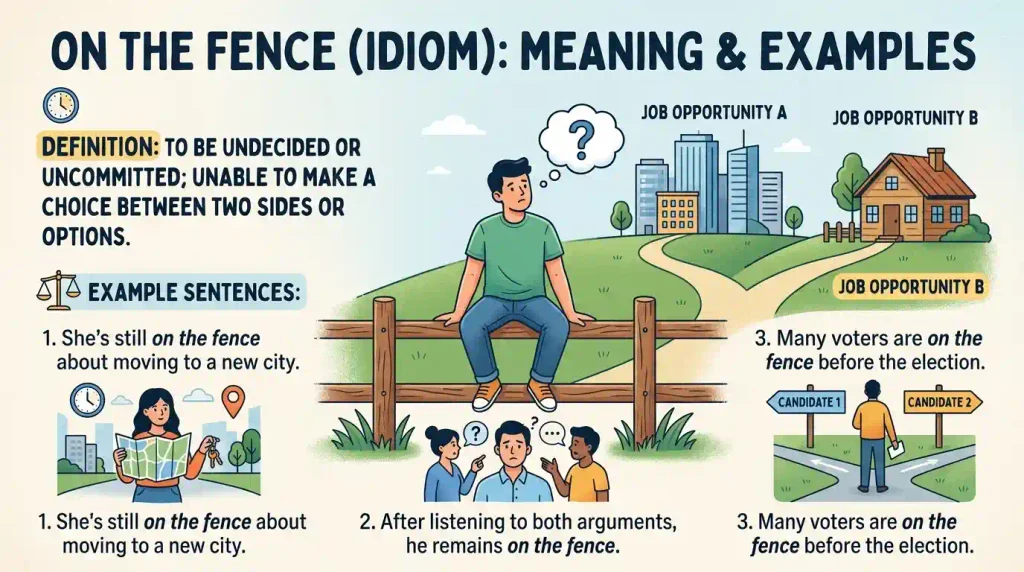
“On the fence” means being undecided or unable to choose between two options. It describes a person who has not yet picked a side, made a decision, or formed a strong opinion. Think of someone sitting on top of a fence, not stepping down onto either side of the yard. That image captures the whole idea perfectly. This phrase is common in everyday speech, especially when talking about opinions, choices, or plans that still feel uncertain.
Meaning or Definition
The phrase “on the fence” is an idiom. An idiom is a group of words that means something different from what the individual words say. When someone is “on the fence,” they are not literally sitting on a fence. Instead, they are stuck between two choices and cannot decide which one to pick.
This expression works for small decisions and big ones. Someone might be on the fence about what to eat for dinner. Another person might be on the fence about a major life choice, like changing jobs or moving to a new city. The phrase fits almost any situation where a person feels torn between two paths.
People also use this phrase to describe political opinions. A voter who has not chosen a candidate yet is often called “on the fence.” News reporters use this term often during election seasons to describe undecided voters.
| Situation | Example Sentence |
| Making a purchase | “I’m on the fence about buying this laptop.” |
| Political opinion | “She’s on the fence about who to vote for.” |
| Career decision | “He’s on the fence about taking the new job.” |
| Food choice | “I’m on the fence between pizza and tacos.” |
Grammar or Correct Usage
The phrase “on the fence” works as an adjective phrase. It usually follows a form of the verb “to be,” such as “is,” “was,” “am,” or “are.” Here is the basic pattern:
Subject + to be + on the fence + about + topic
For example: “I am on the fence about the new policy.”
You can also use “on the fence” after other linking verbs, like “seem” or “feel.” For example: “She seems on the fence about the decision.”
It’s important to always pair this phrase with the word “about” when explaining what someone is undecided on. Saying “I’m on the fence” alone is fine if the topic is already clear from context. But if you want to be specific, add “about” followed by the subject.
This phrase does not change form based on tense in a complicated way. You simply adjust the verb “to be”:
- Present: “I am on the fence.”
- Past: “I was on the fence.”
- Future: “I will be on the fence.”
Origin or History
The origin of “on the fence” likely comes from farming and rural life in the United States during the 1800s. Fences separated properties, fields, and pastures. A person sitting on top of a fence was not standing in either field. They were stuck in the middle, unable to commit to one side or the other.
Over time, this physical image turned into a figure of speech. Writers and speakers began using it to describe people who could not decide between two options, especially in politics. Historical records show the phrase appearing in American newspapers as early as the mid-1800s, often used to describe voters who had not picked a political party.
While the exact first use is hard to pinpoint, the phrase became widely popular in American English by the late 19th century. It has remained a common expression ever since, showing just how useful and relatable this image really is.
British vs American English
“On the fence” is used in both American and British English, though it started as an American phrase. British speakers understand and use this idiom just as often today. There is no real difference in meaning or usage between the two versions of English.
However, some British speakers might also use similar phrases like “sitting on the fence,” which means the same thing but adds emphasis on the ongoing action of staying undecided. Both versions are correct, and native speakers use them interchangeably.
| Region | Common Phrase | Meaning |
| American English | “On the fence” | Undecided or unsure |
| British English | “Sitting on the fence” | Undecided or unsure |
| Both regions | “Fence-sitter” (noun) | A person who avoids taking sides |
Common Mistakes
Many English learners make small errors when using this idiom. Here are the most common mistakes and how to fix them:
Mistake 1: Using the wrong preposition. Some people say “on the fence for” instead of “on the fence about.” The correct word is always “about” when referring to a specific topic.
Mistake 2: Taking it literally. Since this is an idiom, it should never be understood word-for-word. Some new English learners think it describes someone physically sitting on a fence. Always remember it means being undecided.
Mistake 3: Overusing the phrase. While it’s a great expression, using it too many times in one conversation or piece of writing can sound repetitive. Try mixing it with other phrases like “undecided,” “torn,” or “unsure” for variety.
Mistake 4: Wrong verb tense agreement. Make sure the verb “to be” matches the subject correctly. For example, “They are on the fence” is incorrect. The correct form is “They are on the fence.”
Real Life Examples
Seeing this phrase in real sentences helps make the meaning stick. Here are several examples from everyday situations:
“My parents are on the fence about letting me get a dog.” This shows a family decision that hasn’t been settled yet.
“The company is on the fence about launching the new product this year.” This shows a business decision that remains unclear.
“I was on the fence about the movie, but after reading reviews, I decided to watch it.” This shows how someone moved from being undecided to making a choice.
“Many voters remain on the fence just weeks before the election.” This is a common phrase used in news reporting.
“He’s on the fence about If to renew his gym membership.” This shows a simple, everyday personal decision.
These examples show how flexible and useful this idiom can be across many different topics and situations.
Current Usage or Trends
Today, “on the fence” remains one of the most commonly used idioms in American English. It appears frequently in news articles, social media posts, workplace conversations, and everyday chats. Because it clearly and quickly expresses indecision, writers and speakers continue to rely on it.
This phrase is especially popular during election seasons, product launches, and major public debates. Marketing professionals also use it when describing potential customers who haven’t decided to buy a product yet, often calling them “fence-sitters.”
Search interest for phrases like “on the fence meaning” tends to rise among English language learners and students who encounter the phrase in books, movies, or conversations and want a clear explanation. This shows the phrase remains highly relevant in modern communication.
Tips or Best Practices
If you want to use “on the fence” naturally and correctly, keep these tips in mind:
Use it when describing genuine indecision, not when you have already made a choice. Pair it with “about” followed by the topic for clarity. Avoid overusing it in the same paragraph or conversation. Mix it with similar phrases like “torn between,” “undecided,” or “weighing the options” to keep your language fresh. Remember that this phrase works well in both casual conversations and more formal writing, making it a versatile tool for English learners and native speakers alike.
FAQs
What does “on the fence” mean in simple words?
It means being unsure or undecided about something, unable to choose between two options.
Is “on the fence” formal or informal?
It is commonly used in both casual conversations and semi-formal writing, such as news articles, though very formal documents may prefer words like “undecided.”
Can I use “on the fence” in writing?
Yes, it works well in essays, articles, and casual writing. It adds a natural, conversational tone to your sentences.
What is the opposite of “on the fence”?
The opposite would be phrases like “decided,” “certain,” or “made up my mind,” which show a clear choice has been made.
Where did the phrase “on the fence” come from?
It likely comes from American farming culture in the 1800s, describing someone sitting on a fence instead of choosing a side of a field.
Is “fence-sitter” the same as “on the fence”?
Yes, “fence-sitter” is a noun form describing a person who is on the fence, often avoiding taking a clear side.
Conclusion
Understanding the on the fence meaning helps you use this popular idiom with confidence. It simply describes being undecided or stuck between two choices, if it’s a small daily decision or a major life change. This phrase has deep roots in American history and remains widely used today in conversations, news, and writing.
Remember to pair it with “about” when discussing a specific topic, and avoid using it too often to keep your language sounding natural. Now that you know its meaning, origin, and proper usage, you can confidently apply this expression in your own conversations and writing.

Hi, I’m Elias Monroe. I enjoy writing meaningful prayer content that helps people feel calm, hopeful, and spiritually strong. My goal is to share words that bring comfort during both joyful and difficult times.