Low and behold meaning is simple: it is a way to say “look and see!” before you share a surprise. The correct spelling is actually “lo and behold,” with no “w.” People use it to introduce something unexpected, funny, or exciting. Maybe you searched your whole house for your keys, and lo and behold, they were in your hand. In this guide, you will learn what the phrase means, where it came from, how to spell it, and how to use it well.
Quick Answer: What Does Low and Behold Mean?
“Low and behold” is a common misspelling of “lo and behold.” The phrase means “look!” or “see what happened!” You say it when something surprising shows up, often right after you expected something else.
Think of it as a drumroll in words. You build a little suspense, and then you reveal the surprise. That is the whole job of this phrase.
Here are two quick examples:
- I opened the fridge for a snack, and lo and behold, there was one slice of pizza left.
- She walked into the room, and lo and behold, everyone yelled “Surprise!”
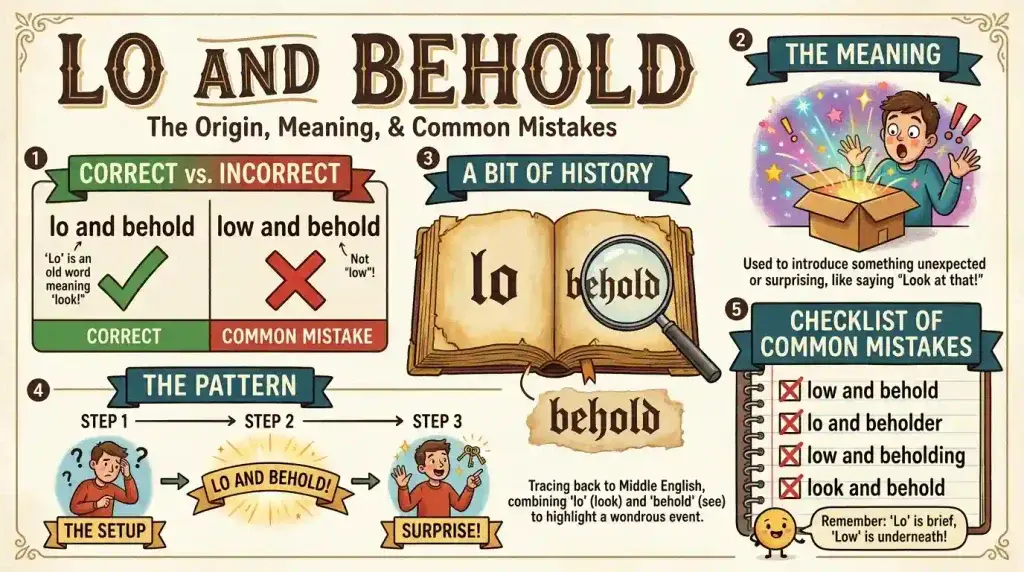
The word “lo” is an old way of saying “look.” The word “behold” also means “look at” or “see.” So the phrase says “look and see” in a fancy, old-fashioned way. That is why it still sounds a little dramatic, and a little playful, today.
Is It “Low and Behold” or “Lo and Behold”?
The right spelling is “lo and behold.” Dictionaries list it this way, and editors and teachers expect it. “Low and behold” is a spelling mistake, even though it is very common.
So why does the mistake happen? Think about how the phrase sounds when you say it out loud. “Lo” and “low” sound exactly the same. They rhyme with “go” and “show.” Because most people hear this phrase more often than they see it written, they pick a spelling that matches a word they already know. “Low” is a word everyone knows. “Lo” is not.
Here is a quick look at the two spellings side by side.
| Spelling | Is It Correct? | Why |
| Lo and behold | Yes | “Lo” is an old word that means “look” |
| Low and behold | No | “Low” means “not high,” which makes no sense here |
| Lo and beholden | No | “Beholden” means “owing a favor,” which is a different word |
If you write a school paper, a work email, a blog post, or a book, use “lo and behold.” Your readers will trust your writing more when the spelling is right.
That said, if you searched for the phrase with the wrong spelling, you are in good company. Thousands of people make the same slip every month. It is an easy one to make, and an easy one to fix once you know.
What Does “Lo and Behold” Really Mean?
Let us break the phrase into two parts.
“Lo” is an old English word used to get attention. People used it the way we might say “Look!” or “Check this out!” Today, you almost never see “lo” on its own. It lives on mostly inside this one phrase, like a small word frozen in time.
“Behold” is a bit more familiar. It means “to look at” or “to see,” usually something special. You may have heard it in songs, old stories, or religious readings. “Behold the king!” is a good example.
Put them together, and you get a double invitation to look. That doubling is on purpose. It adds drama. It tells the listener, “Pay attention, because something surprising is coming.”
The phrase often does three jobs at once:
- It gets the listener’s attention.
- It signals that a surprise is coming.
- It adds a touch of humor or flair.
Most of the time, the surprise is a happy one or a funny one. But it does not have to be. You can use it for a plain surprise too, like finding out your flight was moved to an earlier time. The key is that the result was not what you expected.
It also helps to know what the phrase is not. It is not a way to say “finally” or “at last,” though it can show up in stories where something long awaited happens. It is also not a way to say “by the way.” Its main job is to point at a surprise.
Where Does the Phrase Come From?
The words in this phrase are very old. Both “lo” and “behold” go back to Old English, the form of English spoken more than a thousand years ago. “Lo” started as a sound used to call attention to something. “Behold” grew from an old word that meant “to hold” or “to keep,” and over time it came to mean “to keep your eyes on” something.
These words were common in older writing, especially in religious texts. You can find “lo” and “behold” used again and again in older English versions of the Bible. In those texts, they often show up right before something important or amazing happens. Writers used them to make readers stop and pay attention.
As English changed, most people stopped using “lo” in daily speech. But the two-word phrase “lo and behold” stuck around. It likely lasted because it is fun to say and easy to remember. It also gives a story a nice little pause, like a curtain opening on a stage.
I want to be honest here. Word experts agree that the words themselves are old, but nobody can name the exact person or moment that first joined them into “lo and behold.” When a phrase grows slowly out of everyday speech, there is no single birthday. So you may see different dates online, and it is best to treat any exact date with caution.
How to Use “Lo and Behold” in a Sentence
Using this phrase is easy once you know the pattern. You usually set up a situation first. Then you say “lo and behold” and share the surprise.
The pattern looks like this: Setup + “lo and behold” + surprise.
Here are some examples that show the pattern:
- I looked everywhere for my glasses. Lo and behold, they were on top of my head.
- We waited for the bus for an hour, and lo and behold, three buses showed up at once.
- He said he could never learn to swim. Lo and behold, by August he was jumping off the high dive.
A few small grammar tips will help you here.
First, you can place the phrase at the start of a sentence or in the middle of one. Both work fine. “Lo and behold, the sun came out” and “The sun, lo and behold, came out” are both correct, though the first one is more common.
Second, put a comma after the phrase when it starts a sentence. That small pause matches the way people say it out loud.
Third, you do not need to capitalize “lo and behold” unless it begins a sentence. It is not a title or a name.
Finally, keep the phrase for real surprises. If you use it for something that was not surprising at all, the joke falls flat.
Real Life Examples of “Lo and Behold”
Seeing the phrase in different settings can help it click. The table below shows how it might sound in everyday life.
| Situation | Example Sentence |
| At home | I cleaned under the couch, and lo and behold, I found the missing remote. |
| At school | The teacher said the test was hard. Lo and behold, I got an A. |
| At work | We thought the project would take months, and lo and behold, we finished in two weeks. |
| With friends | I almost skipped the party, but lo and behold, it was the best night of the year. |
| In a story | The knight opened the old chest, and lo and behold, it was full of gold coins. |
| With technology | My phone was dead all day. I plugged it in, and lo and behold, it turned back on. |
Notice how each example has a little setup. You can feel the “I did not expect that” in every one. That feeling is what makes the phrase work.
You may also hear the phrase in movies, books, and even news stories. Writers like it because it adds a light, storytelling feel. A reporter might write that a team was expected to lose, and lo and behold, they won in the final minute. A food blogger might say they added one secret spice, and lo and behold, the soup tasted amazing.
Other Ways to Say “Lo and Behold”
Sometimes you want a different way to say it. Maybe you are writing a lot and do not want to repeat yourself. Maybe the phrase sounds too fancy for your message. Here are some simple swaps.
| Instead of “Lo and Behold” | When It Fits Best |
| Look and see | Friendly, simple, great for kids |
| Surprisingly | Neutral, works in most writing |
| To my surprise | Personal stories |
| Out of nowhere | Sudden events |
| Just then | Quick action in a story |
| Guess what | Casual talk with friends |
| Believe it or not | When the result is hard to believe |
| Sure enough | When something you half expected came true |
Each of these choices has a slightly different feel. “Surprisingly” is plain and clear. “Believe it or not” is chatty. “Sure enough” is a little different, because it often means something happened just as someone predicted, so it is less about shock and more about confirming a guess.
“Lo and behold” has a playful, storytelling flavor that none of these fully match. If you want that flavor, keep the original phrase. If you want a calm, direct tone, pick one of the simpler options.
Common Mistakes With “Lo and Behold”
Now that you know the right way, let us look at the slips people make most often.
Spelling it “low and behold.” This is the biggest one. As we covered, “low” is the wrong word. If you remember only one thing from this article, remember that “lo” has no “w.”
Writing “lo and beholden.” Some people add “-en” to the end and write “beholden.” That is a real word, but it means “owing thanks or a favor to someone.” It does not belong in this phrase.
Using it for non-surprises. If your result was totally expected, the phrase can sound odd. “I went to the store, and lo and behold, I bought milk” does not work, unless you went in expecting to find the store closed.
Overusing it. Because the phrase is so flavorful, a little goes a long way. If you use it three times in one page, it will start to feel silly. Save it for the moments that earn it.
Using it in very serious writing. The phrase is light and a bit playful. In a sad story or a serious report, it may feel out of place. Think about your readers and the mood before you use it.
Mixing up the order. The phrase is always “lo and behold,” not “behold and lo.” The words come in one set order, like “salt and pepper” or “rock and roll.”
Why Do So Many People Write “Low and Behold”?
This mistake is so common that language experts have a name for this kind of slip. It is called an eggcorn. An eggcorn happens when someone replaces a word they do not know with a word that sounds the same and seems to make sense. The name comes from a person who once wrote “eggcorn” instead of “acorn.”
Here, “lo” is a rare, old word. Most of us never use it anywhere else. When our brains hear “lo” and need to write it down, they reach for “low.” It sounds identical, and it is a word we know well.
Other well-known eggcorns include “for all intensive purposes” instead of “for all intents and purposes,” and “nip it in the butt” instead of “nip it in the bud.” In every case, the person’s brain made a logical swap. That is why these mistakes are so easy to make and so hard to spot.
The good news is that making this mistake does not mean you are a weak writer. It simply means you learned the phrase by ear. Many smart, careful people have done the same. Once you learn the correct spelling, you can fix it for good.
Tips to Remember the Right Spelling
If you want a trick to lock in “lo and behold,” try one of these.
- Think “look.” “Lo” and “look” both start with “lo.” Both mean the same thing in this phrase. If you can say “look and behold,” you can remember “lo.”
- Cut the extra letter. “Low” has four letters, but “lo” has only two. Picture the “w” falling off.
- Link it to “behold.” Both words in the phrase are about seeing. Neither one is about height or being close to the ground.
- Say it with a grin. Because the phrase is playful, picture the surprise it introduces. That picture will help the phrase stick in your mind, and the right spelling will come with it.
- Use a spell-check note. If you write a lot, add the correct spelling to your personal dictionary. Many writing tools let you do this.
A little practice is all it takes. After you write it correctly a few times, the right spelling will feel natural.
Is the Phrase Different in British and American English?
There is no real difference. Both American and British English use “lo and behold” the same way, with the same meaning and the same spelling. You will hear it in the United States, the United Kingdom, Canada, Australia, and other English-speaking places.
The only difference you might notice is how common it feels. In everyday talk, many people in all these places treat it as a slightly old-fashioned phrase that adds humor. In writing, it appears in stories, blogs, news articles, and speeches across the English-speaking world.
So you do not need to worry about switching spellings for different readers. Just write “lo and behold,” and you are correct everywhere.
How People Use the Phrase Today
You might wonder if “lo and behold” is out of style. It is not. It is old, but it is still alive and well. People use it in casual speech, social media posts, blog stories, and even headlines.
Today, the phrase often carries a light, joking tone. A person might post a photo of a missing sock and write, “Lo and behold, it was in the dryer all along.” A news writer might use it to add a bit of fun to a story about an unexpected win. A parent might say it when a child suddenly cleans their room without being asked.
Because it is a bit old-fashioned, using it can feel charming. It reminds us of storytelling, fairy tales, and long talks with grandparents. That mix of old and new is part of its appeal.
You will also notice that writers sometimes use it with a wink, as if they know the phrase is dramatic. That is perfectly fine. It lets the reader in on the joke.
If you search for the phrase online, many people type “low and behold,” which shows how often the wrong version spreads. Still, trusted dictionaries and style guides list “lo and behold” as the correct form, and that is the one you should use in your own writing.
FAQs About Low and Behold Meaning
What is the meaning of “low and behold”?
“Low and behold” is a misspelling of “lo and behold.” It means “look and see!” People use it to introduce a surprising or unexpected moment.
Is “low and behold” ever correct?
No. The correct spelling is “lo and behold.” The word “low” means something that is not high, and it has no place in this phrase.
What does “lo” mean?
“Lo” is an old English word that means “look” or “see.” It was once used to get someone’s attention. Today, it survives mostly inside the phrase “lo and behold.”
Where did the phrase “lo and behold” come from?
Both words are very old and appear in older English writing, including old Bible translations. No one knows exactly who first joined them into this phrase, so be careful with sites that claim an exact date.
Can I use “lo and behold” in formal writing?
You can, but use it carefully. The phrase has a playful, storytelling feel. It fits well in stories, blogs, and friendly articles. For very serious or formal papers, a plain word like “surprisingly” may be a better choice.
Is “lo and behold” used the same way in British English?
Yes. British and American English use the same spelling and the same meaning. You can write it the same way for readers anywhere.
Conclusion
Now you know the full low and behold meaning. It is a fun, old-fashioned way to say “look and see!” before you share a surprise. The correct spelling is “lo and behold,” and “low” is only a common mix-up caused by how the phrase sounds.
Remember the simple pattern: set up the moment, say “lo and behold,” and then reveal the surprise. Keep it for true surprises, and avoid using it too often so it stays fresh. If you ever forget the spelling, think of “look” and drop the extra letter.
If you are writing a story, a blog post, or a quick message to a friend, this little phrase can add a spark of personality. Use it with confidence, enjoy the drama it brings, and lo and behold, your writing will sound a little more lively.

Hello, I’m Clara Whitmore. I write daily prayers, devotionals, and faith-based reflections for readers seeking peace and encouragement. I believe prayer has the power to heal hearts and renew faith.