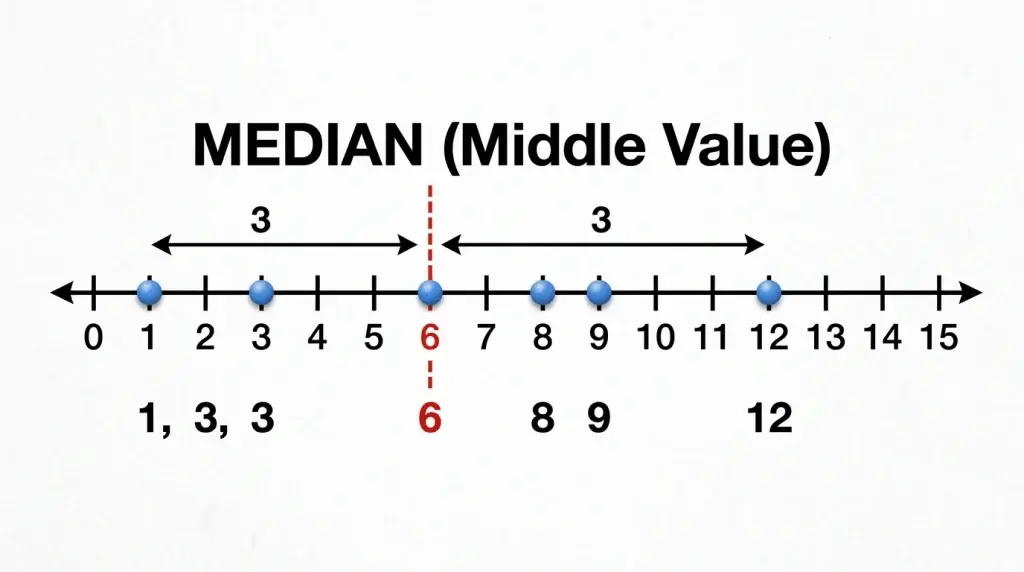
The median meaning in math is simple: it is the middle number in a list after you put the numbers in order. Half of the numbers fall below it, and half fall above it. Maybe you saw the word on a homework sheet, in a news story about home prices, or on a test report. Many people search for it because it sounds tricky, but it really is not.
In this guide, you will learn what the median is, how to find it with an odd or even list, and how it differs from the mean and mode. You will also see real examples, common mistakes, and quick tips. By the end, you will be able to find a median with confidence.
Quick Answer: Median Meaning in Math
The median is the middle value in a set of numbers that has been arranged from smallest to largest. If the list has an odd number of values, the median is the one number in the exact middle. If the list has an even number of values, the median is the average of the two middle numbers.
Here is a tiny example. Take the numbers 3, 5, and 9. They are already in order, and the middle one is 5. So the median is 5.
The word “median” comes from a Latin word that means “middle.” That is a handy way to remember it. The median is the middle of the road, the number that sits right in the center of your data.
Why the Median Matters
You might wonder why we need a middle number at all. Why not just add everything up and divide? We do that sometimes, and it gives us the mean. But the mean can be tricked by numbers that are much bigger or much smaller than the rest. The median is harder to trick.
Think about a classroom of ten kids. Nine of them are between 9 and 10 years old, and the teacher is 45. If you find the average age of everyone in the room, the teacher pulls the number way up. The median age, however, would still be around 9 or 10. It tells you what a “typical” person in the room looks like.
That is why the median is so popular in news reports, business, and science. It gives a fair picture of the center of a data set, even when a few numbers are strange or extreme. In math class, the median is also one of the three main “measures of center,” along with the mean and the mode. Learning it well helps you with later topics like statistics, graphs, and data analysis.
How to Find the Median When You Have an Odd Number of Values
Finding the median is a short process. Once you learn the steps, you can do it with any list. Let’s start with a list that has an odd number of values, such as 5, 7, or 11 numbers.
Step 1: Put the numbers in order. Line them up from smallest to largest. This step is very important, and we will talk about it again in the mistakes section.
Step 2: Count the numbers. Know how many values you have.
Step 3: Find the middle one. With an odd list, there is exactly one number in the center. You can find its place with a small rule: add 1 to the count, then divide by 2.
Let’s try it with this list: 8, 3, 10, 5, 7.
First, put the numbers in order: 3, 5, 7, 8, 10. There are 5 numbers. Add 1 to get 6, then divide by 2 to get 3. So the median is the third number in the ordered list. The third number is 7. That means the median is 7.
Notice that there are two numbers on the left side (3 and 5) and two numbers on the right side (8 and 10). The 7 sits right in the middle with equal numbers on both sides. That is exactly what a median should do.
Here is another example with 9 numbers: 14, 2, 9, 11, 6, 20, 4, 15, 8. In order, they look like this: 2, 4, 6, 8, 9, 11, 14, 15, 20. Add 1 to 9 to get 10, then divide by 2 to get 5. The fifth number is 9, so the median is 9.
How to Find the Median When You Have an Even Number of Values
Things change a little when the list has an even number of values, such as 4, 6, or 10 numbers. Now there is no single middle number. Instead, there are two numbers in the center. To find the median, you find the number that sits exactly halfway between them. That means you add the two middle numbers together and divide by 2.
Try this list: 4, 6, 8, 10. It is already in order. There are four numbers, and the two in the middle are 6 and 8. Add them to get 14. Divide 14 by 2 to get 7. The median is 7.
Did you notice something? The number 7 is not in the original list. That is perfectly fine. With an even list, the median can be a number that is not in your data. It is simply the halfway point between the two middle values.
Let’s do a longer one: 20, 2, 14, 9, 5, 12. First, put the numbers in order: 2, 5, 9, 12, 14, 20. There are six numbers. The third and fourth numbers are in the middle, and those are 9 and 12. Add them to get 21, then divide by 2 to get 10.5. So the median is 10.5.
What if the two middle numbers are the same? Take 4, 6, 6, 9. The middle numbers are both 6. Add them to get 12, divide by 2, and you get 6. The median is 6. When the two middle numbers match, the median is simply that number.
Median Steps at a Glance
Here is a quick table you can use as a cheat sheet. It shows how the process changes depending on how many numbers you have.
| Type of List | What to Do | Example | Median |
| Odd number of values | Order the list, then pick the one middle number | 2, 5, 9, 12, 14 | 9 |
| Even number of values | Order the list, then average the two middle numbers | 2, 5, 9, 12 | 7 |
| Two middle numbers are the same | The median is that repeated number | 3, 6, 6, 10 | 6 |
| Only one number | That number is the median | 15 | 15 |
Median vs. Mean vs. Mode
Students often mix up these three words, and that is normal. They all describe the “center” of a group of numbers, but each one does it in a different way. Let’s use one data set to see the difference: 3, 4, 4, 6, 18.
The mean is the average. You add all the numbers and divide by how many there are. Here, 3 + 4 + 4 + 6 + 18 equals 35. Divide 35 by 5 and you get 7.
The median is the middle number. The list is already in order, and the middle value is 4.
The mode is the number that shows up most often. In this list, 4 appears twice, and the others appear once. So the mode is 4.
| Measure | What It Tells You | How to Find It | Result for 3, 4, 4, 6, 18 |
| Mean | The average | Add all values, then divide by the count | 7 |
| Median | The middle value | Order the list, then pick the center | 4 |
| Mode | The most common value | Find the number that appears most | 4 |
Look at how the mean (7) is higher than most of the numbers in the list. The number 18 pulled it up. The median (4) stayed closer to where most of the numbers actually sit. A fun way to remember all three is this: the mean is the “fair share,” the median is the “middle,” and the mode is the “most.”
When the Median Is Better Than the Mean
The median really shines when your data has outliers. An outlier is a number that is far away from the others, either much higher or much lower. Even one outlier can change the mean a lot, but it barely moves the median.
Here is an example with yearly pay at a tiny company. Five workers earn $30,000, $32,000, $35,000, $38,000, and $400,000. The last person is the owner.
If you add them up, you get $535,000. Divide by 5 and the mean is $107,000. That number sounds great, but four out of the five people earn far less than that. It does not describe a typical worker at all.
Now find the median. The numbers are already in order, and the middle one is $35,000. This is a much better picture of what a normal worker earns there.
This is why you often see the median used for house prices, family income, and wait times. A few very expensive homes or very long waits would make the mean look unfair. The median keeps things honest.
That said, the median is not always the winner. If your data has no strange values and is spread out evenly, the mean works well, and it uses every number in the set. The best choice depends on your data and your question.
Finding the Median in a Frequency Table
Sometimes data comes in a table that shows how many times each value appears. You do not need to write out every number to find the median. You can count your way to the middle instead.
Imagine a teacher asks 20 students how many pets they have. The answers look like this: 4 students have 0 pets, 7 students have 1 pet, 5 students have 2 pets, and 4 students have 3 pets.
There are 20 students, which is an even number. So the median will be the average of the 10th and 11th values. Now count along the table. The first 4 students have 0 pets. Adding the next 7 brings us to 11 students, so students 5 through 11 all have 1 pet. That means the 10th and 11th students both have 1 pet. The median is 1.
This trick saves a lot of time when you have large amounts of data. You just keep a running count until you reach the middle spot or spots.
Real-Life Examples of the Median
You will bump into the median more often than you think. Here are a few places where it shows up.
Home prices. Real estate reports often share the median home price in a city. It tells buyers what a typical home costs without being pushed up by a handful of luxury mansions.
Family income. Government groups, such as the U.S. Census Bureau, report median household income. This shows what a middle household earns, not what the richest households earn.
Test scores. A teacher may share the median score on a quiz. If the median is 82, then half of the class scored 82 or higher, and half scored 82 or lower.
Ages. Cities and countries often share a median age. It shows whether the population is young or old overall.
Wait times. A clinic might say the median wait is 15 minutes. That means half of the patients waited less than 15 minutes, and half waited longer.
Sports. Coaches may look at the median number of points a player scores per game. A single huge game will not trick the median like it can trick the mean.
In every case, the median answers a friendly question: “What does the middle look like?”
Common Mistakes to Avoid
Even smart students slip up with medians. Here are the most common mistakes and how to dodge them.
Forgetting to order the numbers. This is the biggest one. The median only works when the numbers go from smallest to largest (or largest to smallest). Say you have 9, 2, 7, 4, 5. If you just pick the middle spot, you get 7. But the correct way is to sort first: 2, 4, 5, 7, 9. Now the middle is 5. That is a big difference!
Skipping repeated numbers. If a number shows up more than once, count it each time. In the list 2, 2, 2, 5, 9, there are five numbers, and the middle one is the third, which is 2. If you remove the repeats, you would get the wrong answer.
Mixing up median and mode. The mode is the most common number, and the median is the middle one. They can be the same number, but they do not have to be.
Forgetting to average with even lists. When there are two middle numbers, you cannot choose just one. You must find the number halfway between them.
Dividing by the wrong number. When you average the two middle values, always divide by 2. Do not divide by the total count of the list. That step belongs to the mean.
Counting wrong. With long lists, it is easy to lose your place. Cross off numbers from both ends, one small and one large at a time, until you reach the center. This is a great way to double-check your work.
Tips for Finding the Median Faster
A few simple habits can make you quicker and more accurate.
First, always rewrite your list in order before you do anything else. Write it neatly on paper so you can see every number. Second, count your numbers and write the total at the top. Knowing whether the count is odd or even tells you right away which method to use.
Third, try the “cross-off” trick. Cross out the smallest and largest numbers, then the next smallest and the next largest, and keep going. If one number is left in the center, that is your median. If two numbers are left, average them.
Fourth, check your answer with a quick test. Count how many numbers are below your median and how many are above it. They should be about equal. If not, something went wrong.
Finally, practice with real data. Try it with the ages of your family, your last five test scores, or the number of steps you walk each day. When the numbers mean something to you, the idea sticks better.
FAQs About the Median in Math
What is the median in simple words?
The median is the middle number in a list that has been put in order. Half of the numbers are smaller than it, and half are bigger.
How do you find the median of an even set of numbers?
Put the numbers in order and find the two middle ones. Add them together and divide by 2. For 10, 12, 14, 20, the middle numbers are 12 and 14, so the median is 13.
Can the median be a decimal or a number not in the list?
Yes. With an even list, the median is the halfway point between two numbers, so it can be a decimal like 10.5. It might not appear in your original data at all.
Is the median the same as the average?
No. The average is usually the mean, which you find by adding all numbers and dividing by the count. The median is the middle value. They can be close, but they are often different.
Why is the median better than the mean sometimes?
The median is not pulled around by very big or very small numbers. This makes it a fairer choice for data like home prices or salaries, where a few extreme values can make the mean misleading.
Do you have to put the numbers in order to find the median?
Yes, always. If you skip this step, you will likely get the wrong answer. Sorting the list first is the key to finding the true middle.
Conclusion
Now you know the median meaning in math: it is the middle number in an ordered list, and it splits your data into two equal halves. You also learned how to find it with an odd list, where you pick the one middle value, and with an even list, where you average the two middle values. We compared it with the mean and the mode, and we saw why the median is such a trusted tool when outliers are around.
The big takeaway is easy to remember. Order the numbers first, find the center, and double-check your count. Most mistakes happen when people rush or skip the sorting step. Practice with a few small lists each day, and soon the process will feel automatic. Whether you are doing homework, reading the news, or looking at prices, the median helps you see what is truly typical. Keep this guide handy, and you will always know how to find that middle number.

Hello, I’m Clara Whitmore. I write daily prayers, devotionals, and faith-based reflections for readers seeking peace and encouragement. I believe prayer has the power to heal hearts and renew faith.