Have you ever seen the word “sum” in a math problem and paused for a second? You are not alone. The sum meaning in math is simple: a sum is the answer you get when you add two or more numbers together. For example, the sum of 4 and 6 is 10. Many students mix this word up with other math words, and that can cause small mistakes.
In this guide, you will learn what a sum is, how to find one, and how to spot it in word problems. You will also see real examples, helpful tables, common mistakes, and fun facts, so the idea sticks for good.
Sum DEFINITION
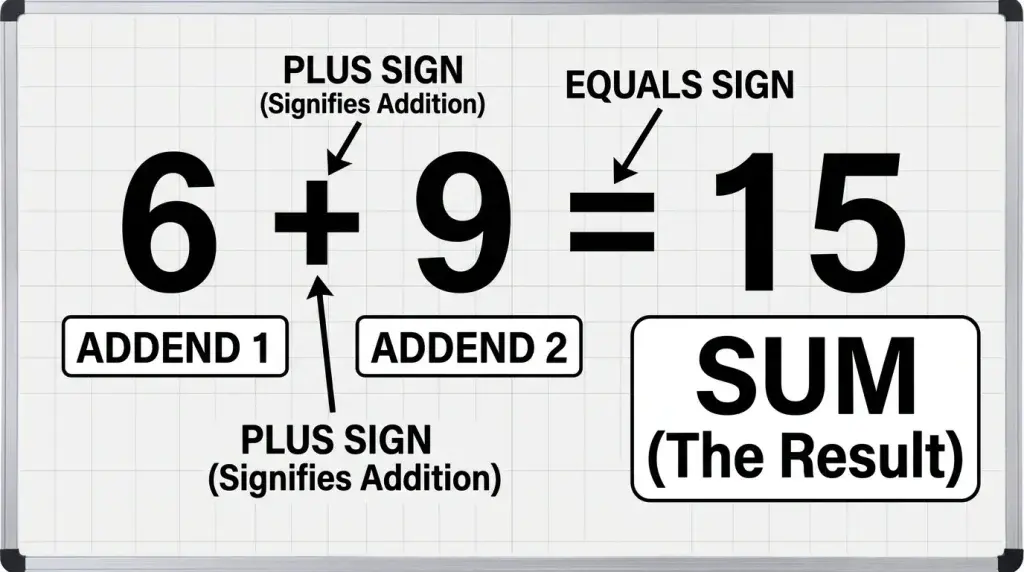
What is sum ? A sum is the total value you get after you combine numbers using addition. The numbers you add have a special name. They are called addends. In the problem 6 + 9 = 15, the numbers 6 and 9 are the addends, and 15 is the sum.
A sum of positive numbers is always larger than each addend. If you add 6 + 9 and get 12, you know something went wrong, because the sum should be bigger than 9.
What DOES Sum Mean?
Here is a handy way to remember it. Picture a basket. You put 6 apples in it. Then you put in 9 more apples. When you count every apple in the basket, you get 15. That 15 is the sum.
A sum can come from just two numbers, or it can come from hundreds of them. It can also include zero, negative numbers, fractions, and decimals. For example, the sum of 0.5 and 0.25 is 0.75. The sum of 3 and negative 1 is 2. The rule never changes. You add, and the answer is the sum.
One more small point is worth knowing. A sum is the answer to an addition problem, but the word can also name the whole problem. Teachers sometimes say, “Do these sums,” and they mean “Solve these addition problems.” In older books and in some countries, “sums” can even mean any math homework. In most American classrooms, though, the word means the result of adding.
How to Find the Sum Step by Step
Finding a sum is easy once you follow a clear plan. Here is a simple way to do it with any set of numbers.
First, read the problem and find the numbers you need to add. Second, line them up if they are large, with ones under ones, tens under tens, and so on. Third, add the digits column by column, starting on the right. Fourth, carry over any extra tens to the next column. Finally, write your answer and check it.
Let’s try an example: 248 + 175. Start with the ones column. 8 + 5 = 13, so write 3 and carry 1. Next, add the tens column. 4 + 7 + 1 (the carried number) = 12, so write 2 and carry 1. Then add the hundreds column. 2 + 1 + 1 = 4. The sum is 423.
A good way to check your work is to add the numbers in the opposite order. If you add 175 + 248, you should still get 423. Another way is to subtract one addend from your sum. If 423 − 175 gives you 248, you know your sum is right.
For small numbers, you can also use mental math. To add 9 + 6, you might think, “9 plus 1 is 10, and 5 more is 15.” Tricks like this make sums faster over time. The more you practice, the more natural it feels.
Sum Meaning
In math, a sum is the result of adding numbers. If you add 8 + 5, the sum is 13. If you add 2 + 3 + 7, the sum is 12. The word “sum” always points to addition, and it never points to subtraction, multiplication, or division.
You can think of a sum as the “all together” number. When you put groups of things into one big group and count them, the final count is the sum. That is the whole idea. Everything else in this article builds on this one simple thought.
Sum Meaning in Math With Real Life Examples
You use sums all the time, even when you do not notice. Real examples can make the idea feel much less scary.
Imagine you are at a store. You buy a notebook for $3, a pen for $2, and a snack for $4. The sum of your items is $3 + $2 + $4 = $9. That is how much you will pay before tax.
Now think about a video game. You score 120 points in level one and 85 points in level two. Your total score is the sum, which is 205 points. Sports fans do this too. If a basketball player scores 12 points in the first half and 15 points in the second half, her sum for the game is 27 points.
Cooking uses sums as well. If a recipe needs half a cup of milk and another quarter cup of milk for the sauce, you add 1/2 + 1/4. The sum is 3/4 of a cup.
Even saving money is a sum. If you save $5 each week for four weeks, you add 5 + 5 + 5 + 5. The sum is $20. When you see sums in daily life, the math word stops feeling like a school-only idea.
Sum vs. Total vs. Difference vs. Product
Students often mix up math words that sound alike. The table below shows how sum compares with other common terms.
| Math Word | Operation | Example | Answer |
| Sum | Addition | The sum of 8 and 4 | 12 |
| Total | Addition (everyday word) | The total of 8 and 4 | 12 |
| Difference | Subtraction | The difference of 8 and 4 | 4 |
| Product | Multiplication | The product of 8 and 4 | 32 |
| Quotient | Division | The quotient of 8 and 4 | 2 |
As you can see, “sum” and “total” usually mean the same thing in simple problems. The word “total” is more common in daily life, while “sum” is the neater math word. The other three words, difference, product, and quotient, each belong to a different operation. If you remember that sum goes with plus, you will avoid many mix-ups.
Key Words That Point to a Sum in Word Problems
Word problems can feel tricky because the math is hidden inside a story. Luckily, certain words often give you a clue that you should add. The next table lists some of the most common ones.
| Clue Word or Phrase | Example Sentence | What You Do |
| Sum | Find the sum of 15 and 20. | 15 + 20 = 35 |
| Total | What is the total number of pets? | Add all the pets |
| In all | How many books are there in all? | Add the groups |
| Altogether | How many apples do they have altogether? | Add each person’s apples |
| Combined | What is the combined weight of the boxes? | Add the weights |
| Plus | What is 7 plus 9? | 7 + 9 = 16 |
| More than | Sam has 5 more than Lee, who has 8. | 8 + 5 = 13 |
These clue words are helpful, but do not follow them blindly. Always read the whole problem. Sometimes a word like “more than” can mean something different based on the question. Think about the story, picture what is happening, and then choose your operation.
Here is a short example. “Mia has 14 stickers. Her brother gives her 9 more. How many stickers does Mia have now?” The story shows that Mia’s pile is growing. So you add 14 + 9, and the sum is 23.
Rules and Properties of Sums
Sums follow a few friendly rules. Knowing them can save you time and help you check your answers.
The first rule is the commutative property. It says you can change the order of the addends, and the sum stays the same. So 7 + 5 and 5 + 7 both equal 12. This is great when you want to start with the bigger number to make mental math easier.
The second rule is the associative property. It says you can group numbers in different ways without changing the sum. For example, (2 + 3) + 7 = 12, and 2 + (3 + 7) = 12. You can pick the grouping that feels easiest. Many people like to make a 10 first, so they would add 3 + 7 before adding the 2.
The third rule is the identity property. When you add zero to any number, the sum is that same number. So 15 + 0 = 15. Zero is called the additive identity because it does not change the value.
There are also some handy patterns with odd and even numbers. The sum of two even numbers is always even, as in 4 + 6 = 10. The sum of two odd numbers is also even, as in 3 + 5 = 8. The sum of one odd number and one even number is always odd, as in 3 + 4 = 7. These patterns help you quickly spot answers that cannot be right.
The Sum Symbol: Sigma Notation
As you move into higher grades, you will meet a fancy symbol that looks like a curvy “E.” It is the Greek capital letter sigma, written Σ. In math, it is a short way to say “add up a list of numbers.”
Here is how it works. Writing Σ with a small “1” at the bottom and a “5” at the top, followed by “n,” means “add the numbers n from 1 to 5.” So the sum is 1 + 2 + 3 + 4 + 5, which equals 15. The bottom number tells you where to start. The top number tells you where to stop. The letter next to the sigma tells you what to add.
Why use this symbol at all? Imagine you need to add all the numbers from 1 to 1,000. Writing every number would take forever. Sigma notation squeezes the whole idea into a tiny space. Scientists, engineers, and teachers use it all the time.
You may not need sigma notation right now, but it is good to know that the word “sum” is so important in math that it has its very own symbol.
Famous Sums and Number Patterns
Some sums are so interesting that people have told stories about them for years. The most famous one is about a boy named Carl Friedrich Gauss, who later became one of the greatest mathematicians in history. The story says that his teacher asked the class to add all the numbers from 1 to 100, hoping it would keep them busy for a while. Young Gauss supposedly found the answer in moments. Historians are not sure every detail of the tale is true, but the math trick it teaches is real and useful.
Here is the trick. Pair the first number with the last: 1 + 100 = 101. Then pair the second with the second-to-last: 2 + 99 = 101. Every pair has the same sum of 101. Since there are 50 pairs, you multiply 50 × 101 and get 5,050. That is the sum of the numbers from 1 to 100.
You can use the same idea for any list that starts at 1. The shortcut formula is the last number times the next number, divided by 2. For 1 to 10, that is 10 × 11 ÷ 2 = 55. Try it yourself with a calculator, and you will see it works.
Here is another cool pattern. When you add odd numbers in order, the sum is always a perfect square. Look at this: 1 = 1, 1 + 3 = 4, 1 + 3 + 5 = 9, and 1 + 3 + 5 + 7 = 16. The sums 1, 4, 9, and 16 are the squares of 1, 2, 3, and 4. Math is full of little surprises like this.
Sum in Geometry and Other Math Areas
The word “sum” shows up well beyond basic addition. Knowing where it appears will help you feel ready for new topics.
In geometry, you will learn that the angles inside any triangle always have a sum of 180 degrees. If two angles measure 50 and 60 degrees, the third must be 70 degrees, because 50 + 60 + 70 = 180. The angles inside a four-sided shape, like a square or rectangle, have a sum of 360 degrees.
In statistics, the sum helps you find the average, also called the mean. You add all the numbers in a set, then divide the sum by how many numbers there are. If your test scores are 80, 90, and 100, the sum is 270. Divide by 3, and the average is 90.
In algebra, you might be asked to find “the sum of two numbers” when you are given clues. For example, if two numbers add up to 20 and one of them is 12, the other is 8. Later on, you may even add whole expressions, such as x + 3 and x + 5, which have a sum of 2x + 8.
In calculus, big sums help people find areas under curves. These are called Riemann sums. That may sound far away today, but it all grows from the same simple idea you learned here: putting pieces together to find a whole.
Where the Word “Sum” Comes From
The English word “sum” comes from the Latin word “summa,” which is generally understood to mean “highest” or “top.” Many sources explain that people in ancient Rome often added numbers by counting upward, so the final, highest number became the answer. That is why the word came to mean the result of adding.
The plus sign (+) has a history too. A commonly shared explanation is that it started as a quick way to write the Latin word “et,” which means “and.” The sign was in use in Europe by the 1400s. Sources do not always agree on every detail, so it is best to treat the exact story as a popular explanation and not a sure fact.
Common Mistakes With Sums
Even good students slip up now and then. Knowing the usual traps can help you avoid them.
The biggest mistake is mixing up sum and product. If a problem says “the sum of 3 and 4,” the answer is 7, not 12. Always link the word “sum” with plus.
Another common error is forgetting to carry. When a column adds up to more than 9, you need to carry the extra tens to the next column. Skipping this step makes the answer too small.
Messy alignment causes trouble as well. If the digits are not lined up by place value, you might add a tens digit to a ones digit. Using graph paper or drawing light column lines can really help.
Some people also forget about negative numbers. The sum of 5 and negative 8 is negative 3, not 13. When you add a negative number, you move down the number line.
Finally, watch out for the word “some.” It sounds just like “sum,” but it means “a few” or “a part of something.” In math, only “sum” means the answer to addition.
Tips to Get Better at Finding Sums
Getting faster and more confident with sums takes practice, but it does not need to be boring. Here are a few ideas that work well.
Start by learning your addition facts, such as 6 + 7 = 13 and 8 + 9 = 17. When these facts feel automatic, bigger problems get much easier. Flash cards, quick games, and short daily practice sessions all help.
Try “making ten.” To add 8 + 5, take 2 from the 5 to make the 8 into 10. Then add the leftover 3. You get 13. This trick works well for many pairs.
Use a number line when you feel stuck. Put your finger on the first number and “hop” forward for each unit of the second number. It is a very clear way to see what a sum really means.
Estimate before you add. If you are adding 398 + 205, you can round to 400 + 200 and expect an answer near 600. If your real answer comes out as 503 or 703, you will know to check again. The correct sum is 603.
Lastly, turn math into a story. Imagine coins, candy, or steps on a walk. When numbers connect to real things, they stick in your memory much better.
FAQs
What is the sum in math in simple words?
The sum is the answer you get when you add numbers together. If you add 10 and 5, the sum is 15.
Is sum the same as total?
In most simple problems, yes. Both words mean the result of adding. “Total” is more common in daily life, while “sum” is used more often in math class.
What is the difference between a sum and an addend?
An addend is a number you add. The sum is the answer. In 2 + 3 = 5, the numbers 2 and 3 are addends, and 5 is the sum.
Can a sum be smaller than the numbers you add?
Yes, but only when negative numbers are involved. The sum of 10 and negative 4 is 6, which is smaller than 10. With positive numbers only, the sum is always bigger than each addend.
What does “find the sum” mean?
It means you should add all the given numbers and write the final answer. If a problem says “find the sum of 12, 8, and 5,” you add 12 + 8 + 5 to get 25.
What is the sum of a number and zero?
The sum is the number itself. For example, 9 + 0 = 9. This is called the identity property of addition.
Conclusion
Now you know the full sum meaning in math. A sum is simply the answer to an addition problem, the “all together” number you get when you combine values. You learned that the numbers being added are called addends, that the order of addends does not change the sum, and that clue words like “total,” “in all,” and “combined” often point to addition. You also saw how sums show up in shopping, sports, geometry, and averages, and how a young Gauss may have used a clever trick to add 1 to 100.

Hi, I’m Rebecca Hayes. I write faith-filled articles, healing prayers, and daily devotionals to encourage people in every season of life. My passion is helping readers find peace, hope, and strength through prayer.