Have you ever filled out a form and stopped at the question, “What is your mother’s maiden name?” You are not alone. Many people pause here, especially if their family story is a little complicated. The mother’s maiden name’s meaning is simple. It is the last name your mother had at birth, before she married and possibly changed it.
Banks, schools, hospitals, and government offices often ask for it. In this guide, you will learn what the phrase means, why people ask for it, and how to find the answer in tricky cases. You will also learn how to keep it safe online. Whether you are a student, a parent, or just curious, we will use plain words and real examples to help you.
Quick Answer
Your mother’s maiden name is the family name she was given when she was born. It is usually the last name of her parents, which means it is your maternal grandfather’s surname in most families. If your mother was born “Linda Carter” and later became “Linda Brooks” after marriage, then her maiden name is Carter. That is the answer to give on any form that asks for it.
Mother Maiden Name Meaning in Simple Words
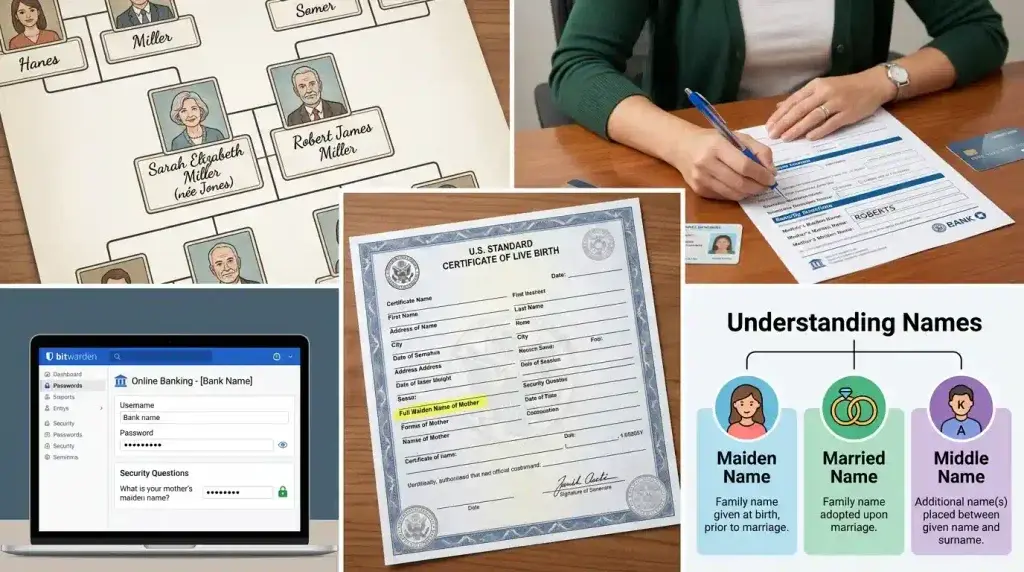
Let’s break the phrase into parts. “Mother” means the woman who gave birth to you or raised you as her child, depending on the form. “Maiden name” means the last name a woman had before marriage. Put them together, and you get the last name your mom carried as a girl and young woman.
Here is a helpful way to remember it. Think of a family tree. Your mother sits one step above you. Her birth family has its own last name. That name is her maiden name, even if she has not used it for many years. It does not disappear. It stays part of her history and her legal birth record.
One important point: a maiden name is not the same as a middle name. Some women use their maiden name as a middle name after marriage. For example, Sarah Jane Carter might become Sarah Carter Brooks. In that case, Carter appears in the middle, but it is still her maiden name.
The phrase is also not about whether the mother is married today. A woman who is divorced, widowed, or still married all have a maiden name. A woman who never married has one too, but it is simply her birth last name, which she still uses.
Why the Word “Maiden” Is Used
The word “maiden” is an old English word for a young, unmarried woman. Over time, “maiden name” became the common way to describe the surname a woman used before marriage. The phrase has been part of English for a very long time, though I could not confirm an exact date for when it first appeared, so I will not guess.
The idea grew out of a long tradition in English-speaking countries. In many families, a woman took her husband’s last name when she married. Under old English law, a married woman’s legal identity was largely folded into her husband’s. That is one reason the custom became so common. Today the rules are very different. In the United States, a woman is generally free to keep her birth name, take her spouse’s name, hyphenate, or choose another option.
Some people find the word “maiden” outdated. Because of that, you will often see forms use other wording, such as “birth surname,” “surname at birth,” or “family name at birth.” They all mean the same thing in this context.
Why Banks, Schools, and Websites Ask for It
You might wonder why so many places want this one detail. There are two main reasons: identity checks and family records.
For identity, a mother’s maiden name has long been used as a security question. The thinking was that it is something you know well, but a stranger would not easily guess. Banks, credit card companies, and phone providers have used it for decades to confirm that you are really you.
For records, the name helps connect people to their families. Hospitals may ask for it on birth paperwork. Governments use it when issuing certain documents. Genealogists, who study family history, rely on it to trace family lines back in time, because women’s birth names often show where a family tree branches.
Here is a quick look at where you may see this question.
| Where You See It | Why They Ask |
| Bank or credit card account | To confirm your identity over the phone or online |
| Birth certificate application | To record both parents’ full birth names |
| Passport or travel forms | To match your family details with official records |
| School or college forms | To complete family background information |
| Family history websites | To trace relatives and link family trees |
| Online account recovery | To act as a backup security question |
Not every form uses the information in the same way, but the meaning stays the same each time.
How to Find Your Mother’s Maiden Name
For most people, this is easy. You simply ask your mom. But what if you cannot ask, or you are not sure? There are several reliable places to look.
Start with your own birth certificate. In many places, it lists your mother’s full name at birth. Marriage records are another strong source, since they often show a woman’s birth name next to her spouse’s name. Old family papers, such as baptism records, family Bibles, and letters, can also help. Other relatives, like grandparents, aunts, and uncles, are often happy to share family stories and names.
If you are still stuck, online family history sites and local archives can help. Public records vary by state and country, and some are not free. Always be careful when sharing personal details on any site, and use only trusted sources.
Special Cases That Can Cause Confusion
Real families do not always fit a neat pattern. Here are some common situations and how to handle them.
Your mother married more than once. Her maiden name stays the same no matter how many times she marries. It is always her name at birth, not the name from her first or second marriage.
Your mother kept her birth name. If she never changed her name, her maiden name is simply her current last name. Many forms still want the answer, and you just write that name.
Your mother uses a hyphenated name. Say her name is Maria Lopez-Brooks. Her maiden name is likely Lopez, and Brooks is the name she added. Check her birth record if you are unsure.
You were adopted. This depends on the form. If the question refers to your legal mother, use the name of your adoptive mother. If it asks about your birth mother, you will need her birth name from your records. Read the question carefully.
You have two mothers or a different family setup. Many forms are changing to be more flexible. If a form asks for “mother’s maiden name,” answer using the parent who fits that question best, or contact the organization to ask how to proceed.
Your family follows another naming tradition. In many cultures, women keep their birth names after marriage. In others, names follow different patterns. In those cases, the name your mother had at birth is still the answer.
Mother Maiden Name Meaning in Different Situations
The meaning stays steady, but the way you apply it can shift a little. This table shows how it works in common cases.
| Situation | What to Use as the Maiden Name |
| Mother married once and changed her name | Her last name before the marriage |
| Mother married twice | Her original birth last name |
| Mother never changed her name | Her current last name, which is also her birth name |
| Mother uses a hyphenated name | The part she had at birth, usually the first part |
| Mother is divorced and went back to her birth name | Her birth name, which is the one she returned to |
| You were adopted | The name of the mother the form is asking about |
If a form is unclear, look for a help link or call the organization. It is always better to ask than to guess.
Is It Safe to Use as a Security Answer?
Here is something worth knowing. A mother’s maiden name is not as secret as it used to be. For many families, it can be found in public records, old newspaper notices, and family tree websites. Social media can also give clues. If a person posts a family tree, tags relatives, or shares old photos, someone could piece the name together.
Because of this, many security experts now say a mother’s maiden name is a weak security answer. A scammer who studies your family online may be able to guess it. That does not mean you should panic. It simply means you should treat it with care.
A few simple habits can help. Avoid sharing your mother’s birth name in public posts or quizzes. Be careful with fun social media games that ask for family names, since some are designed to collect answers to common security questions. Also, think twice before listing family relationships in detail on public profiles.
Better Ways to Answer Security Questions
If a website asks for your mother’s maiden name, you do not always have to give the true answer. Many security experts suggest treating the answer like a password. That means you can enter a made-up answer, as long as you can remember it.
One option is to use a random phrase or a long made-up word. Another is to store the answer in a password manager, which is a tool that safely keeps your logins and notes. This way, even if someone knows your real family history, they cannot get into your account by guessing.
Whenever a site offers stronger protection, take it. Two-step verification, which sends a code to your phone or email, is much safer than any security question. Passkeys and authenticator apps are strong choices too. Use security questions only when there is no better option, and make your answers hard to guess.
Common Mistakes to Avoid
People make a few easy errors with this question. Knowing them can save you time and stress.
| Mistake | What to Do Instead |
| Using your mother’s current married name | Use her last name from before marriage |
| Using your own last name by habit | Check what your mother’s birth name was |
| Using your father’s mother’s name | Make sure you mean your mother’s own birth name |
| Spelling the name differently each time | Pick one spelling and keep it consistent |
| Posting the name on social media | Keep it private and off public pages |
| Forgetting a made-up answer | Save it in a password manager |
The spelling issue deserves special attention. Last names can have several spellings, like Smith and Smyth or Johnson and Johnston. If a site checks your answer exactly, a small spelling change could lock you out. Write down the spelling you choose.
Real Life Examples
Let’s look at a few quick stories to see how this works.
Imagine a young man named Daniel. His mother is Anna Rivera-Cole, and her birth name was Anna Rivera. When Daniel opens a bank account, the form asks for his mother’s maiden name. He writes about Rivera. That is correct, because Cole came from her marriage.
Now picture a woman named Priya who is setting up a new email account. She sees the security question about her mother’s maiden name. She knows it is easy to find online because of a family tree her cousin posted. So she creates a made-up answer, saves it in her password manager, and turns on two-step verification. Her account is much safer.
Last, think of Tom, who was adopted as a baby. A government form asks for his mother’s maiden name. Tom reads the question closely. It asks about his legal mother, so he lists his adoptive mother’s birth name. When he is unsure, he calls the office, and they confirm his choice.
These small stories show that the idea is simple, but the details matter.
Current Usage and Trends
Times are changing. Many companies are moving away from security questions about family names, because those answers can be too easy to find. Instead, they use text-message codes, authenticator apps, and fingerprint or face login. Some forms are also changing their wording to be more inclusive of different families, using phrases like “parent’s surname at birth.”
Even so, you will still see this question in many places, especially on older systems, in some government paperwork, and in family history research. It is a good idea to know the meaning, even if you do not always use the real answer for security.
Naming customs are shifting too. More women today keep their own names after marriage, use both names, or choose a new name with their partner. Because of this, the idea of a “maiden name” is changing in everyday life. Still, the question remains common, and the meaning has not changed.
Tips and Best Practices
Here are a few practical ideas to keep in mind.
Write down your mother’s full birth name now, and keep it somewhere safe. This helps if you ever need it for a form and cannot reach family. Talk with older relatives about family names and spellings, which also helps preserve your family story. Check each form carefully, since the wording may differ from one place to another. Use a password manager for any made-up security answers. Finally, switch on two-step verification wherever you can, so you are not relying on a single question to protect your account.
FAQs
What does mother maiden name mean in simple words?
It means the last name your mother had when she was born, before she got married. It is usually her father’s last name.
Is my mother’s maiden name the same as her middle name?
Not always. Some women do use their maiden name as a middle name after marriage, but the two are different ideas. A maiden name is a birth last name, while a middle name is just a middle name.
What if my mother never changed her last name?
Then her maiden name is the same as her current last name. You can write that name on any form that asks.
Why do banks ask for my mother’s maiden name?
Banks have used it to check your identity, because it was once seen as private information. Today, many banks are moving to safer methods, like one-time codes sent to your phone.
Is it safe to share my mother’s maiden name online?
It is best to be careful. This detail can often be found through public records and family trees, so avoid posting it on social media or in online quizzes.
Do I have to give my real mother’s maiden name on websites?
For security questions, many experts say you can use a made-up answer, as long as you remember it. For legal or government forms, you should always give the true name.
Conclusion
The mother maiden name’s meaning comes down to one clear idea: it is the last name your mother was born with, before any change from marriage. It may sound like a small detail, but it shows up on banking forms, official records, and family history projects. Knowing the right answer helps you move through paperwork with less stress.
Remember that special cases, like adoption, remarriage, or hyphenated names, are very common, so do not worry if your family story is not simple. Read each form closely, and ask for help when the wording is unclear. Most of all, protect this information online. Because it can be easy to find, treat it like a password, use made-up answers for security questions when that is allowed, and turn on stronger protection like two-step verification. A little care today can keep your accounts and your family details safe for years to come.

Hi, I’m Sarah Mitchell. I love writing faith-based content that brings peace, hope, and encouragement to everyday life. Through prayers and devotionals, my goal is to help readers feel closer to God and stronger in faith.