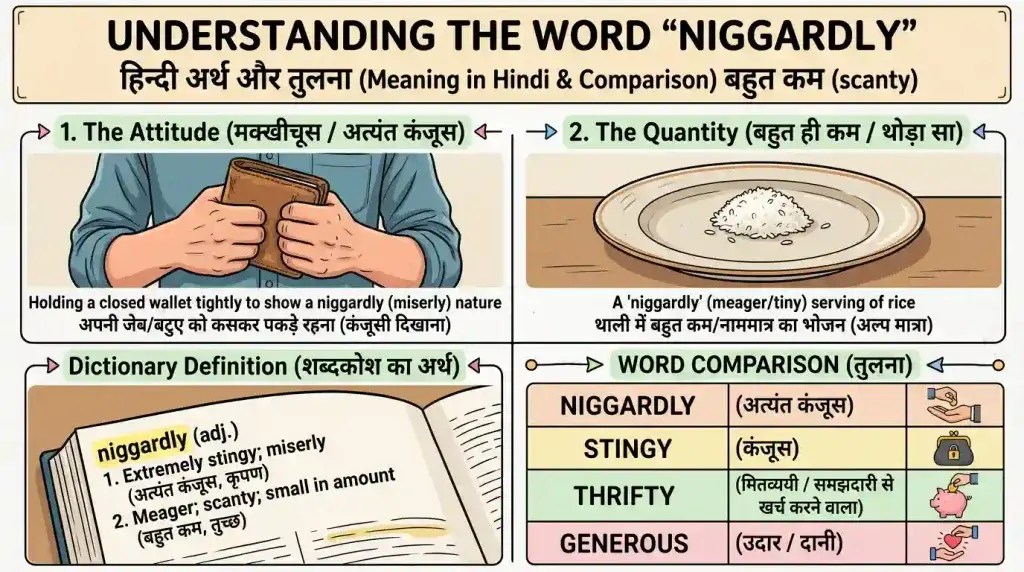
Have you ever come across a strange English word and wondered what it means in Hindi? “Niggardly” is one of those words. The niggardly meaning in Hindi is कंजूस (kanjoos), which means stingy, or unwilling to spend or give. It is an old English word for a person who holds on to money too tightly. It can also describe something very small or scanty, like a niggardly portion of food.
Many readers search for it after seeing it in a book, an exam, or a news story. Some also want to know why the word sometimes causes confusion. In this guide, you will learn the Hindi words, how to use it, where it came from, and why many people now choose other words. You will also find easy examples, tables, and clear answers.
Niggardly Meaning in Hindi: The Quick Answer
“Niggardly” is an adjective that means stingy, miserly, or very unwilling to spend or give. In Hindi, the best matches are कंजूस (kanjoos) and कृपण (kripan). It is pronounced “NIG-erd-lee.”
Here is a simple example: “He was niggardly with his money.” In Hindi, that is: “वह अपने पैसे खर्च करने में कंजूस था।”
The word has a second meaning, too. It can describe something that is tiny, weak, or not enough. A “niggardly amount” means a very small amount, in Hindi अल्प or बहुत थोड़ा.
What Does Niggardly Really Mean?
Let’s look at the word more closely. “Niggardly” has two main meanings, and both are about having or giving too little.
The first meaning is about people. A niggardly person does not like to spend money, share things, or give help. They hold on to what they have, even when they could easily give a little. Think of a man who never tips at a restaurant, even after great service. That is niggardly behavior.
The second meaning is about amounts. When something is niggardly, there is not enough of it. A niggardly meal is small and thin. A niggardly raise at work is so tiny that it feels like an insult. Here the word describes the size, not a person’s character.
The word can also work as an adverb. If someone gives “niggardly,” they give in a stingy way. This use is rare today, but you may still see it in older books.
Notice that the word is almost always negative. Calling someone niggardly is not a compliment. It suggests that the person is selfish or too careful with money. If you want a kinder word for someone who saves money wisely, “thrifty” or “frugal” is a better choice.
Hindi Words for Niggardly
Hindi has many words that match “niggardly.” Each one has its own flavor. This table shows the most common ones.
| Hindi Word | How to Say It | Meaning | Best Used When |
| कंजूस | kanjoos | Stingy | Everyday talk, the most common match |
| कृपण | kripan | Miserly | Formal or written Hindi |
| मक्खीचूस | makkhichoos | Extremely stingy | Casual, funny, or strong insult |
| अनुदार | anudaar | Not generous | Describing a person’s nature |
| अल्प | alp | Small, scanty | Describing a small amount |
| तुच्छ | tuchchh | Petty or very small | Describing a tiny portion |
If you need just one word, use कंजूस. Almost every Hindi speaker will understand it right away. If you are writing something formal, such as a school essay, कृपण may sound more polished.
The word मक्खीचूस is a fun one. It literally means “one who sucks a fly,” a joke about someone so stingy that he would not let even a fly go to waste. It is a casual word, so use it only with friends and family.
For the second meaning, “very small or not enough,” Hindi speakers often use अल्प or बहुत कम. For example, “a niggardly salary” can be “बहुत कम वेतन.”
How to Use Niggardly in a Sentence
Using this word is easy once you know the patterns. It usually describes a person, a gift, a payment, or an amount. It often appears with the word “with,” as in “niggardly with money.”
Here is a table of common patterns with Hindi meanings.
| Pattern | English Example | Hindi Meaning |
| niggardly + person | “He is a niggardly man.” | वह एक कंजूस आदमी है। |
| niggardly with + thing | “She is niggardly with praise.” | वह तारीफ़ करने में कंजूसी करती है। |
| a niggardly + amount | “They paid a niggardly sum.” | उन्होंने बहुत थोड़ी रकम दी। |
| niggardly + gift | “It was a niggardly gift.” | वह एक कंजूसी भरा तोहफ़ा था। |
| not niggardly | “He was not niggardly at all.” | वह बिल्कुल कंजूस नहीं था। |
A few grammar notes can help. First, “niggardly” is an adjective, so it describes a noun. Second, when you want to talk about being stingy with something, add “with.” For example, “niggardly with his time.” Third, the word is fairly formal and a bit old-fashioned. In daily speech, most people simply say “stingy” or “cheap.”
Real Life Examples of Niggardly
Examples make a word easier to remember. Here are some situations where this word fits.
| Situation | Example | Hindi Idea |
| Money habits | “He is too niggardly to buy a gift.” | इतना कंजूस कि तोहफ़ा भी नहीं ख़रीदता |
| Giving praise | “The coach was niggardly with compliments.” | तारीफ़ में कंजूसी |
| A small meal | “We got a niggardly serving of rice.” | चावल की बहुत कम मात्रा |
| A low payment | “The job offered a niggardly salary.” | बहुत कम वेतन |
| Time and help | “She was niggardly with her time.” | समय देने में कंजूस |
Now let’s look at a few short stories.
Mr. Sharma owned a small shop in a busy market. He never gave his workers a bonus, even during festival time. One worker said quietly, “He is so niggardly.” The word fit well, because Mr. Sharma could easily afford to give a little, but he chose not to.
Anita cooked a big dinner for her guests, but her uncle only left a small tip for the delivery boy who brought the sweets. Her cousin whispered, “That was a niggardly tip.” It means the tip was far too small for the service.
A teacher once said, “The author is niggardly with details in the first chapter.” She meant that the writer gave only a few details and left readers wanting more.
You can see that the word works for money, but also for praise, time, food, and details. In every case, there is “less than expected.”
Where Does Niggardly Come From?
The history of this word is old, and it is worth getting right, because there is a lot of confusion online.
Language experts generally agree that “niggardly” entered English in the Middle Ages, around the 1300s. It likely came from Scandinavian languages, where similar words described stingy or miserly people. An older English form, “nigard,” meant a miser. Over time, the “-ly” ending was added to make it an adjective.
Here is the most important point. The word “niggardly” has no connection to the hurtful racial slur that looks and sounds similar. The two words come from completely different roots. The slur comes from a word that means “black” in Latin, while “niggardly” comes from an older word for stinginess. Dictionaries such as Merriam-Webster and the Oxford English Dictionary make this clear.
So the sound is similar by chance, not by history. Still, that chance has caused real problems, which we will talk about next.
What we do not know for sure is the exact first use. Language changes slowly, and no one person is credited with creating the word. If you see a site that gives an exact date and name, be careful. It is safest to say that the word grew out of older Scandinavian and English words.
Why Do Some People Avoid the Word Niggardly?
This is a very common question, and it is a big reason people search for this word. Because “niggardly” sounds so much like a hurtful slur, some listeners hear it and feel upset, even though the two words are not related.
A famous example happened in 1999 in Washington, D.C. A city worker used the word “niggardly” while talking about a budget. Some people who heard it misunderstood and were offended, and the worker resigned. After the public learned the word’s true meaning, the city’s mayor invited him back, and he returned to work in a different role. The story became a well-known lesson about how word sounds can cause trouble.
What should you do? The word is correct English, and no dictionary calls it offensive. But many writers and speakers now avoid it, simply because it can distract or hurt people. If your goal is to be clear and kind, using “stingy,” “miserly,” or “tightfisted” is easy and safe.
Think of it this way. A good speaker picks words that help the listener understand. If a word may cause pain or confusion, a simple swap saves everyone the trouble. That is not about being afraid of language. It is about caring for the people you talk to.
If you do see the word in an old book, a test, or a news story, you now know what it means. You can read it calmly and understand it as “stingy.”
Niggardly vs. Similar Words
Many words in English describe someone who does not like to spend. They are close in meaning, but each has a different feel. This table shows how they compare.
| English Word | Hindi Word | Feel | Positive or Negative |
| Niggardly | कंजूस / कृपण | Stingy, very unwilling to give | Negative |
| Stingy | कंजूस | Common, everyday word | Negative |
| Miserly | कृपण / कंजूस | Hoarding money, like a miser | Negative |
| Tightfisted | मक्खीचूस | Very tight with money | Negative |
| Cheap | कंजूस / सस्ता | Casual, can also mean low price | Usually negative |
| Thrifty | मितव्ययी | Careful with money, wise | Positive |
| Frugal | किफ़ायती | Saves money on purpose | Positive |
| Generous | उदार / दानी | Gives freely | Positive |
Here is a helpful way to think about it. “Thrifty” and “frugal” describe people who save money in a smart way. They are often praised. “Stingy,” “miserly,” and “niggardly” describe people who save too much and hurt others by not giving or sharing. They are usually criticized.
The opposite of “niggardly” is “generous” or “liberal.” In Hindi, these are उदार (udaar), दानी (daani), and दरियादिल (dariyadil).
If you want a smoother, everyday choice, “stingy” is the best swap. It carries the same meaning without any confusion.
Is Niggardly a Positive or Negative Word?
The word is negative. It describes someone who is selfish with money, time, or kindness, or something that is unfairly small.
That said, there is a small difference between “niggardly” and “thrifty.” A thrifty person plans well and spends wisely. A niggardly person refuses to give or spend even when it would be fair or kind to do so. For example, saving money for a rainy day is thrifty. Refusing to give a fair wage to a hardworking helper is niggardly.
Because the word is negative, it is best used with some care. Calling a friend niggardly may sound rude. Using a lighter word like “careful with money” may be kinder if the person is simply saving.
Common Mistakes to Avoid
Even simple words can trip people up. Here are the mistakes that show up most often.
The first mistake is thinking the word is connected to a hurtful slur. As we saw, the two words have different roots. The word is correct, but it is wise to be aware of how it may sound to listeners.
The second mistake is using it as a compliment. Some learners think it means “careful” or “thrifty.” It does not. It carries a negative tone.
The third mistake is mixing it up with similar-sounding words. “Niggling” means small and annoying, like a niggling doubt. It is a different word with a different meaning.
The fourth mistake is using it when a simpler word works better. In casual talk, “stingy” is easier to say and easier to understand.
The fifth mistake is translating it with a word that is too weak. “Careful” in Hindi (सावधान) is not the same thing. Use कंजूस or कृपण for the right feeling.
Last, avoid using the word to describe a group of people. Describing a whole community as stingy can be unfair and hurtful. Stick to describing a specific person’s behavior or a specific amount.
How People Use Niggardly Today
Today, the word is much less common than it used to be. You may still find it in a few places.
In older books and classic stories, authors used it to describe misers, tight budgets, and small rewards. If you read old novels, you will probably meet it.
In school tests and vocabulary lists, it appears as a tricky word to learn. Students preparing for English exams may see it among words about money and character.
In news and business writing, it is rare. Writers often choose “stingy,” “meager,” or “inadequate” instead.
In everyday speech, very few people say it. Many native speakers have never used it. That is part of why so many readers search for its meaning.
One trend is worth noting. As people become more careful about how words sound, “niggardly” has slowly faded from daily use. It remains in dictionaries and in older writing, but most modern writers prefer clear and simple alternatives.
Tips for Learning and Using Niggardly
If you want to remember this word, a few easy habits will help.
Link it to a Hindi word. Whenever you see “niggardly,” think “कंजूस.” That one connection can last a long time.
Use it in a practice sentence. Write one sentence about a stingy person and one about a very small amount. Seeing both meanings helps the word stick.
Learn the opposites, too. Words like “generous” and “liberal” make the meaning clearer by contrast.
Consider using “stingy” in real life. For conversation and writing, a simpler word is usually the best choice.
Know the background. Understanding the word’s history makes it easy to stay calm if you hear it, and to explain it to others kindly.
Read the word in context. When you see it in a book or article, look at the sentences around it. They often give hints about whether the writer means “stingy” or “very small.”
Finally, trust your judgment. If you are not sure how your listener will react, pick a different word.
FAQs
How do you say niggardly in Hindi?
The most common Hindi words are कंजूस and कृपण. For a very stingy person, people also say मक्खीचूस in casual talk.
Is niggardly related to a racial slur?
No. The word comes from older Scandinavian and English roots meaning stingy. The slur comes from a different source. The two only sound alike by chance.
Is niggardly an offensive word?
Dictionaries do not list it as offensive. But because it sounds like a hurtful slur, some people may misunderstand it. Many speakers choose “stingy” or “miserly” to avoid confusion.
What is the opposite of niggardly?
The opposite is “generous.” In Hindi, that is उदार (udaar), दानी (daani), or दरियादिल (dariyadil).
What are some good words to use instead of niggardly?
You can use “stingy,” “miserly,” “tightfisted,” or “cheap.” For amounts, you can say “meager,” “scanty,” or “very small.”
Conclusion:
The niggardly meaning in Hindi is easy to remember: it is कंजूस, a person who is stingy and unwilling to spend or give. The word can also describe an amount that is very small or not enough. It is a negative word, and it is a close cousin of “miserly” and “stingy.”
We also learned an important fact. Even though “niggardly” sounds like a hurtful racial slur, the two words are not related. The word comes from older Scandinavian and English roots. Still, because of the similar sound, many people choose simpler words like “stingy” to keep their message clear and kind.
So here is some practical advice. Learn the word so you can understand it in books and tests. Link it to कंजूस in your mind. In daily life, pick the clearest and kindest word for your listener. Good communication is about being understood, and a simple word often does the job best.

Hello, I’m Clara Whitmore. I write daily prayers, devotionals, and faith-based reflections for readers seeking peace and encouragement. I believe prayer has the power to heal hearts and renew faith.