
You’re at a café in Madrid, juggling your phone and a fresh cortado, when your elbow knocks the cup straight onto the table. Coffee everywhere. You blurt out an apology in your clumsiest Spanish, bracing for a scolding. Instead, the waiter smiles, grabs a cloth, and says, “No pasa nada.”
So what is the no pasa nada meaning? In everyday Spanish, it means “it’s okay,” “no worries,” or “don’t worry about it.” Though the words literally translate to “nothing happens,” native speakers use the phrase to brush off mistakes, calm worries, and keep things relaxed.It’s one of the most common expressions you’ll hear in Spain and Latin America, and one of the most useful to know.
In this guide, you’ll learn what it means, how the grammar works, when to use it, and which alternatives sound natural. You’ll also see real dialogues, regional differences, and common mistakes to avoid.
Quick Answer: What Does “No Pasa Nada” Mean?
“No pasa nada” is a Spanish expression meaning “it’s okay,” “no worries,” or “no big deal.” Word for word, it translates to “nothing happens.” Spanish speakers use it to reassure someone after a mistake, an apology, or a small problem.
Pronunciation: noh PAH-sah NAH-dah
Literal Meaning vs. Real Meaning
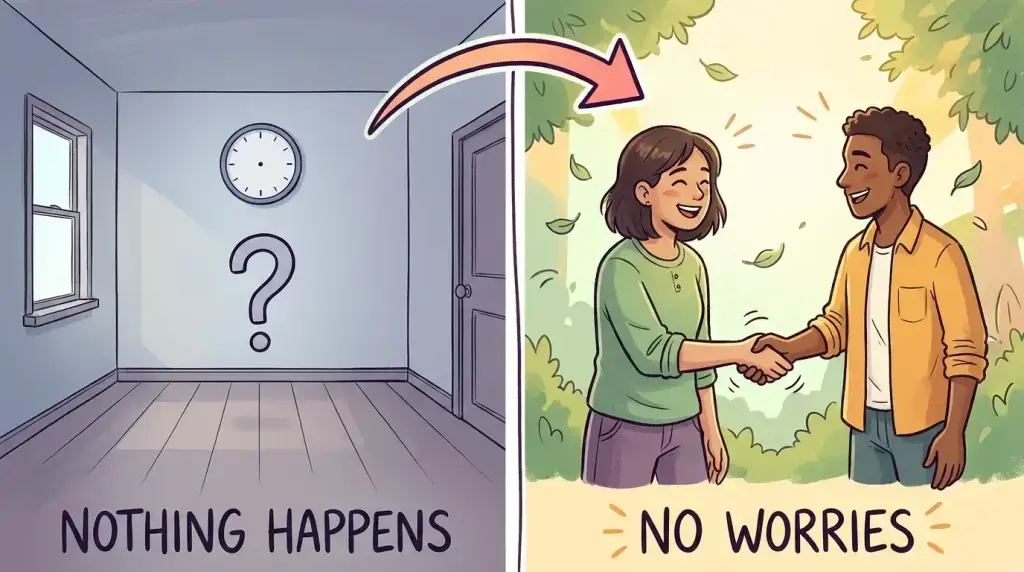
Translate the phrase word by word and you get “no” (not), “pasa” (happens), and “nada” (nothing). The literal result is “nothing happens,” which sounds odd in English.
Spanish speakers hear something different. The phrase carries the idea that nothing serious has occurred, so there’s nothing to worry about. The speaker is telling you the situation is under control.
Depending on the context, natural English equivalents include:
- No worries
- It’s fine
- It’s all good
- No big deal
- Don’t mention it
- Never mind
- It doesn’t matter
A word-for-word translation misleads learners because the phrase works as a social signal, not a report of events. A waiter who says “no pasa nada” after you spill a drink isn’t claiming that nothing happened. He is telling you that the spill doesn’t matter and that you can relax.
Keep this in mind whenever you translate Spanish idioms. Meaning travels through context and intention, and individual words often carry less weight than you’d expect.
Grammar Breakdown
The phrase looks simple, yet it contains a few grammar points worth understanding.
The Verb Pasar
Pasar is one of the most flexible verbs in Spanish. Depending on the sentence, it can mean “to happen,” “to pass,” “to spend time,” or “to come in.” In “no pasa nada,” it carries the sense of “to happen.” The same verb appears in the everyday question ¿Qué pasa?, which means “What’s going on?”
Spanish Double Negatives
English learners often feel uneasy about “no… nada,” because English treats double negatives as an error. Spanish works differently. When a negative word such as nada, nadie, or nunca follows the verb, the verb needs no in front of it. So “no pasa nada” is perfectly correct, and “pasa nada” on its own would sound wrong in standard Spanish.
Present Tense, General Meaning
The present tense here doesn’t describe an action happening right now. It expresses a general reassurance: nothing bad is happening, and nothing bad will follow.
Related Forms
The phrase changes with the situation. Here are the most common variations:
| Form | Meaning | Example |
| No pasa nada | It’s okay / no worries | Perdona el retraso. No pasa nada. |
| No pasó nada | Nothing happened | Tranquila, no pasó nada. |
| No ha pasado nada | Nothing has happened | No ha pasado nada grave. |
| No va a pasar nada | Nothing is going to happen | No va a pasar nada si preguntas. |
| No me pasa nada | Nothing is wrong with me | Estoy bien, no me pasa nada. |
| No pasa nada si… | It doesn’t matter if… | No pasa nada si llegas tarde. |
The Different Meanings and Uses of “No Pasa Nada”
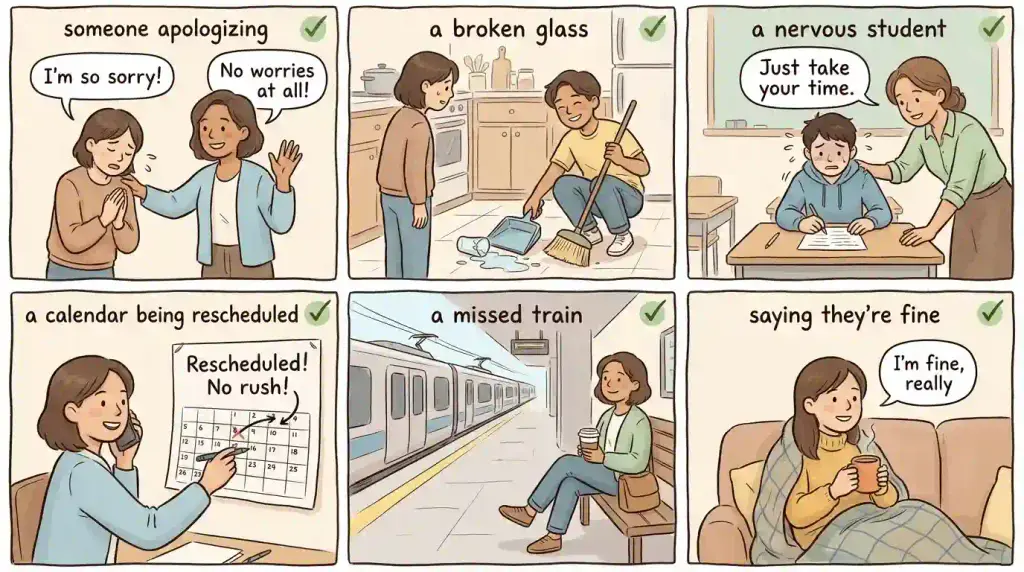
Although it usually means “no worries,” the phrase adapts to several situations. Knowing each one helps you sound natural.
1. Responding to an Apology
This is the most common use. When someone says sorry, “no pasa nada” tells them to let it go.
Perdona, llego tarde. (Sorry, I’m late.)
No pasa nada, acabamos de empezar. (No worries, we just started.)
2. Reassuring Someone Who Made a Mistake
If a friend breaks a glass or sends the wrong file, the phrase softens the moment.
Se me ha caído el vaso. (I dropped the glass.)
No pasa nada, yo lo recojo. (It’s fine, I’ll pick it up.)
3. Calming an Anxious Person
Here, the phrase works as comfort. You are promising that nothing bad will come of the situation.
Tengo miedo de suspender el examen. (I’m afraid of failing the exam.)
No pasa nada, puedes repetirlo. (It’s okay, you can retake it.)
4. Showing Flexibility or Giving Permission
Used with si, the phrase signals that a change of plans is fine.
No pasa nada si lo dejamos para mañana. (It’s no problem if we leave it until tomorrow.)
5. Minimizing a Problem
A late train, a typo, or a small spill can all be waved away with this phrase. It keeps the mood light and stops people from dwelling on minor setbacks.
6. Answering “¿Qué te pasa?”
When someone asks what’s wrong, you can reply “No me pasa nada” to say that nothing is bothering you. Be aware that the answer sometimes sounds unconvincing, much like “I’m fine” in English.
¿Qué te pasa? Estás muy callado. (What’s wrong? You’re very quiet.)
Nada, no me pasa nada. (Nothing, I’m fine.)
7. Sarcastic or Dismissive Use
Occasionally, speakers use the phrase ironically. Imagine a politician insisting “aquí no pasa nada” while the room is clearly in chaos. In such cases, tone of voice reveals the real message: the speaker is pretending that a problem doesn’t exist.
Tone, Register, and Context
Most of the time, “no pasa nada” sits between informal and neutral. You can say it to friends, family, coworkers, and strangers without causing offense.
How Tone Changes the Message
Delivery matters more than the words. Said warmly with a smile, the phrase feels kind and generous. Said flatly or with a shrug, it can sound careless.
When to Be Careful
Avoid it when someone has made a serious mistake or is genuinely upset. If a colleague loses an important client file, a quick “no pasa nada” may feel like you’re ignoring the problem. In those moments, acknowledge the situation first, then offer reassurance.
Softeners and Intensifiers
Native speakers often add small words to shape the tone:
- No pasa nada, de verdad. (It’s really okay.)
- No pasa nada, hombre / mujer. (Come on, it’s fine.)
- Tranquilo/a, no pasa nada. (Relax, it’s okay.)
- No pasa absolutamente nada. (Absolutely nothing is wrong.)
These additions make the phrase sound more sincere and personal.
Example Dialogues
Seeing the phrase in context helps it stick. Each dialogue below includes an English translation.
At a Restaurant
Perdone, he derramado el agua.
No pasa nada, ahora le traigo otra.
“Excuse me, I spilled the water.”
“No problem, I’ll bring you another.”
Between Friends
Siento no haber llamado antes.
No pasa nada, sé que has tenido un día complicado.
“I’m sorry I didn’t call sooner.”
“It’s okay, I know you’ve had a rough day.”
At Work
Me he equivocado en el informe.
No pasa nada, lo corregimos antes de la reunión.
“I made a mistake in the report.”
“No worries, we’ll fix it before the meeting.”
Parent and Child
Mamá, he roto el juguete.
No pasa nada, cariño. Lo arreglamos juntos.
“Mom, I broke the toy.”
“It’s okay, sweetie. We’ll fix it together.”
Traveling
Lo siento, he perdido el autobús.
No pasa nada, sale otro dentro de media hora.
“Sorry, I missed the bus.”
“It’s fine, another one leaves in half an hour.”
A Text Message Exchange
Uf, creo que llegaré con diez minutos de retraso.
Tranqui, no pasa nada. Te esperamos.
“Ugh, I think I’ll be ten minutes late.”
“Relax, it’s fine. We’ll wait for you.”
Regional and Cultural Notes
Where It’s Used
The phrase is extremely common in Spain, where you’ll hear it dozens of times a day. Speakers across Latin America understand it and use it too, though other expressions compete with it in some countries.
Pronunciation Differences
In parts of southern Spain, speakers often drop final consonants and soften syllables. As a result, “no pasa nada” may sound closer to “no pasa ná.” Don’t be thrown off if you hear this version, because the meaning stays the same.
Regional Preferences
Different regions lean toward different alternatives:
- Spain: no pasa nada, no te agobies, tranqui
- Mexico: no hay problema, no te preocupes, ni modo (for situations that can’t be changed)
- Argentina and Uruguay: no pasa nada, tranqui, quedate tranquilo
- Colombia: no pasa nada, tranquilo, no hay problema
These are tendencies, not strict rules, and speakers within each country vary.
The Cultural Attitude
Many learners connect the phrase to a relaxed outlook on time and small mishaps. There’s some truth in that, since Spanish-speaking cultures often value warmth and flexibility in social situations. Still, treat the idea with care. It’s a stereotype, and plenty of people in these countries are punctual, organized, and serious about deadlines. The phrase simply reflects a habit of keeping minor problems in proportion.
Similar Phrases and Alternatives
Spanish offers many ways to say “no worries.” Choosing the right one depends on formality and region.
| Phrase | Meaning | Formality | Best used when |
| No pasa nada | It’s okay | Neutral | Responding to apologies or small mistakes |
| No hay problema | No problem | Neutral | Confirming a request is fine |
| Ningún problema | No problem at all | Neutral | Being extra polite |
| No te preocupes | Don’t worry | Informal | Comforting a friend |
| No se preocupe | Don’t worry | Formal | Speaking to strangers or elders |
| Tranquilo/a | Relax / calm down | Informal | Reassuring someone nervous |
| No importa | It doesn’t matter | Neutral | Dismissing a minor issue |
| No es nada | It’s nothing | Neutral | Downplaying a small favor or problem |
| No es para tanto | It’s not that big a deal | Informal | Cooling down an overreaction |
| Está bien | It’s fine | Neutral | Accepting an apology or situation |
| Pelillos a la mar | Let’s forget it | Informal, idiomatic | Making peace after a minor quarrel |
Choosing the Right One
In formal settings, such as speaking with a client or an older person, no se preocupe or no hay problema feels safer. With friends and family, no pasa nada, tranqui, and no te agobies sound more natural. Idioms like pelillos a la mar add color, though they’re better saved for casual conversation.
Easily Confused Phrases

A few expressions look or sound similar but mean something different.
No Pasa Nada vs. De Nada
This is the most common mix-up. De nada means “you’re welcome,” and you say it after someone thanks you. No pasa nada means “it’s okay,” and you say it after someone apologizes. Mixing them up can lead to confusing exchanges.
No Pasa Nada vs. No Es Nada
No es nada literally means “it’s nothing.” It often downplays a small injury, favor, or concern. For example, after someone asks about a scratch, you might say, “No es nada.” The phrase no pasa nada focuses more on reassurance after a mistake.
No Pasa Nada vs. No Importa
No importa means “it doesn’t matter.” It’s a bit more direct and can sometimes sound colder. No pasa nada tends to feel warmer and more comforting.
¿Qué Pasa?
Without the negative, ¿Qué pasa? means “What’s happening?” or “What’s up?” Depending on the tone, it can be a casual greeting or a worried question about a problem.
Common Mistakes Learners Make
Even advanced students slip up with this phrase. Watch out for these pitfalls.
1. Saying it when you should apologize. If you step on someone’s foot, “no pasa nada” isn’t your line. Offer perdón or lo siento first. The phrase is for the person receiving the apology.
2. Confusing it with de nada. Remember that de nada answers “thank you,” while no pasa nada answers “sorry.”
3. Translating it literally. Telling an English speaker “nothing happens” in a conversation would confuse them. Always convert it to an equivalent such as “no worries.”
4. Misplacing the stress. The emphasis falls on the first syllable of pasa and nada: PA-sa NA-da. Stressing the wrong syllables makes the phrase harder to recognize.
5. Overusing it in serious situations. In moments of real conflict or loss, the phrase may sound dismissive. A more thoughtful response shows respect.
6. Forgetting the double negative. Remember that Spanish requires no before the verb here. Dropping it breaks the grammar.
How to Practice
Reading about a phrase helps, but using it makes it stick. Try these exercises.
Quick Exercises
- Complete the dialogue. Perdona, se me ha olvidado el libro.
- Translate. “It’s okay if we start later.”
- Choose the right phrase. After someone says gracias, do you say de nada or no pasa nada?
- Switch the tense. Change “no pasa nada” to the past: “nothing happened.”
- Role-play. With a study partner, act out a spilled drink, a missed train, and a late arrival.
Listening Tips
Spanish TV series, podcasts, and YouTube channels are full of this phrase. Listen for it, notice the tone, and pay attention to what happens just before it. Over time, you’ll recognize the rhythm and feel for when it fits.
A Weekly Challenge
For the next seven days, try using “no pasa nada” at least once a day, in Spanish conversations or in your own head. Keep a short note of each situation. By the end of the week, the phrase will feel familiar.
Quick Recap and Cheat Sheet
- Meaning: it’s okay, no worries, no big deal
- Literal translation: nothing happens
- Pronunciation: noh PAH-sah NAH-dah
- Use it when: someone apologizes, makes a small mistake, or feels worried
- Alternatives: no hay problema, no te preocupes, tranquilo/a, no importa
- Don’t confuse it with: de nada (you’re welcome)
- Tone tip: say it warmly, and avoid it when someone is truly upset
Frequently Asked Questions
What does “no pasa nada” mean in English?
It means “no worries,” “it’s okay,” or “it’s no big deal.” The literal translation is “nothing happens.”
Is “no pasa nada” formal or informal?
It sits between neutral and informal. You can use it in most everyday situations, though no se preocupe is a safer choice in very formal settings.
What is the difference between “no pasa nada” and “de nada”?
De nada means “you’re welcome” and follows a thank-you. No pasa nada means “it’s okay” and follows an apology or small mistake.
Can I say “no pasa nada” to my boss?
Yes, in most workplaces it’s fine, particularly for small issues. For serious problems, acknowledge the situation first so you don’t appear careless.
How do you pronounce “no pasa nada”?
Say it as noh PAH-sah NAH-dah, with stress on the first syllable of pasa and nada.
Does “no pasa nada” mean “nothing happens”?
Literally, yes. In practice, it means “don’t worry” or “it’s fine.”
Is it used in Latin America?
Yes. It’s understood throughout the Spanish-speaking world, although some countries prefer alternatives like no hay problema or no te preocupes.
What is the past tense of “no pasa nada”?
The past form is no pasó nada, meaning “nothing happened.” It’s often used to reassure someone after an event: Tranquilo, no pasó nada.
Conclusion
The no pasa nada meaning comes down to one comforting idea: don’t worry, everything is fine. Though it translates literally as “nothing happens,” the phrase works as a small act of kindness that keeps conversations warm and stress low.
Try it this week. Use it when someone apologizes, when a plan changes, or when a friend needs a little reassurance. With a little practice, it’ll roll off your tongue like a native speaker’s.
Want more phrases like this? Subscribe to our newsletter for weekly Spanish expressions, or explore our guides to common Spanish phrases and how to apologize in Spanish.

Hi, I’m Rida, the writer behind this site about word meanings.
I explain words in simple English with clear definitions, synonyms, and real examples.
My goal is to help learners and curious readers pick the right word with confidence.
Every article is checked against trusted dictionaries so you can learn with trust.