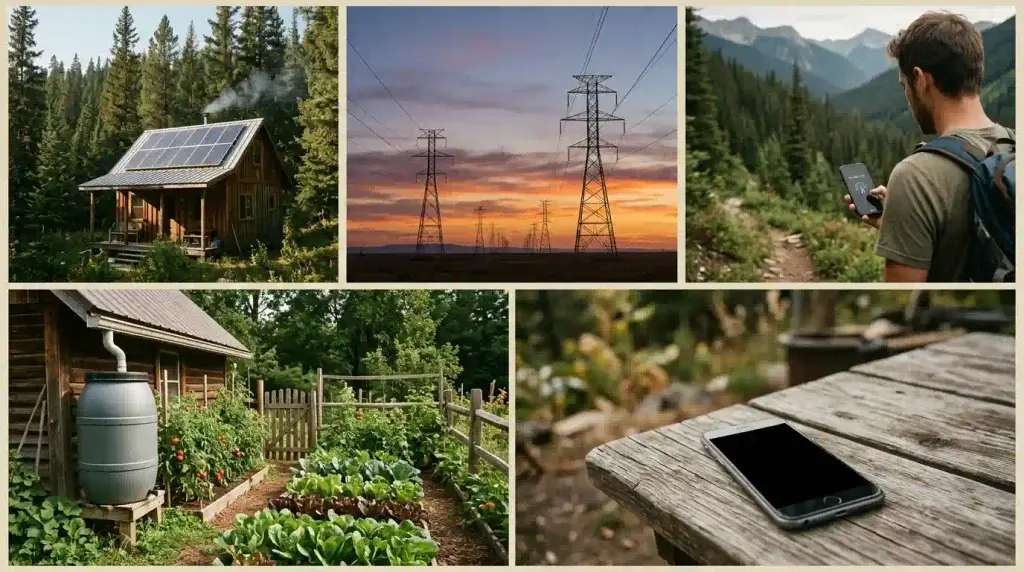
The off the grid meaning is simple. It describes living without public services like city power, water, or gas. It also means being out of reach, with no phone, internet, or tracking. People use the phrase for homes, trips, and even people who want to disappear for a while.
You may have heard it in a movie, a news story, or from a friend who said, “I’m going off the grid this weekend.” Many people search this phrase because it sounds exciting but a little confusing. Does it mean living in a cabin in the woods? Does it mean turning off your phone? The answer is both, and a bit more. In this guide, you will learn the clear meaning, where the phrase came from, how to use it in a sentence, common mistakes, and what real off-grid life looks like today.
Quick Answer: Off the Grid Meaning in Plain Words
“Off the grid” means not connected to the public systems most of us use every day. The “grid” is the big network of power lines that carries electricity from power plants to homes. If your house makes its own power, you are off the grid.
The phrase has a second meaning, too. It can mean being cut off from technology and the people who might find you. If someone says, “She’s off the grid,” they may mean she has no phone signal, no email, and no way to be reached.
So here is the short version. Off the grid means living on your own, without public utilities, or staying out of reach for a while. Which meaning fits depends on the sentence around it.
The Two Main Meanings of Off the Grid
Most dictionaries and everyday speakers use the phrase in two ways. Knowing both will help you read any sentence correctly. Here is a quick look at each one.
| Meaning | What It Describes | Example Sentence |
| Utility meaning | A home or life that does not use public power, water, or gas | “They built a cabin that runs on solar power. It is totally off the grid.” |
| Contact meaning | A person who cannot be reached or tracked | “I’ll be off the grid on my hiking trip, so call me next week.” |
The first meaning is the older and more common one. It is about where your electricity and water come from. A farmhouse with its own solar panels and a well is a classic example.
The second meaning grew as phones and the internet became part of daily life. When almost everyone can be reached at any time, being unreachable stands out. That is why people say they are “going off the grid” when they leave their devices behind for a trip.
Sometimes the two meanings mix. A person who moves to a remote cabin with solar power and no internet is off the grid in both ways. In this case, the phrase fits well.
Where the Phrase Comes From
To understand the phrase, start with the word “grid.” In the early 1900s, power companies began linking their lines into large networks. These networks became known as electrical grids. Once towns and cities were wired together, “the grid” became a simple way to talk about the whole system.
Living apart from that system came later as an idea. Many writers connect off-grid living with the back-to-the-land movement of the 1960s and 1970s. During those years, some people left cities to farm, build homes, and live more simply. Many wanted to depend less on big companies and more on themselves.
It is hard to name the exact day or person who first said “off the grid.” Language grows slowly, and people do not always write down who said a phrase first. So it is better to say the phrase grew out of the word “grid” and spread as off-grid homes became more common.
The second meaning, about being out of reach, came along as technology changed. As people started carrying phones, using bank cards, and posting online, “the grid” began to mean a wider web of tracking. Going off it meant stepping away from all of that. Spy stories and thrillers helped the phrase catch on in this way.
How to Use “Off the Grid” Correctly
Using the phrase well is easy once you see how it works. It acts as an adjective or an adverb. That means it can describe a noun, like “an off-the-grid cabin,” or a verb, like “She lives off the grid.”
Here is a handy rule about hyphens. When the phrase comes before a noun, writers often add hyphens. You might write “an off-the-grid house” or just “an off-grid house.” When it comes after the noun or verb, you usually leave the hyphens out. For example, “The house is off the grid.”
You will also see it with different verbs. People say they “live off the grid,” “go off the grid,” “stay off the grid,” or “drop off the grid.” Each one fits a slightly different story. Living off the grid is a long-term lifestyle. Going off the grid is often a short trip or a sudden choice. Dropping off the grid usually means someone vanished from view.
Here are a few sample sentences to show the range:
My aunt has lived off the grid for ten years, and she loves it. We turned off our phones and went off the grid for the weekend. The old farm is completely off the grid, with its own well and wood stove. He dropped off the grid after he quit his job.
Notice that none of these sentences needs extra explaining. The meaning is clear from the story around it.
Real Life Examples of Going Off the Grid
Examples make any phrase easier to remember. Let’s look at a few common ways people use it in daily life.
The first is the full-time off-grid home. Picture a family on a few acres of land. They use solar panels for power, a well for water, and a wood stove for heat. Their power bills are zero because they have no connection to the electric company.
The second is the weekend escape. A group of friends goes camping in a place with no cell signal. For two days, no one checks email or social media. They say they went off the grid, and everyone knows what they mean.
The third is the digital detox. Someone gets tired of notifications and decides to leave their phone in a drawer for a week. They may still live in a normal house with city power, but they are off the grid when it comes to technology.
The fourth is the privacy seeker. Some people use cash, avoid social media, and keep their personal details private. They want fewer companies tracking them. People may say this person is trying to live off the grid, even if the house itself uses normal city power.
The fifth is the story or movie character who disappears. In films, a spy or someone running from trouble often goes off the grid. This is the dramatic use of the phrase, and it shows up often in books and television.
What Living Off the Grid Looks Like Day to Day
Many people picture one thing when they hear the phrase: a small cabin in the woods. The truth is wider. Off-grid homes can be tiny houses, farms, vans, boats, or even regular-sized houses built with smart design. What matters is how each basic need gets met.
| Basic Need | Common Off-Grid Solution |
| Electricity | Solar panels with batteries, small wind turbines, or a backup generator |
| Water | A private well, rainwater collection, or a nearby spring |
| Heat | Wood stoves, propane heaters, or passive solar design |
| Waste | Septic tanks, composting toilets, or greywater systems |
| Food | Home gardens, small livestock, and stored supplies |
| Internet | Satellite service, cell boosters, or none at all |
Power is usually the first thing people plan. Solar panels turn sunlight into electricity, and batteries store it for night time or cloudy days. Many people also keep a small generator for long gray spells. Planning how much power you need is key, because every light and appliance adds up.
Water takes careful thought too. A well needs a pump, and the pump needs power. Rainwater systems need clean tanks and filters. Whatever the source, water must be tested so it is safe to drink.
Food and heat tie into the seasons. Many off-grid families grow vegetables, can or freeze extra food, and cut firewood ahead of winter. Life moves with the weather, and planning ahead matters a great deal.
One surprise is that not everyone off the grid goes without internet. Satellite internet has made it possible for some people to work from remote homes. So off the grid does not always mean off the web.
Off the Grid vs. Similar Terms
A few related words get mixed up with this phrase. Seeing them side by side clears up the confusion.
| Term | What It Means | How It Differs |
| Off the grid | Not tied to public utilities, or out of reach | The main phrase in this article |
| Grid-tied | Connected to the power grid, often with solar panels | Still uses the public system |
| Hybrid | Mostly self-powered but keeps a grid link as backup | A middle path |
| Homesteading | Living a self-reliant life with farming and food skills | May or may not be off the grid |
| Digital detox | A break from phones and screens | Only about technology |
| Under the radar | Staying unnoticed or quiet | About attention, not utilities |
Homesteading is the one people mix up most. A homesteader grows food, raises animals, and makes things by hand. Some homesteaders are off the grid, but many still use city power. The two ideas often travel together, yet they are not the same.
Grid-tied solar is another common mix-up. A house with solar panels that still connects to the power company is not off the grid. It simply makes some of its own power while keeping a safety net.
Is Living Off the Grid Legal?
This is a big question for anyone who dreams of an off-grid life. The honest answer is that it depends on where you live. Rules can change from one state, county, or town to another.
Some places have building codes that require a home to connect to public power or water. Others have rules about septic systems, rainwater collection, or the size of a home. A few areas also limit how long someone can live in an RV or tiny house on a piece of land.
Because rules vary so much, it is smart to check with your local building office before you buy land. Ask about permits, water rights, waste systems, and zoning. A short phone call can save a lot of money and stress later.
This article cannot give legal advice, and no single rule applies everywhere in the United States. Always confirm the details for your own area.
Pros and Cons of Going Off the Grid
Like any big life choice, going off the grid has good sides and hard sides. A fair look at both helps you decide.
On the bright side, many people enjoy lower monthly bills once the system is built. They feel more independent and less tied to big companies. Others love the quiet, the fresh air, and the close link to nature. For some, learning new skills is a joy in itself.
There are real challenges, too. Setting up solar panels, batteries, wells, and septic systems can cost a lot at the start. Repairs are your own job, and when something breaks at night, there is no company to call. Weather can affect your power and water. Living far from town can also mean long drives for groceries, health care, and school.
Loneliness can be a problem for some people. Being far from friends and family is not easy for everyone. It helps to think about your own personality and needs before you make the leap.
Common Mistakes People Make With This Phrase
Even careful writers slip up with this phrase. Here are the mistakes you will see most often.
The first mistake is thinking it always means living in the woods. It can also mean a short trip without your phone, or even a person who is hard to find. Check the story around the phrase before you guess.
The second is writing “off the grid” with the wrong spelling, like “of the grid.” The word is “off,” with two f’s. This small slip is surprisingly common in quick messages.
The third is mixing it up with grid-tied systems. A home with solar panels that still pays a power bill is not off the grid. It has only partly stepped away.
The fourth is using the hyphens in the wrong place. As a rule, add hyphens before a noun, as in “an off-grid cabin,” and skip them after, as in “the cabin is off the grid.”
The fifth is assuming that off the grid always means no internet. Many off-grid households use satellite service and even work online. The phrase is about utilities and reach, not a complete ban on technology.
Current Usage and Trends
The phrase is more popular now than it was a few decades ago. Several things help explain why.
Solar panels and home batteries have become easier to buy and install than they used to be. This has opened the door for people who once thought off-grid living was too hard. Tiny houses, van life, and remote work have also made simple living look attractive to many.
At the same time, people feel tired of constant screens and alerts. Phrases like “digital detox” and “unplugging” are everywhere, and “going off the grid” is often used in the same way. A weekend without a phone can feel like a small adventure.
You will also see the phrase in travel writing, where hotels and cabins promote “off-grid getaways.” In these cases, the place may still have basic comforts. The phrase is used to sell a feeling of peace and escape, so read the details before you book.
News stories use it too, especially during power outages or storms. Writers may say a town was “knocked off the grid,” which means its power was cut. This is a looser use, but it shows how flexible the phrase has become.
Tips for Anyone Curious About Going Off the Grid
If the idea tempts you, there is no need to jump in all at once. Small steps can teach you a lot.
Start with a short trial. Spend a weekend in a cabin or campsite with no cell signal. Notice what you miss and what you enjoy. This costs little and tells you a lot about your own habits.
Next, learn how much energy you use now. Look at your power bills and add up the big users, like heating, cooling, and the water heater. Knowing your numbers is the first step in planning any solar system.
Then, consider a middle path. Many people add solar panels and a battery to a regular home while keeping the grid link. This lowers bills and gives backup power without the risks of a full break.
Talk to people who live this way. Off-grid families are often glad to share what worked and what failed. Their real stories are worth more than any guess.
Finally, check your local rules, set a budget, and plan for repairs. Good planning is what turns a dream into a safe, steady life.
FAQs
What does off the grid mean in simple words? It means living without public utilities like city power and water, or being out of reach of phones and tracking. The sentence around it tells you which meaning is used.
What is “the grid” in this phrase? The grid is the large network of power lines that brings electricity to homes and businesses. In a wider sense, it can also mean the web of modern systems that keep track of us.
Is off the grid hyphenated? It depends on where it sits in the sentence. Use hyphens before a noun, like “an off-grid home.” Leave them out after a verb or noun, like “the home is off the grid.”
Can you be off the grid and still have internet? Yes. Many people use satellite internet or cell boosters in remote homes. Off the grid is mostly about utilities and being reachable on your own terms.
Is it legal to live off the grid? In many places, yes, but rules differ by state, county, and town. Building codes, water rights, and waste rules may apply. Always check with your local office first.
What is the difference between off the grid and homesteading? Off the grid is about not using public utilities. Homesteading is about self-reliant living, like growing food and making things by hand. A person can do one without the other.
Conclusion
Now you know the off the grid meaning in full. At its heart, it means living apart from public utilities like power and water, or being out of reach for a while. The first meaning is about how a home runs. The second is about how easy a person is to find. Both come from the same idea: stepping away from the systems most people rely on every day.
The phrase has grown from a lifestyle label into an everyday expression. You can use it for a cabin with solar panels, a quiet weekend without your phone, or a character who vanishes in a movie. Just check the context, mind your hyphens, and avoid mixing it up with grid-tied or homesteading.
If the idea excites you, start small. Try a short trip, learn your energy habits, and check your local rules. Little steps will show you whether this way of living fits you, long before you make any big move.

Hi, I’m Rebecca Hayes. I write faith-filled articles, healing prayers, and daily devotionals to encourage people in every season of life. My passion is helping readers find peace, hope, and strength through prayer.