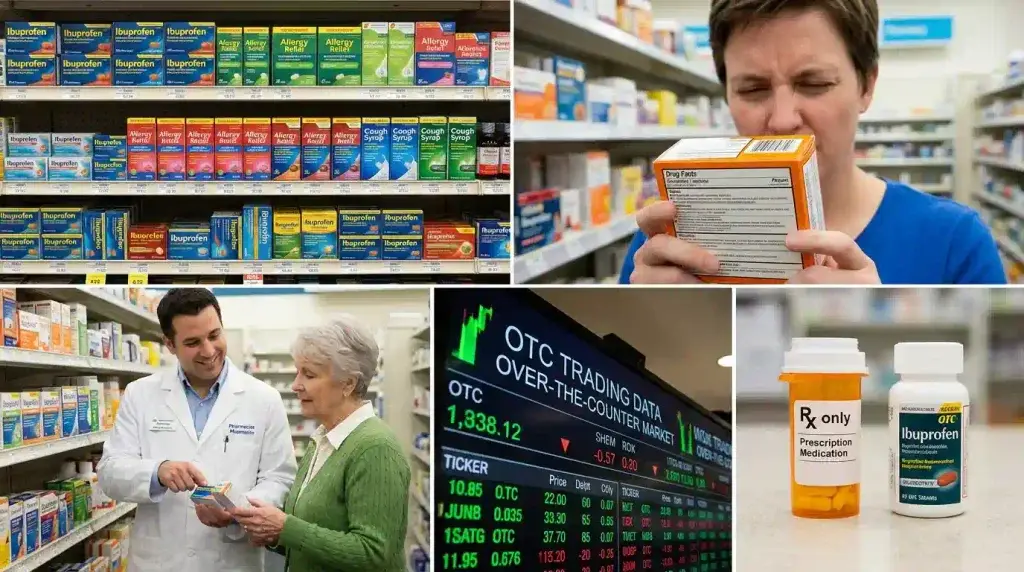
The over the counter meaning is simple. “Over the counter” (OTC) describes a product you can buy without a prescription from a doctor. You walk into a store, pick it up, and pay for it. That’s it.
You’ve probably seen the letters OTC on a medicine box, a pharmacy sign, or even a news story about stocks. The phrase shows up in more places than you might think, and it doesn’t always mean the same thing. That’s why so many people search for it.
In this guide, you’ll learn what the phrase means in medicine, how OTC drugs differ from prescription drugs, and how to read the label. You’ll also see how the term works in the stock market, which mistakes to avoid, and how to stay safe. Let’s start with a quick answer.
Quick Answer: What Does Over the Counter Mean?
Over the counter means you can buy something without a prescription. Most often, it describes medicines like pain relievers, cough syrups, and allergy pills. In finance, it describes trades made directly between two parties instead of on a big public exchange.
Here is the short version in a table.
| Where You See It | What It Means | Simple Example |
| Medicine | Sold without a doctor’s prescription | Ibuprofen from a drugstore |
| Stock market | Traded outside a major exchange | A small company’s shares sold on an OTC market |
| Everyday talk | Available to anyone, no special permission | “You can get that over the counter” |
The rest of this article explains each of these in plain words.
Over the Counter Meaning in Medicine
This is the meaning most people want. An over-the-counter medicine is a drug that regulators have decided is safe enough for people to use on their own. You don’t need a doctor to approve it first.
In the United States, the Food and Drug Administration (FDA) makes these decisions. The FDA looks at whether a medicine is safe and works well when people follow the label. It also checks whether people can understand the directions without help. If the answer is yes, the drug can be sold on regular store shelves.
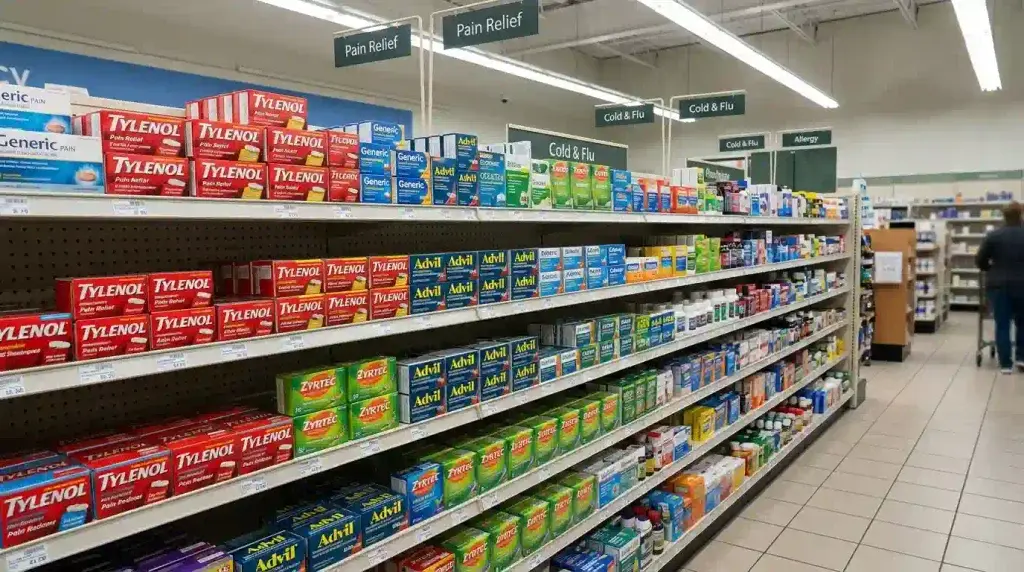
Think about a headache. You don’t need a doctor’s note to treat it. You can pick up a pain reliever at a grocery store, gas station, or pharmacy. That’s the whole idea behind OTC medicine.
The word “safe” does not mean “risk-free,” though. Every medicine can cause side effects if you use it the wrong way. OTC just means the risks are low enough when you follow the directions. We’ll cover safety tips later.
Why Is It Called “Over the Counter”?
The phrase comes from how stores used to work. In old pharmacies and shops, goods sat behind a counter. A worker passed items across it to the customer. Anything you could buy this way, with no special paperwork, was sold “over the counter.”
The term stuck even though many stores now let you grab things from open shelves. Today, no counter is needed. The words just describe the idea of buying something freely, without extra permission.
In the United States, the line between prescription and non-prescription drugs became much clearer in 1951. A law called the Durham-Humphrey Amendment set rules for which drugs needed a prescription and which did not. That law helped shape the system we use today.
How OTC Medicines Differ From Prescription Medicines
People often mix these up, so here is a clear side-by-side look.
| Feature | OTC Medicine | Prescription Medicine |
| Doctor’s note needed? | No | Yes |
| Where you buy it | Stores, pharmacies, online shops | Pharmacies, with a valid prescription |
| Strength | Usually milder | Often stronger |
| Who decides how to use it | You, using the label | Your doctor or pharmacist |
| Insurance coverage | Often not covered | Often covered, at least in part |
| Typical use | Short-term, common problems | Serious or ongoing conditions |
A few things are worth noting. First, some medicines come in both forms. For example, ibuprofen is sold over the counter in lower doses, while higher doses need a prescription. Second, “milder” does not mean “harmless.” Taking too much of an OTC drug can still hurt you.
Third, price can surprise you. OTC medicines are often cheaper per box, but insurance may not pay for them. Some health plans do cover certain OTC items, so it’s smart to check your own plan.
Common Types of OTC Products
OTC products cover a wide range of everyday health needs. Here are the main groups.
| Category | What It Helps With | Common Examples |
| Pain relievers | Headaches, sore muscles, fever | Acetaminophen, ibuprofen, aspirin |
| Allergy medicine | Sneezing, itchy eyes, runny nose | Antihistamines like loratadine |
| Cold and cough | Stuffy nose, cough, sore throat | Cough syrups, lozenges, decongestants |
| Stomach relief | Heartburn, upset stomach, gas | Antacids, acid reducers |
| Skin care | Rashes, minor cuts, itching | Hydrocortisone cream, antibiotic ointment |
| Sleep and vitamins | Occasional sleeplessness, nutrition gaps | Sleep aids, multivitamins |
Some of these may surprise you. Sunscreen, for example, is regulated as an OTC drug in the United States because it protects against sunburn. So is fluoride toothpaste.
Dietary supplements, such as vitamins and herbs, are often sold in the same aisles. They’re handled under different rules than OTC drugs, though. The FDA does not approve supplements before they hit the shelf the way it reviews drug products. So being sold in a store does not always mean a product went through the same checks.
How to Read an OTC Drug Facts Label
Here’s a skill that can keep you safe. Every OTC medicine in the United States must carry a “Drug Facts” label. It follows the same layout on every box, so once you learn it, you can read any of them.
The label starts with the active ingredient. This is the part that actually does the work, and it also tells you how much is in each dose. Next comes the uses section, which lists what the medicine treats.
Then you’ll see warnings. Please don’t skip this part. It tells you when not to use the product, when to talk to a doctor first, and what side effects to watch for. It also lists things to avoid, such as driving or drinking alcohol.
After that come the directions. These tell you how much to take, how often, and for how long. They often give different doses for adults and children. Last, you’ll find inactive ingredients, which matter if you have allergies, and storage tips.
One helpful habit is to check the active ingredient on every product you use. Many cold and flu medicines contain the same ingredient as your pain reliever. If you take both, you could get a double dose without realizing it. That’s one of the most common OTC mistakes, and the label can help you avoid it.
What Are Behind-the-Counter Medicines?
Here’s a middle category that confuses many people. Some medicines are not prescription drugs, yet they are not on open shelves either. They sit behind the pharmacy counter. You can buy them without a prescription, but you have to ask the pharmacist.
A well-known example is pseudoephedrine, a decongestant. In the United States, a law passed in 2005 limits how much a person can buy, and stores keep it behind the counter. You may need to show an ID, and the store records your purchase. The rules exist because the ingredient can be misused to make illegal drugs.
So behind the counter is still technically OTC in many cases, but with extra steps. If a pharmacist asks you a few questions, they’re not being rude. They’re following the rules and helping you stay safe.
Over the Counter Meaning in Stocks and Finance
The phrase has a second life in the money world, and it’s worth knowing if you read business news.
Most people picture stocks traded on a big exchange, like the New York Stock Exchange or Nasdaq. Those exchanges have strict listing rules. An over-the-counter market works differently. Here, buyers and sellers trade directly, often through a network of dealers, instead of through a central exchange.
Many smaller or newer companies trade this way. So do some foreign companies and some firms that don’t meet exchange listing rules. These are sometimes called OTC stocks or “penny stocks,” though not every OTC stock is a penny stock.
OTC trading isn’t only about shares. Large banks and companies also trade things like bonds, currencies, and other financial contracts “over the counter.” In these deals, the two sides agree on the terms privately.
Is it risky? It can be. OTC stocks often have less public information, fewer trading rules, and less trading activity. That can make prices jump around, and it can make shares hard to sell. This is general information, not financial advice. If you’re thinking about buying OTC stocks, it’s wise to research carefully and talk to a licensed financial professional.
Grammar and Correct Usage
Writing the phrase correctly is easier than it looks. Here are the main rules.
When the words come before a noun and describe it, use hyphens. For example: “She bought an over-the-counter medicine.” The hyphens tie the three words together into one describing word.
When the words come after a verb and stand alone, hyphens are usually not needed. For example: “You can buy this medicine over the counter.” Here, “over the counter” tells you how or where you buy it.
You can also shorten it to OTC, written in capital letters with no periods. Most writers spell it out the first time and then use OTC after that. For example: “over-the-counter (OTC) medicine.”
Here are a few sentence examples to make it stick:
- “This is an over-the-counter drug.” (hyphens, before a noun)
- “The drug is sold over the counter.” (no hyphens, after a verb)
- “Many OTC products are cheap.” (short form)
Style guides can differ a little, so if you’re writing for a school or company, check their rules.
Common Mistakes People Make
Even careful people slip up with OTC medicines and with the phrase itself. Here are the mistakes seen most often.
Thinking “OTC” means “totally safe.” It doesn’t. Too much acetaminophen, for instance, can harm the liver. Always stick to the dose on the label.
Doubling up on ingredients. As mentioned, many multi-symptom cold medicines contain a pain reliever. Taking another pain pill on top can lead to an overdose.
Ignoring age limits. Some OTC products are not meant for young children. Cough and cold medicines, for example, come with age warnings. Never guess a child’s dose. Read the label or ask a pharmacist.
Mixing with other medicines. OTC drugs can interact with prescription drugs, supplements, or alcohol. When in doubt, ask a pharmacist. It costs nothing and takes a minute.
Using it too long. OTC medicines are meant for short-term problems. If symptoms last more than a few days or keep coming back, see a doctor.
Mixing up the word “counter” in writing. A few people write “over the counter” as “over-the-counters” or “over counter.” The correct form is “over the counter,” or “over-the-counter” before a noun.
Real Life Examples
Examples help the meaning feel real, so here are a few everyday situations.
Maria wakes up with a stuffy nose and a sore throat. She stops at a drugstore on her way to work and buys cold medicine. No prescription needed. That’s an over-the-counter purchase.
James has a bad toothache. He takes an OTC pain reliever to get through the day. But he also books a dentist appointment, because a toothache can mean a bigger problem that a pain pill won’t fix.
A pharmacy sign says, “Allergy medicine available over the counter.” That tells shoppers they can pick it up without a doctor’s visit.
In finance, a news story says, “The small company’s shares trade on the over-the-counter market.” That means the stock is not listed on a major exchange like the NYSE.
Notice the pattern. In each case, the phrase points to something you can get or do without a special approval step.
Current Trends in OTC Products
The OTC world keeps changing, and several recent moves show how the idea is growing.
In 2022, the FDA finalized a rule creating a new category of over-the-counter hearing aids for adults with mild to moderate hearing loss. These devices went on sale in stores and online in late 2022, so many adults can now buy them without a prescription or a medical exam.
In March 2023, the FDA approved naloxone nasal spray for OTC use. Naloxone can reverse an opioid overdose, and making it easier to buy can help save lives.
In July 2023, the FDA approved the first daily birth control pill for OTC use in the United States. It became available to buy without a prescription in 2024.
These changes show a bigger trend. Regulators and health groups are looking for ways to make safe products easier to reach. At the same time, they remind people that easy access means reading labels carefully and asking questions. Rules and product availability can change, so check the FDA website for the latest information.
Tips for Using OTC Medicines Safely
A few simple habits can keep you out of trouble.
Read the whole Drug Facts label every time, even if you’ve used the product before. Ingredients and warnings can change.
Use the smallest dose that works, and don’t take more than the label says. More is not better.
Keep a short list of everything you take, including vitamins and supplements. Show it to your doctor or pharmacist when you ask about a new product.
Check the expiration date. Old medicine may not work as well.
Store medicines in a cool, dry place, out of reach of children. A bathroom cabinet is common, but humidity can wear down some products, so a bedroom shelf or a kitchen cabinet away from the stove may be better.
Finally, talk to a healthcare professional if you’re pregnant, nursing, older, or have a long-term health condition. They can tell you which OTC products are a good fit for you. This article is for general learning and is not medical advice.
FAQs
1. What does over the counter mean in simple words?
It means you can buy something without a prescription. For medicine, you just go to a store and buy it. No doctor’s note is needed.
2. What does OTC stand for?
OTC stands for “over the counter.” You’ll see it on medicine boxes, pharmacy signs, and in stock market news.
3. Is over-the-counter medicine safe?
It’s safe for most people when used exactly as the label says. But it can still cause side effects or harm if you take too much, mix it with other drugs, or use it when the label says not to.
4. Do I need ID to buy OTC medicine?
Usually not. A few products, like some cold medicines with pseudoephedrine, require an ID and are kept behind the pharmacy counter.
5. What is the difference between OTC and prescription drugs?
OTC drugs can be bought freely and are usually milder. Prescription drugs need approval from a doctor and are often used for more serious or ongoing health problems.
6. What does over the counter mean in stocks?
It means shares are traded directly between buyers and sellers through dealers, instead of on a major exchange. These markets can carry more risk, so research matters.
Conclusion
Now you know the over the counter meaning in both of its main forms. The key takeaway is that easy access comes with a job for you. Read the label, check the active ingredients, follow the dose, and don’t mix products without checking. If something feels unclear, a pharmacist is a free and friendly source of help.
If your symptoms don’t improve in a few days, or you’re ever unsure, call a doctor. OTC products are great tools for everyday problems, and using them wisely keeps them that way.

Hi, I’m Rebecca Hayes. I write faith-filled articles, healing prayers, and daily devotionals to encourage people in every season of life. My passion is helping readers find peace, hope, and strength through prayer.