The whole nine yards meaning is simple: it means everything, the full amount, or all of it. When someone gives you the whole nine yards, they give you every part of the deal, with nothing left out.
You hear this phrase in movies, at work, and around the dinner table. Yet many people stop and wonder, why nine yards? Why not eight, or ten? That question has puzzled word experts for decades, and the true answer is still a mystery.
In this guide, you will learn what the phrase means, how to use it, and which origin stories are real and which are myths. You will also see examples, common mistakes, and answers to popular questions.
Quick Answer: The Whole Nine Yards Meaning in Plain Words
“The whole nine yards” means the entire thing, with every part included. It often suggests going all the way or doing something with every extra detail. If a hotel gives you a room, a free breakfast, a spa day, and a ride to the airport, you got the whole nine yards.
The phrase is an idiom. An idiom is a group of words that means something different from the words alone. Nobody is measuring anything in yards. The “nine yards” are just a colorful way to say “all of it.”
Most dictionaries agree on this meaning. They also agree on something else: no one knows for sure where the phrase began. We will talk about that later, because it is the most interesting part of the story.
Meaning and Definition of the Whole Nine Yards
Let’s break the phrase into its parts. The word “whole” tells us that nothing is missing. The words “nine yards” add a feeling of size, as if the thing is long and full. Together, they point to a complete package.
Think of it like a big meal. A plain sandwich is just a sandwich. A sandwich with chips, a drink, a cookie, and a pickle is the full meal. The whole nine yards is that full meal in word form.
The phrase can carry two flavors, and both are common.
The first flavor is “everything that comes with it.” A builder might say, “We will paint the walls, fix the floors, and replace the doors. The whole nine yards.” The meaning here is a complete job.
The second flavor is “going all out.” A person who plans a birthday party with a cake, a band, balloons, and a magician went the whole nine yards. The meaning here is extra effort and care.
The phrase is friendly and casual. It fits well in everyday talk, emails to friends, and light writing. It is less common in very formal papers, such as a legal contract or a science report.
How to Use the Phrase Correctly
Using the whole nine yards is easy once you see how it works in a sentence. It usually acts like a noun. That means it can be the thing someone gets, gives, or wants.
The word “the” always comes first. People say “the whole nine yards,” not “a whole nine yards.” The word “whole” stays in the middle, and “nine” stays as a number word. Most writers spell out “nine” in this phrase, though you may see “9” in casual texts.
You do not need a hyphen anywhere. You also do not need to change the phrase for plural or past tense, since it is a fixed expression. The verb around it changes, but the phrase stays the same. Compare “He gives the whole nine yards” with “He gave the whole nine yards.” Only the verb moved.
One more tip: you can add extra words to make it stronger. People sometimes say, “the whole nine yards and then some.” That means even more than everything. It is a fun way to show something went above and beyond.
Real Life Examples
Real examples help the meaning stick. Here is a table showing how the phrase works in different parts of life.
| Situation | Example Sentence | What It Means |
| Wedding | “They hired a band, a photographer, and a chef. They did the whole nine yards.” | They included every fancy extra. |
| Shopping | “I bought the phone, the case, the charger, and the warranty. The whole nine yards.” | I bought the full set. |
| Work | “The new boss gave us the whole nine yards on safety rules.” | She explained every detail. |
| Restaurant | “I ordered the steak with all the sides, soup, and dessert. The whole nine yards.” | I got the complete meal. |
| School | “Our teacher showed us a video, a game, and a quiz. She went the whole nine yards.” | She did everything possible. |
| Travel | “The tour included hotels, food, and tickets. It was the whole nine yards.” | Nothing was left out. |
Notice that each example has a list of things or a feeling of “a lot.” That is a clue about when this phrase works best. When you want to wrap up a long list in a few words, the whole nine yards does the job nicely.
Here is a longer, real-sounding story. Maya wanted to surprise her mom for her fiftieth birthday. She booked a quiet cabin, ordered her mom’s favorite cake, invited old friends, and even made a photo book. When her mom walked in and cried happy tears, a friend whispered, “Wow, Maya gave her the whole nine yards.” That line sums up the effort perfectly.
Where Does the Whole Nine Yards Come From?
Here is where the story gets tricky. Even though the phrase is famous, its true birth is unknown. Language experts have searched old newspapers, books, and records for years. They have not found one clear answer.
What we do know is this. Researchers have found a few early uses from the early 1900s in the United States. Those old examples are rare, and most do not explain the “nine.” Some old versions used different numbers, which shows the phrase may have changed over time.
After that, the phrase seems to fade from view. Then it pops up again in the 1960s, and it becomes much more common. Many of the early examples from that time come from the American South. That gives us a hint about where the phrase may have grown up, though it does not prove it.
Because the evidence is thin, anyone who says they know the exact origin is probably guessing. This is a good example of why accuracy matters more than a cool story. A trusted dictionary will tell you the origin is uncertain, and that is the honest answer.
One idea that sounds sensible is cloth. Fabric was once sold by the yard, and a long piece of cloth could stand for “a lot.” Early uses connected to dress material fit that idea. Still, that is a guess, not a proven fact.
Popular Origin Stories That Do Not Hold Up
Over the years, people have shared many stories about where the phrase came from. Some are clever. Most have no strong proof behind them. Here is a table to help you sort them out.
| Popular Story | What People Claim | The Problem |
| Cement mixers | Trucks held nine cubic yards of cement, so a full load was “nine yards.” | No solid records show the phrase started this way. |
| WWII ammo belts | Fighter planes carried nine yards of bullets in a belt. | No proof from that time links the phrase to ammo. |
| Scottish kilts | A true kilt needs nine yards of cloth. | No old records back this up, and kilt sizes vary. |
| Ship sails | Tall ships had nine sails on three masts. | No sailor records use the phrase this way. |
| Football | A team needs nine yards to almost get a first down. | A first down needs ten yards, so it does not fit. |
These stories spread because humans love a good explanation. A neat tale feels better than “nobody knows.” But a story can be fun and still be wrong.
Notice the common thread. Each story has a nice picture, but none has a clear paper trail. A paper trail would be an old book, letter, or newspaper that uses the phrase the same way. Without that, the story stays a legend.
The best habit is to enjoy these tales as fun trivia, not as facts. If you share one, you can say, “People say this, but no one has proven it.” That keeps you honest and still entertaining.
When the Phrase Became Popular
The phrase climbed in popularity during the 1960s and 1970s. It started showing up in books, newspapers, and everyday talk across the United States. By the 1980s, many Americans knew it well, and few people questioned where it came from.
Pop culture helped a lot. In the year 2000, a comedy movie called The Whole Nine Yards starring Bruce Willis and Matthew Perry brought the phrase to a whole new group of people. After that, the saying felt even more at home in American life.
Today, the phrase is used by people of all ages. Teachers use it, business leaders use it, and teens use it when they talk about a big plan. It has a warm, friendly sound that never feels old-fashioned.
British vs American English
The whole nine yards is mostly an American saying. British people know it well because of movies and television, but they use other phrases more often. This is a helpful point for readers who learn English as a second language.
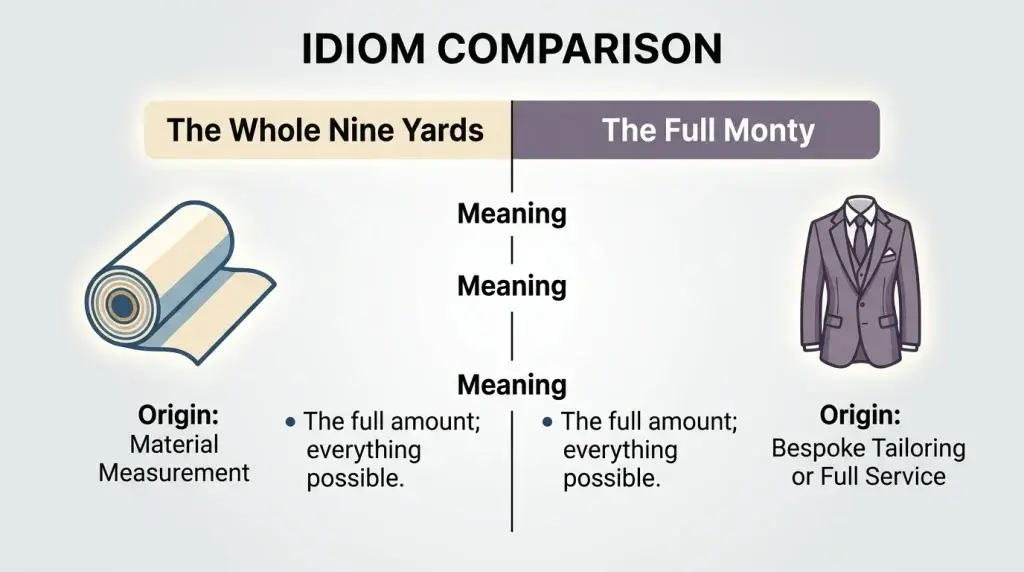
In British English, a common similar phrase is “the full monty.” It also means everything, and it also has a mysterious origin. You may also hear “the works” in both countries.
| Phrase | Common Place | Meaning |
| The whole nine yards | United States | Everything, the full amount |
| The full monty | United Kingdom | Everything, the whole thing |
| The whole ball of wax | United States | The entire thing |
| The works | Both | Everything included |
| Go all out | Both | Do your very best with no limits |
If you are writing for an American reader, the whole nine yards is a perfect choice. If your reader lives in the United Kingdom, they will still understand it, but the full monty may sound more natural to them.
Common Mistakes to Avoid
Even simple phrases can trip us up. Here are the mistakes people make most often.
The first mistake is changing the number. Some people say “the whole six yards” or “the whole ten yards.” The standard phrase uses nine. A few very old examples do use other numbers, but today nine is the one everyone expects.
The second mistake is taking it literally. A new English learner might think the phrase talks about a real length of nine yards. It does not. It is a figure of speech, so do not use it when you really mean a measurement.
The third mistake is using it for tiny things. If you only have one small item, the phrase feels strange. Saying “I ate the whole nine yards of one cookie” does not work. The phrase needs a sense of “many parts” or “all the extras.”
The fourth mistake is using it in very formal writing. A court paper or a science journal usually calls for plainer words like “completely” or “in full.” The phrase is friendly and casual, so save it for relaxed writing.
The last mistake is stating a made-up origin as fact. As you learned, the true origin is unknown. It is better to say “no one is sure” than to repeat a myth.
Tips for Using the Phrase Well
A few simple habits will help you use the whole nine yards like a natural speaker.
Use it when you want to sum up a long list. Instead of naming ten items, you can name two or three and then say, “the whole nine yards.” This keeps your sentence short and lively.
Match it to the mood. The phrase is cheerful, so it fits stories about parties, trips, meals, and projects. It works for serious topics too, as long as the tone stays relaxed. For example, “The doctor gave me the whole nine yards on my test results” is clear and kind.
Do not overuse it. A great phrase loses its sparkle if it shows up in every paragraph. Use it once in a while, and it will stay fresh.
Try a few close cousins for variety. You can say “everything and the kitchen sink,” “all the bells and whistles,” or “the complete package.” These share a similar feeling and keep your writing from sounding repetitive.
Finally, pair it with a clear list. Readers enjoy a short list followed by the phrase. It feels like a bow on a gift.
Current Usage and Trends
Today, the whole nine yards lives happily in everyday speech. You hear it in news stories about big events, in ads for deals that include many extras, and in casual chats between friends.
Businesses like the phrase because it promises value. A spa might advertise “the whole nine yards of relaxation.” A car dealer might offer “the whole nine yards” of add-ons. It feels generous and complete.
Online, people also use it in short messages and social posts. You might see “Went to the game and did the whole nine yards: face paint, foam finger, the works.” The phrase keeps its charm even in quick, modern writing.
Interestingly, the mystery of its origin has helped keep it alive. People love to guess and share theories, so the phrase stays in the conversation.
FAQs
What does the whole nine yards mean?
It means everything, the full amount, or all the parts of something. It can also mean going all out with great effort.
Where did the whole nine yards come from?
No one knows for sure. Early examples appear in the early 1900s, and the phrase became popular in the 1960s. Many fun stories exist, but none is proven.
Is the whole nine yards from cement mixers or WWII?
These are popular stories, but there is no solid proof for them. Experts treat them as unproven legends.
Is the whole nine yards formal or casual?
It is casual. It works well in friendly talk and relaxed writing, but plain words are better in very formal papers.
What is a good example sentence?
“The hotel gave us a big room, free food, and a tour. It was the whole nine yards.” This shows a full package with nothing left out.
What is a British version of this phrase?
The closest British phrase is “the full monty.” It also means everything, and its origin is also unclear.
Conclusion
The whole nine yards meaning is easy to remember: it stands for everything, the complete package, or going all out. You can use it to describe a big party, a full meal, a long list of services, or any effort that leaves nothing behind.
What makes the phrase special is its mystery. Smart researchers have searched for its true origin and still have not found it. Stories about cement trucks, kilts, and ammo belts are fun, but they remain unproven.
So here is a practical tip. Use the phrase in friendly, casual writing, pair it with a short list, and keep it fresh by not overusing it. And when someone asks where it came from, you can say with confidence, “Nobody knows for sure.” That honest answer is the best one, and it might even start a great conversation.

Hi, I’m Sarah Mitchell. I love writing faith-based content that brings peace, hope, and encouragement to everyday life. Through prayers and devotionals, my goal is to help readers feel closer to God and stronger in faith.