STFU meaning in text is simple: it stands for “shut the f*** up.” People use it to tell someone to stop talking, or sometimes to show playful shock. You have probably seen it in a group chat, a comment section, or a late-night message from a friend. Then you wondered, “Is this person mad at me, or just joking?” That is the tricky part of this little four-letter slang.
The same letters can sound angry, funny, or surprised, depending on who sends them and how. In this guide, you will learn what STFU means, where it likely came from, and how to read the tone. You will also see real examples, a few common mistakes, and kinder ways to say the same thing. Let’s start.
Quick Answer: STFU Meaning in Text
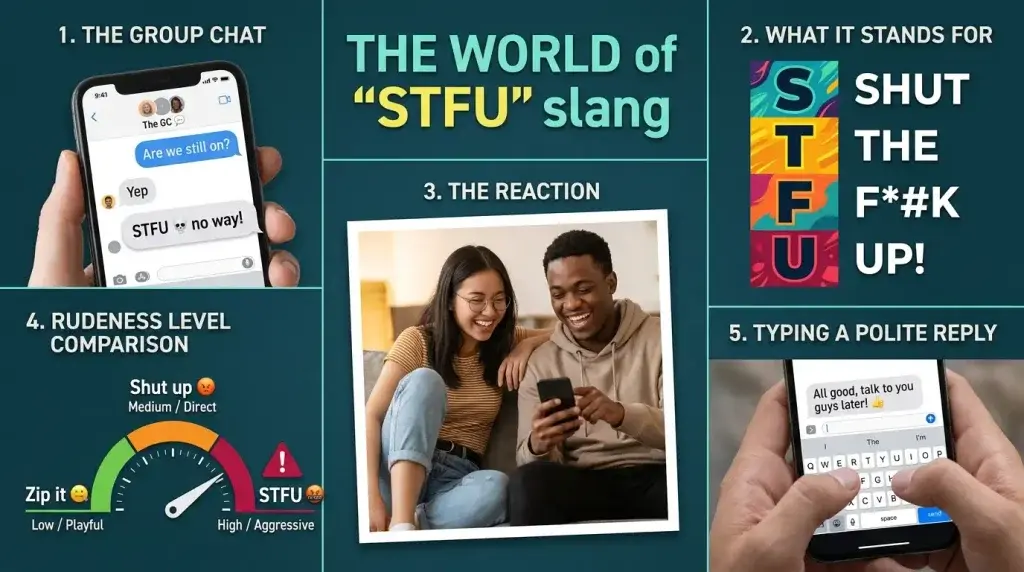
STFU means “shut the f*** up.” It is an internet and texting abbreviation. In most cases, it is a rude way to say “be quiet” or “stop talking.” Among close friends, it can also mean “no way!” or “you are kidding!” The meaning depends on the tone, the people, and the situation.
Here is the short version you can remember. If a stranger sends it in a heated argument, it is an insult. If your best friend sends it after you share big news, it is probably excitement. When you are not sure, treat it as rude until you know better.
What Does STFU Stand For?
Each letter in STFU stands for one word. The S is for “shut,” the T is for “the,” the F is for a strong curse word, and the U is for “up.” Put together, the phrase is “shut the f*** up.”
Because it includes a swear word, STFU is not a polite phrase. Many people avoid it at work, at school, and around family. Some apps and websites even filter it out. That is why people often type it in a short form. The letters feel less harsh than the full words, but the meaning is the same.
It helps to know that STFU is an initialism. That means you say each letter on its own, like “S-T-F-U.” It is not read as a word. This puts it in the same group as LOL, OMG, and BRB. The difference is that those three are mild, while STFU has real bite.
The Three Main Ways People Use STFU
One reason this slang confuses people is that it has more than one job. Most of the time, it falls into one of three groups.
The first use is anger. Someone is upset and wants the other person to stop talking. In this case, STFU is a harsh command. It often shows up in arguments, online fights, and heated comment threads. If you receive it this way, the sender is not being friendly.
The second use is playful disbelief. Here, STFU works like “shut up!” does when friends say it out loud. Picture a friend telling you they got tickets to a show you love. You might reply, “stfu, are you serious?!” You do not really want them to be quiet. You are just surprised and happy. This use is common between close friends who know each other well.
The third use is a joke or a tease. Someone says something silly, and a friend answers with “stfu” and a laughing emoji. It is like a light push on the shoulder. The tone is warm, not mean.
Notice that all three uses look the same on the screen. The letters do not change. Only the setting changes. That is why reading the situation matters more than reading the word.
Real Life Examples of STFU in Text
Examples make slang easier to understand. Below is a table that shows how the same word can carry different feelings.
| Text Message | Who Sent It | What It Likely Means |
| “stfu you’re always interrupting” | A frustrated person in an argument | Stop talking. I am angry. |
| “STFU!! You got the job?!” | A close friend, excited | No way! I am so happy for you. |
| “stfu 😂 that is so dumb” | A friend joking around | You are being silly, and I find it funny. |
| “just stfu already” | An angry stranger online | Rude insult. Do not engage. |
| “stfu, you did NOT do that” | A friend in shock | I can’t believe you did that. |
Look at the clues around the word. Emojis, exclamation points, and the words that follow all help. A laughing face often points to a joke. The word “already” or “just” often points to anger. A question that shows surprise, like “are you serious?”, usually points to disbelief in a fun way.
Now think about a few short chat scenes. In a group chat, one friend writes, “I finally passed my driving test!” Another replies, “STFU congrats!!!” That is happy and friendly. In a different chat, two people argue about money. One writes, “stfu, you never listen.” That is clearly harsh. Both messages contain the same slang, yet they feel very different.
Is STFU Rude? Understanding Tone and Context
Yes, STFU is rude in most settings. The full phrase includes a curse word and an order to be silent. If you say that to someone’s face, it would sound harsh. Typing it does not make it gentler.
Still, language is flexible. Friends often use rude words as a way to show closeness. Between people who trust each other, STFU can feel like a joke or even a compliment. The key is that both people must understand the game. If one person thinks it is play and the other thinks it is an attack, feelings get hurt.
Here are a few things that shape the tone. First, think about your relationship. Close friends have more room for rough humor than coworkers do. Second, think about the topic. A serious or sad subject is a bad place for STFU. Third, think about the platform. A private chat with a best friend is very different from a public post that many people can read.
There is one more thing to keep in mind. Text has no voice. You cannot hear a smile or see a raised eyebrow. Because of this, a joke can land as an insult. When in doubt, add a clue like an emoji, or choose a softer phrase.
Grammar and Correct Usage
STFU follows loose rules, because it is slang. Still, a few habits are common, and they help you use it well.
Most people write it in lowercase (“stfu”) or in all capital letters (“STFU”). Lowercase often feels casual or flat. All capitals often feel louder, if that means anger or excitement. Neither is wrong, but the style adds to the feeling.
STFU works as a command, so it usually stands alone or sits at the start of a message. For example: “STFU, that’s amazing!” It can also come after other words, such as “Just stfu.” You will rarely see it used as a noun or in the middle of a long, formal sentence.
Punctuation matters too. Extra exclamation points usually show excitement. A period or no punctuation can feel cold. Compare “stfu!!!” with “stfu.” The first sounds lively, and the second sounds sharp.
You also should not use STFU in formal writing. Emails to teachers, bosses, or customers are not the place. It does not belong in school papers, job applications, or business messages. Keep it for casual chats with people who know your style.
Where Did STFU Come From?
The exact first use of STFU is hard to prove. No single person or date is known for sure, and it is better to say so than to guess. What we can say is that it grew out of the older phrase “shut up,” which has been around for a very long time. The short form seems to have spread as people began typing fast in online chat rooms, message boards, and early text messages.
In those days, typing took effort, especially on phone keypads. People shortened long phrases to save time. LOL, BRB, and many other abbreviations came from this habit. STFU fits the same pattern. It packs a strong feeling into four letters.
Over time, social media, gaming chats, and group texts carried the slang to a wider audience. Today it shows up in memes, comment sections, and everyday messages. Its long life shows how popular quick, punchy slang can be.
STFU vs. Similar Slang and Phrases
STFU has many cousins. Some are milder, and some are just as rude. This table helps you compare them.
| Phrase | Meaning | Rudeness Level | Common Use |
| STFU | Shut the f*** up | High | Anger or playful shock |
| Shut up | Be quiet, or “no way!” | Medium | Anger or surprise |
| Shush | Please be quiet | Low | Gentle request |
| Zip it | Stop talking | Low to medium | Joking or mild annoyance |
| Pipe down | Lower your voice or stop | Low to medium | Mild warning |
| No way | I can’t believe it | Very low | Surprise |
| Omg stop | I am amazed or embarrassed | Very low | Fun reaction |
As you can see, STFU sits near the top of the rudeness scale. That is why people often swap it for “shut up” when they want to sound a little lighter. Even then, “shut up” can still hurt in the wrong moment.
You may also see other slang that uses the same style, like GTFO (“get the f*** out”). This one is also used for surprise among friends, such as “GTFO, you met him?!” The same rules apply. Know the person, and know the mood.
Common Mistakes When Using STFU
Even a short slang word can cause trouble. These are the mistakes people make most often.
The first mistake is using it with the wrong person. A boss, a teacher, a grandparent, or someone you just met will probably not enjoy it. Always think about who will read your message.
The second mistake is using it during a serious talk. If a friend is sharing something sad or private, STFU can feel like you do not care. Save it for light, fun moments.
The third mistake is guessing the tone. Many people see “stfu” and assume the worst, or assume it is a joke, without checking. Look at the whole message. Think about the history between you and the sender. If you are still unsure, ask. A simple “are you joking?” can save a friendship.
The fourth mistake is believing it is harmless because everyone says it. Online, many people use it, but that does not make it safe in every space. Schools, workplaces, and many websites have rules about rude language. A joke can still break those rules.
The fifth mistake is using it in public posts. A message sent in a private chat stays between friends. A public comment can be seen by anyone, and it can be taken out of context. Screenshots last a long time.
How to Respond If Someone Texts You STFU
Getting a message with STFU can feel sharp, even when it is meant as fun. Your best reply depends on the tone.
If you think it is playful, you can play along. Try something like “Haha, I’m serious though!” or “I know, right?!” This keeps the mood light.
If you think it is angry, stay calm. Fighting back with the same words often makes things worse. You can step away, wait a little, and answer later. A calm line like “Let’s talk when we both cool down” works well.
If it feels like bullying or harassment, you do not need to reply at all. Save the messages, block the person if needed, and tell a trusted adult, a manager, or the platform. Nobody has to accept constant rude messages.
If you are unsure, ask directly. A short, kind question is often enough: “Wait, are you joking or upset?” Most people will tell you the truth.
Polite Alternatives to STFU
Sometimes you want to say “stop talking” or “I can’t believe it” without the harsh edge. Luckily, English has plenty of softer choices.
For asking someone to be quiet, you can say “Could you give me a minute?” or “I need some quiet right now.” These are clear and respectful. You can also say “Let’s pause this talk” when a chat gets heated.
For showing surprise, try “No way!”, “You’re kidding!”, “Stop it, really?”, or “That’s wild!” These carry the same excitement without any curse word.
For joking with friends, you could write “Oh, hush 😂” or “Okay, okay, calm down.” They give a teasing feeling that is safe in most groups.
Using softer words does not make you boring. It shows that you can pick the right tone for the moment, and that is a real skill in writing.
When Not to Use STFU
There are some places where STFU is almost always a bad idea. Avoid it in school messages, work emails, customer service chats, and any formal setting. Avoid it with people who are older than you or in charge of you. Skip it when someone is upset, grieving, or sharing something personal.
Also avoid it when you do not know how the other person feels about rude language. Some people dislike curse words, even in short form. Being kind and careful costs nothing, and it protects your relationships.
Current Usage and Trends
STFU is still part of everyday online talk. It appears in text chats, social media comments, gaming voice and text chat, and meme captions. In many friend groups, it has slid into a playful reaction word rather than a true insult, much like how “shut up” is used out loud.
At the same time, the meaning keeps changing with the crowd. Younger users may use it more casually. Others may see it as plainly rude. Because slang shifts fast, the safest plan is to watch how the people around you use it. I cannot give exact numbers on how often it is used, since reliable public data on that is hard to find.
Tips and Best Practices
A few simple habits will help you handle STFU well, if you send it or receive it.
Read the whole message before you decide on a meaning. Look at the emojis, the punctuation, and the words around it. Think about your history with the person. If you have joked this way before, it is likely fine. If not, take care.
When you send it, add a clue that shows your mood. A laughing emoji or a happy phrase like “that’s amazing!” makes your meaning clear. Without a clue, your friend may guess wrong.
Keep it out of serious talks and formal places. And when you feel angry, pause before you type. Words in text last longer than words in the air, and you cannot take them back once they are sent.
Finally, remember that you always have another option. A softer phrase will almost always get your point across with less risk.
FAQs
What does STFU mean in text? STFU means “shut the f*** up.” It is a rude way to tell someone to stop talking. Among close friends, it can also show shock or excitement, like “no way!”
Is STFU a bad word? It contains a curse word, so many people see it as rude or bad language. It is not suitable for school, work, or formal talk. Between friends, some people treat it as a joke.
Can STFU be friendly? Yes, but only sometimes. When friends say it with a laughing emoji or after good news, it often means “I can’t believe it!” Always check the tone and your relationship first.
What is the difference between STFU and “shut up”? Both ask someone to be quiet or show surprise. STFU is stronger because it includes a curse word. “Shut up” is a bit milder, though it can still be rude.
How should I reply if someone sends me a STFU? Check the tone first. If it looks playful, you can joke back. If it feels angry, stay calm or step away. If it feels like bullying, you can block the sender and tell someone you trust.
What can I say instead of STFU? Try “No way!”, “You’re kidding!”, “Please give me a minute,” or “Let’s pause this.” These keep your point clear without the harsh language.
Conclusion
Now you know the STFU meaning in text. It stands for “shut the f*** up,” and it can sound angry, funny, or shocked, depending on the moment. The letters stay the same, but the feeling changes with the people, the tone, and the place. That is why careful reading matters more than the word itself.
The main lesson is easy to remember. Treat STFU as rude until you know it is playful. Use it only with close friends, keep it out of formal spaces, and add a friendly clue when you mean it as a joke. If you receive it and feel confused, ask, or reply calmly. And whenever you want to be safe, pick a softer phrase. Clear, kind words almost always work better than sharp ones, online and off.

Hi, I’m Sarah Mitchell. I love writing faith-based content that brings peace, hope, and encouragement to everyday life. Through prayers and devotionals, my goal is to help readers feel closer to God and stronger in faith.