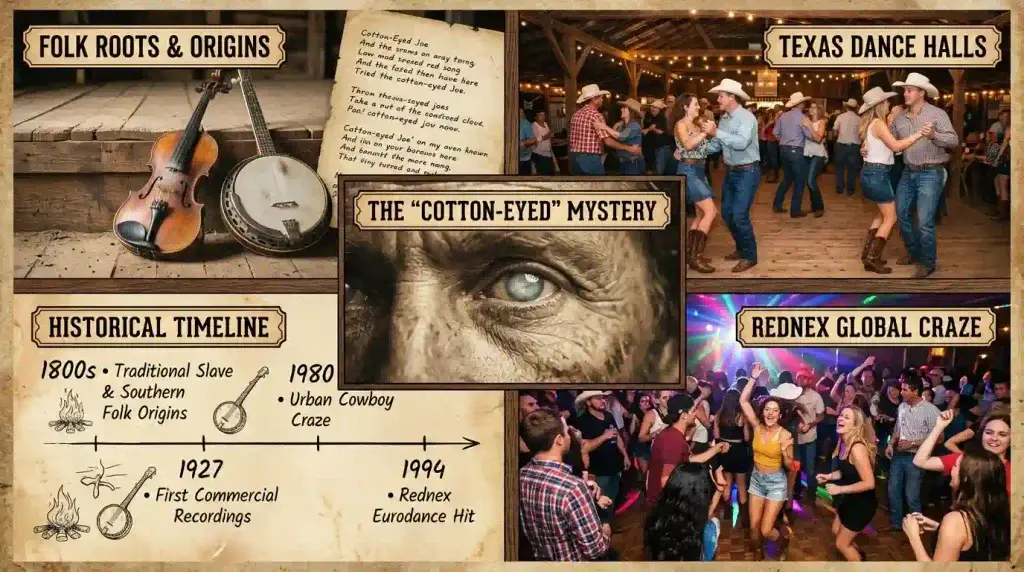
The cotton eye joe meaning starts with a simple idea. It is an old American folk song about a man named Joe, and “cotton-eyed” most likely describes eyes that look pale, cloudy, or milky. Nobody knows for sure who Joe was, and that mystery is part of the fun.
You may have heard this song at a wedding, a school dance, a ball game, or a country bar. Maybe you only know the fast Rednex version with the banjo and the techno beat. Many people sing along without knowing what the words mean.
In this guide, you will learn what “cotton-eyed” means, who Joe might have been, where the song came from, and why people still dance to it today. You will also see which popular ideas are myths.
The Cotton Eye Joe Meaning in Simple Words
Let’s put it as plainly as we can. “Cotton Eye Joe” is a folk song about a man who made trouble in the life of the singer. The singer wonders where Joe came from and where he went. The singer also says that if Joe had not shown up, life might have turned out differently, with a happy marriage years earlier.
The phrase “cotton-eyed” is the harder part. It is a nickname, and nicknames in old songs often described how a person looked. Most experts agree it points to an unusual eye color or eye condition. The eyes might be pale blue, cloudy, or very white around the center.
So when someone asks about the cotton eye joe meaning, there are really two answers. One is the meaning of the nickname. The other is the meaning of the song as a story. This article covers both.
What Does “Cotton-Eyed” Really Mean?
No single answer has been proven. Folklorists, historians, and music fans have offered several ideas over the years. Each one makes sense in its own way, and some may even be true at the same time.
The most common idea is that Joe had a medical problem with his eyes. In the 1800s, many people could not get good medical care. Cataracts can make the eye look cloudy and white, almost like a small ball of cotton. An eye infection could do the same thing.
A second idea is about drinking. Some people say Joe drank too much homemade liquor, called moonshine. Poorly made moonshine could be poisonous and could harm a person’s sight. Others say a heavy drinker could have red, watery, or glassy eyes. This idea is popular, but there is little proof for it.
A third idea is much simpler. Joe may have had very light blue or gray eyes that looked almost white. In a community where most people had dark eyes, that would stand out right away.
A fourth idea says the name described a person whose eyes showed a lot of white. Some people link this to a wide-eyed, startled look. A fifth idea says the word is a changed version of a different word and that people simply heard it wrong over time. This one is less popular, and experts do not agree on it.
Here is a quick table to help you compare the ideas.
| Theory | What It Says | How Strong Is the Evidence? |
| Cataracts or eye illness | Joe’s eyes looked cloudy or white | Common idea, but not proven |
| Bad moonshine | Drinking harmed Joe’s sight | Popular story, little proof |
| Very pale eyes | Joe’s eyes were light blue or gray | Makes sense, not proven |
| Wide, white-showing eyes | Joe had a startled or staring look | Possible, weak support |
| Changed word | “Cotton-eyed” came from another word | Unclear, debated |
The honest answer is that we do not know. Anyone who tells you there is one sure answer is guessing.
Who Was Cotton Eye Joe?
Here is another place where the facts run out. There is no record that proves one real man named Cotton Eye Joe inspired the song. He may have been a real person in a real town. He may also have been made up, or he may be a mix of many men.
Folk songs often work this way. A song starts with one story, and then travelers share it. Each singer changes a line, adds a verse, or switches a place name. After many years, the original person is lost.
What we can say is how Joe is shown in the song. He is a charming outsider. He shows up, gets attention, and then leaves. The singer is left with questions. This is a very old story shape, and people in many cultures have sung about a man who passes through town and changes lives.
Because the song has so many versions, Joe can feel like a different person each time.
What the Song Is About
Most versions share a few main ideas. The singer asks Joe where he came from and where he went. The singer also says that without Joe, there would have been a wedding long ago. That line is the heart of the song.
Some listeners hear this as a joke. The singer blames Joe for a missed marriage, but in a playful way. Others hear a sadder message about lost chances. Both readings can be correct, because the tune is often fast and happy while the words hint at regret.
That mix is one reason the song has lasted so long. A cheerful beat can carry a sorrowful thought, and many folk songs from the American South do exactly that.
Different singers have also added their own verses. Some of them talk about dancing, about people in town, or about everyday work. Because of this, you may find that the words you know are not the same as someone else’s version. That is normal for folk music. It was passed along by ear long before it was written down.
Origin and History of the Folk Song
The song is very old. Many experts believe it was sung in the American South before the Civil War, which ended in 1865. Many folklorists connect its roots to the music and culture of enslaved African Americans, who sang and played tunes on fiddles and banjos. The exact start of the song is not known, though, and that is worth saying clearly.
Written records come later. Folk song collectors began to write down such tunes in the late 1800s and early 1900s. A well-known printed version appeared in 1922, in a book of African American folk rhymes by Thomas W. Talley. That shows the song was already a known part of Southern folk life by then.
As the years passed, the tune spread across the South and into Texas. Fiddlers played it at barn dances and house parties. It became a favorite for square dances and social dances because the beat is steady and easy to follow.
In the 1900s, country and western swing bands brought the song to bigger crowds. Bob Wills and His Texas Playboys, a famous Texas band, recorded a version in the 1940s. That helped link the song to Texas, where it became a dance hall favorite.
Here is a short timeline.
| Time Period | What Happened |
| Before 1865 | The song was likely sung in the American South |
| Late 1800s to early 1900s | Folk song collectors began writing it down |
| 1922 | A version was printed in a book of folk rhymes |
| 1940s | Western swing bands recorded popular versions |
| 1994 to 1995 | Rednex made it a worldwide dance hit |
The Rednex Version: Why Everyone Knows It
For many people today, “Cotton Eye Joe” means one thing: the Rednex song. Rednex is a Swedish group that put a fast banjo and fiddle sound on top of a modern dance beat. They released it in 1994, and it became a big hit across Europe. It also reached the American charts in 1995.
The music video helped a lot. It showed a funny, over-the-top country scene with big hats, wild dancing, and plenty of energy. The song was easy to remember and easy to dance to, so it spread to parties, schools, and sports events.
This version changed how many people think of the song. Before, it was mainly a folk tune and a Texas dance favorite. After, it was also a pop party song heard around the world.
One thing to know is that the Rednex version is a modern pop recording based on the old folk tune. The famous words and beat in that version belong to that recording, not to the oldest folk versions. If you want the older sound, try searching for fiddle and banjo versions from earlier decades.
The Cotton Eye Joe Dance
The song is also tied to a dance. In Texas and nearby states, the Cotton-Eyed Joe is a country dance that many people learn as children. Dancers usually move in couples or in lines, and the steps are quick and bouncy.
The dance is simple at its core. Partners move forward in a steady pattern with kicks and hops, and they often change partners as the music plays. People of all ages can join in, which is why it works so well at weddings and community events.
Over time, many local styles appeared. Some use a two-step rhythm. Others lean more toward line dancing. The Rednex version added its own famous moves, and dancers at parties often do a mix of the old and new styles.
The dance fits the meaning of the song well. The tune is lively and friendly, so the dance is meant to bring people together and make them smile. The sad little story in the words fades into the background while the feet do the talking.
Common Mistakes and Myths
Because the song is so old and so popular, many myths have grown around it. Here are the most common ones.
The first myth is that we know exactly who Joe was. We do not. There is no solid proof of one real man behind the song.
The second myth is that “cotton-eyed” definitely means drunk. This is a popular guess, but it is only one idea among several. Cloudy eyes and pale eyes are just as likely.
The third myth is that the Rednex song is the original. It is not. The tune is far older, and the Rednex version is a modern dance remix of a folk tradition.
The fourth myth is that the song belongs only to Texas. Texas loves it, and it is a big part of Texas dance culture, but the song’s roots reach back across the American South.
The fifth mistake is spelling. You will see “Cotton Eye Joe” and “Cotton-Eyed Joe” in many places. Both are widely used. The version with “-Eyed” and a hyphen is closer to standard grammar, while the Rednex title dropped the “d.” Either way, people will know what you mean.
Real-Life Examples of Where You Hear It
You can find this song in many everyday places. At sports games, it often plays during breaks, and fans clap and dance in the stands. In Texas and other Southern states, many dance halls play it every week. It also shows up in movies, TV shows, and online videos, often when a scene needs a fun, country feel.
People also use the name as a joke. If someone says a stranger looks like “Cotton Eye Joe,” they might mean the person looks a little odd or rough around the edges. It is a playful phrase, not a serious label.
Here is a simple example. A teacher might ask a class, “Who knows what cotton-eyed means?” One student might say, “Maybe his eyes looked white and cloudy.” That is a good answer, and it matches the most common idea.
Tips for Understanding and Sharing the Song
If you want to understand the song better, start by listening to more than one version. Play a slow fiddle recording, a western swing recording, and the Rednex hit. You will hear how the same tune changes with each style.
Next, pay attention to the story in the words. Ask yourself who the singer is, how they feel about Joe, and what they lost. The song is short, but it holds a lot of feeling.
If you are teaching it to a child, keep it simple. You can say that Joe was a man with pale or cloudy eyes, and the song is about a person who came and went. Then let the child enjoy the beat and the dance. You do not need to explain every theory.
When you write about the song, be honest about what is known and what is only a guess. Say “many experts believe” or “one idea is” instead of stating a guess as a fact. That keeps your writing trustworthy.
Finally, remember that this song belongs to a long tradition. It was passed along by real people, in real communities, long before it was on the radio. Treat its history with respect, and you will enjoy it even more.
FAQs
What is the simple meaning of Cotton Eye Joe?
It is a folk song about a man named Joe who came into the singer’s life and then left. The singer wonders about Joe and says life might have been different without him.
What does “cotton-eyed” mean?
Most people think it describes eyes that look pale, white, or cloudy. The cause might be an eye illness, very light eye color, or another reason. No theory is proven.
Was Cotton Eye Joe a real person?
Nobody knows. There is no clear proof of one real man behind the song. Joe may have been real, made up, or based on several people.
Where did the song Cotton Eye Joe come from?
It most likely began in the American South before the Civil War. Many folklorists connect it to African American music traditions. It was later written down, recorded, and made famous in Texas dance halls.
Who made the most famous version?
The Swedish group Rednex made the best-known pop version in 1994. It became a hit in Europe and reached the American charts in 1995.
Is Cotton Eye Joe about drinking?
Some people think “cotton-eyed” means drunk or hurt by bad moonshine. That is only one theory. The song’s main story is about a man who came and went and a missed chance at marriage.
Conclusion
The cotton eye joe meaning comes down to two parts. “Cotton-eyed” most likely points to pale or cloudy eyes, and the song tells the story of a man named Joe who left the singer with questions and regret. Beyond that, the facts get fuzzy, and no one can prove who Joe was or exactly where the nickname came from.
What we do know is that this is a very old American folk song with deep Southern roots. It grew through fiddlers, dance halls, western swing bands, and finally a worldwide pop hit. Its happy beat and sad story together make it special.
Here is some practical advice. Next time you hear the song, listen to the words, not just the beat. Try an older version too. And if someone asks what it means, you can share the best ideas, and also admit that the mystery is part of the charm.

Hi, I’m Elias Monroe. I enjoy writing meaningful prayer content that helps people feel calm, hopeful, and spiritually strong. My goal is to share words that bring comfort during both joyful and difficult times.