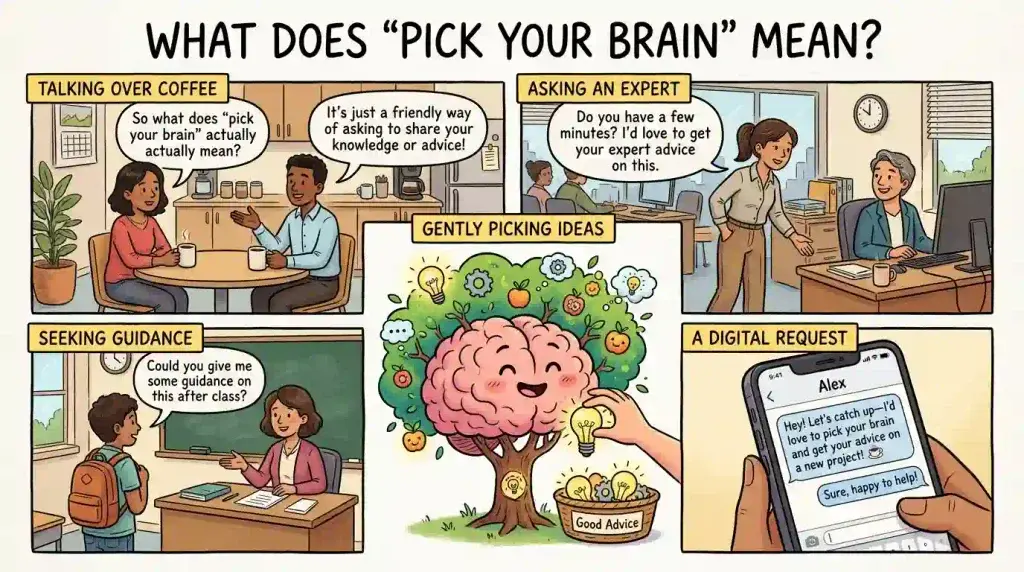
“Pick your brain” means to ask someone with knowledge or experience for advice, ideas, or information. The person asking wants to learn from what you know. It is a polite, friendly way to request help, and it is often used when someone wants a short chat with an expert.
You may have heard this phrase in an email, at work, or from a friend. Maybe someone said, “Can I pick your brain for a minute?” and you wondered what they wanted. Don’t worry. The phrase sounds odd, but the idea is simple. This guide explains the pick your brain’s meaning, how to use it correctly, when it can sound rude, and what to say instead.
Quick Answer: What Does “Pick Your Brain” Mean?
To pick someone’s brain is to ask them questions so you can learn from their knowledge. It is an informal idiom, not a literal action. Nobody is touching anyone’s head. The speaker simply hopes to gain useful tips, ideas, or answers from a person who knows more about a subject.
For example, a new business owner might say to a friend who runs a bakery, “I would love to pick your brain about how you find customers.” The owner wants advice, and the friend can share what they have learned over the years.
Pick Your Brain Meaning in Simple Words
Think of your brain as a big storage room filled with years of learning. When someone asks to pick your brain, they want to step inside that room and take a few helpful things out. They are not asking you to do a big job for them. They just want to hear what you know.
The word “pick” works a bit like picking fruit from a tree. You choose the best parts and take them. Or you can think of it like picking through a pile to find something useful. Both ideas point to the same thing: gathering good information from someone’s mind.
Here are a few other ways to say the same thing:
- Ask for advice
- Get your ideas
- Learn from your experience
- Ask for your opinion
- Tap into your knowledge
The phrase is almost always used in a positive, respectful way. It shows that the speaker values the other person’s skills.
Is “Pick Your Brain” an Idiom?
Yes, it is an idiom. An idiom is a phrase whose meaning is different from its exact words. If you read “pick your brain” word by word, it sounds strange, even a little scary. But native English speakers understand it right away as a request for help or advice.
It is also considered informal. That means it fits best in everyday talk, friendly emails, and casual work chats. In very formal writing, such as a legal letter or a school report, you would choose a plainer phrase like “seek your advice.”
Many English learners find idioms hard because they cannot be understood by translating each word. A good tip is to learn idioms as full phrases, not as separate words. Once you remember that “pick your brain” equals “ask for advice,” you will not forget it.
How to Use “Pick Your Brain” Correctly
The grammar is easy. The phrase follows a simple pattern: someone picks someone else’s brain, often about a topic. The most common forms are “pick your brain,” “pick her brain,” “pick his brain,” and “pick their brain.”
Because it is a verb phrase, it changes with tense. You can say “I picked her brain yesterday,” “I am picking his brain right now,” or “I will pick your brain tomorrow.” The word “brain” stays singular even when you talk about more than one person. For example, “We picked their brains” is also fine, but “We picked their brain” is more common in casual speech.
Here is a handy table showing how it looks in different forms.
| Form | Example Sentence |
| Present | “I want to pick your brain about my resume.” |
| Past | “I picked her brain about moving to a new city.” |
| Future | “I will pick his brain after the meeting.” |
| Question | “Can I pick your brain for a few minutes?” |
| Negative | “I don’t want to pick your brain too much.” |
| With “about” | “She picked my brain about starting a podcast.” |
Most of the time, you will see the word “about” after the phrase. It tells the listener what topic you want to talk about, which makes the request clearer and more polite.
Real Life Examples
Examples help the meaning stick, so here are some common situations.
At work, a new employee might say, “You have been here for ten years. Could I pick your brain about how the team handles big projects?” The new person wants to learn the ropes from someone with experience.
Among friends, you might say, “You just bought a house, right? I would love to pick your brain about the process.” Your friend has fresh knowledge, and you hope to avoid mistakes.
In school or college, a student could ask a teacher, “May I pick your brain about my science project idea?” This is a respectful way to ask for guidance.
In business, a small shop owner may write to a marketing expert, “I admire your work and would like to pick your brain about growing my online store.” Here the phrase opens a door to a helpful talk.
In family life, a young adult might say to an older cousin, “You studied nursing. Can I pick your brain about if it’s a good career?” It is warm, simple, and clear.
Pick Your Brain vs. Similar Phrases
English has many ways to ask for help. Some are close to “pick your brain,” while others mean something a little different. This table shows the main differences.
| Phrase | Meaning | Tone |
| Pick your brain | Ask for knowledge or ideas | Friendly, informal |
| Ask for advice | Request guidance on a problem | Neutral, works anywhere |
| Seek your counsel | Ask for wise guidance | Formal, serious |
| Bounce ideas off you | Share ideas to hear your reaction | Casual, two-way |
| Tap into your expertise | Use your special skills or knowledge | Professional |
| Rack your brain | Think very hard yourself | Different meaning |
The last one is a common mix-up. “Rack your brain” means to think hard to remember something. It is about your own thinking. “Pick your brain” is about asking someone else.
When “Pick Your Brain” Can Sound Rude
Here is something many articles skip. Some people do not like this phrase, and the reason is fair. When a busy expert hears “Can I pick your brain?”, they may feel the person wants free help without giving anything back.
This is especially true for people who earn money from their knowledge. Think of a lawyer, a designer, a coach, or a writer. Their advice is their product. If strangers keep asking to pick their brains for free, it can feel like being asked to work without pay.
Other people simply feel the phrase is a little lazy because it is vague. It does not say how long the chat will take or what the person really needs. A busy person may think, “How much of my time is this going to cost?”
None of this means you should never use the phrase. Most people are happy to help a friend or coworker. But if you are asking a busy stranger, a clearer request is usually kinder and works better.
Better Ways to Ask Someone to Pick Their Brain
If you want to ask for advice and make a good impression, try these simple habits.
Be specific about the topic. Instead of “Can I pick your brain?”, say, “I’m trying to learn how to price my art. Could I ask you three quick questions?” A clear request is easier to say yes to.
Say how much time you need. People relax when they know the limit. “Could we talk for 15 minutes this week?” sounds fair and small.
Do your homework first. Read what you can on your own so you can ask smart, focused questions. This shows respect for their time.
Offer something in return. You might buy them a coffee, share a useful link, or offer to help with something they care about. Even a sincere thank-you note goes a long way.
Make it easy to say no. A line like “No worries if you’re too busy” takes away pressure and keeps things friendly.
Here are a few ready-to-use examples:
- “I really admire your work in photography. Would you have 10 minutes to share advice on getting started?”
- “I’m planning to switch careers into nursing. Could I ask you a few questions about your path?”
- “Could I buy you a coffee and learn how you built your business?”
Common Mistakes People Make
A few small errors can make the phrase confusing or awkward.
The first mistake is taking it literally. If you are learning English, remember that nobody is really picking anything out of a head. It is only a figure of speech.
The second is mixing it up with “rack your brain.” These two phrases look alike but have different meanings, as the table above shows.
The third is using it in very formal writing. In a legal paper or an official report, a simpler, more serious phrase fits better.
The fourth is being too vague. Saying “I want to pick your brain” with no topic leaves the other person guessing.
The fifth is asking too often or for too long. If someone gives you ten minutes, try to stay close to that. Respecting limits makes people more willing to help again.
The sixth is forgetting to say thank you. A quick message afterward, such as “That advice really helped, thank you,” builds goodwill.
Where Did the Phrase Come From?
The exact start of this idiom is not clearly known, so I will not guess at a specific date or person. What we can say is that “pick” has long been used in English to mean choosing or taking small pieces from something, like picking fruit or picking a bone. Using it for taking ideas from someone’s mind is a natural stretch of that older meaning.
Dictionaries list “pick someone’s brain” as a well-known English idiom, and it is used widely in the United States and in other English-speaking countries. If you want the most reliable history, trusted sources like Merriam-Webster or the Oxford English Dictionary are good places to check.
Is It Used the Same in American and British English?
Both American and British speakers understand and use the phrase. The meaning is the same in both. You may notice that Americans use it a bit more often in business and networking talk, but this is a general feeling, not a strict rule. A British speaker might also say “pick your brains” in the plural, though many people use the singular on both sides of the ocean. Either form is understood.
Tips for Using the Phrase Well
A few last habits will help you sound natural and kind.
Match the phrase to the setting. With a friend or coworker, it is perfect. With a very senior person you have never met, a more careful opening may be better.
Keep your tone warm. A smile in your voice, or a friendly emoji in a text, shows you are not demanding anything.
Listen more than you talk. The point is to learn, so take notes and ask follow-up questions.
Follow up. After the chat, tell them what you did with their advice. People love to know they helped.
Finally, be ready to give back. Maybe one day you can share your own knowledge when someone wants to pick your brain. That is how good communities grow.
FAQs About the Pick Your Brain Meaning
What does “pick your brain” mean in simple words?
It means to ask someone for their knowledge, ideas, or advice. You are hoping to learn something useful from their experience.
Is “pick your brain” polite?
Usually, yes. Most people take it as a compliment because it shows you value their knowledge. But it works best when you are specific and respect their time.
What is the difference between “pick your brain” and “rack your brain”?
“Pick your brain” means asking someone else for help. “Rack your brain” means thinking very hard yourself, often to remember something.
Can I use “pick your brain” in an email?
Yes. It fits well in friendly or professional emails. Just add the topic and a time limit, like “Could I pick your brain about marketing for 15 minutes?”
Why do some people dislike this phrase?
Some experts feel it sounds like a request for free work. They may al\so find it vague. Being clear and offering something in return solves most of these worries.
What can I say instead of “pick your brain”?
You can say “ask for your advice,” “learn from your experience,” “get your thoughts,” or “ask a few questions.” These are clear and work in most situations.
Conclusion
The pick your brain meaning is easy once you see it clearly: it is a friendly way to ask someone to share what they know. The phrase is informal, popular, and mostly polite, but it can feel vague or pushy if used carelessly. That is why the best approach is to be specific, respect the person’s time, and say thank you.
Next time you need advice, try a clear and kind request, such as “Could I ask you a few questions about your career path?” It shows respect and makes it easier for the other person to say yes. And when someone wants to pick your brain, remember how good it feels to share what you have learned. Knowledge grows when it is passed along, and a simple, honest question is often where it starts.
discover more article
Friday the 13th Meaning: Why This Day Feels Unlucky

Hi, I’m Elias Monroe. I enjoy writing meaningful prayer content that helps people feel calm, hopeful, and spiritually strong. My goal is to share words that bring comfort during both joyful and difficult times.