Have you ever wondered why some speeches move you to tears while others just teach you facts? The answer often comes down to three Greek words: ethos, logos, and pathos. In simple terms, these three words describe the ways people try to convince you of something. Ethos means trust, logos means logic, and pathos means feelings.
Ancient Greek thinker Aristotle first wrote about these ideas over 2,000 years ago, and they still shape ads, speeches, and even social media posts today.
In this article, you’ll learn what each word means, how they work together, and how to spot them in real life.
Quick Answer
Ethos, logos, and pathos are three ways to persuade people. Ethos appeals to credibility and trust. Logos appeal to logic and facts. Pathos appeals to emotions and feelings. Together, they form the base of good persuasive writing and speaking, a system Aristotle called the three modes of persuasion.
Meaning or Definition
Let’s break down each word one at a time, since they each do a different job.
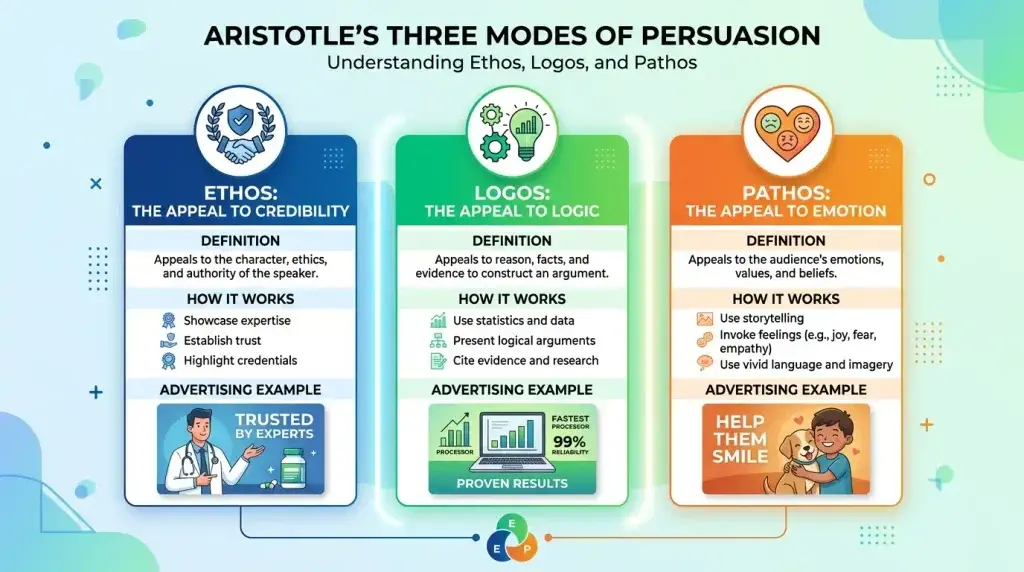
Ethos comes from the Greek word for “character.” It’s about trust. When a speaker uses ethos, they show you why you should believe them. This could be their job, their experience, or their honesty. For example, a doctor talking about medicine has a strong ethos because of their training.
Logos comes from the Greek word for “word” or “reason.” It’s about logic. Logos uses facts, numbers, and clear reasoning to prove a point. If someone shows you a chart of rising temperatures to prove climate change is real, that’s logos at work.
Pathos comes from the Greek word for “suffering” or “feeling.” It’s about emotion. Pathos tries to make you feel something, like happiness, fear, anger, or sadness. A commercial that shows a lonely dog waiting for a home is using pathos to tug at your heart.
Here’s a simple table to help you remember the difference:
| Term | Greek Meaning | What It Appeals To | Simple Example |
| Ethos | Character | Trust and credibility | A nurse explaining a health tip |
| Logos | Reason | Logic and facts | A graph showing sales growth |
| Pathos | Suffering/Feeling | Emotion | A sad story about a rescue animal |
Most strong arguments use all three together, not just one. A great speech might open with a personal story (pathos), back it up with statistics (logos), and remind you of the speaker’s background (ethos).
Origin or History
These three terms come from ancient Greece, specifically from a philosopher named Aristotle. Around 350 BCE, Aristotle wrote a work called Rhetoric, where he explained how people could persuade others effectively. He believed that good persuasion needed a mix of character, logic, and emotion. That’s why he introduced ethos, logos, and pathos as the three main tools of persuasion.
Aristotle wasn’t just writing for fun. He was training people, especially those in politics and law, to speak persuasively in public settings like courts and assemblies. Ancient Athens relied heavily on public speaking, so these skills mattered a lot back then. Interestingly, these same ideas are still taught in schools today, showing just how timeless they are.
Over the centuries, teachers, writers, and public speakers have kept using this framework because it works. It gives a simple way to break down why some messages stick with us and others don’t.
Grammar or Correct Usage
People sometimes get confused about how to pronounce and use these words correctly. Let’s clear that up.
- Ethos is pronounced “EE-thos” or “ETH-os.” It’s often used as a noun, like “The company’s ethos is honesty.”
- Logos is pronounced “LOH-gos.” Note that this is different from a company “logo,” even though they sound similar. Logos refers to logical appeal, not a business symbol.
- Pathos is pronounced “PAY-thos.” It’s also a noun, as in “The speech was full of pathos.”
All three words are singular nouns in English, even though they might sound like they could be plural. You don’t say “ethoses” or “pathoses.” Just use the word as is, no matter how many examples you’re discussing.
When writing about these terms, it helps to use them as adjectives too. For instance, people often say “an ethical appeal,” “a logical appeal,” or “an emotional appeal” instead of repeating the Greek terms over and over. This keeps writing clear for readers who might not know the original Greek words.
Common Mistakes
Many people mix up these three terms, especially when they’re new to writing or public speaking. Here are some common errors to avoid.
One mistake is thinking pathos always means sadness. Actually, pathos covers any strong emotion, including joy, excitement, anger, or fear. A funny commercial can use pathos just as much as a sad one.
Another mistake is confusing logos with facts alone. Logos isn’t just about throwing numbers at people. It’s about clear, sound reasoning. You could have facts that don’t actually support your point, which would be weak logos, not strong logos.
People also sometimes think ethos only means “being a good person.” While character matters, ethos is really about appearing trustworthy to your specific audience. A teenager might trust a popular influencer’s ethos on fashion but not trust a scientist’s ethos on the same topic, even if the scientist is more honest overall.
Here’s a table showing these mistakes and the better way to think about them:
| Common Mistake | Better Understanding |
| Pathos only means sadness | Pathos means any strong emotion |
| Logos means just using numbers | Logos means sound, logical reasoning |
| Ethos means being truly good | Ethos means seeming trustworthy to your audience |
| Only one appeal is needed | Strong arguments often blend all three |
Avoiding these mix-ups will help you understand persuasive writing and speaking much more clearly.
Real Life Examples
Seeing these ideas in action makes them much easier to understand. Let’s look at some everyday examples.
A toothpaste ad that says “9 out of 10 dentists recommend this brand” is using both ethos and logos. The dentist recommendation builds trust (ethos), while the number “9 out of 10” gives a logical reason to believe it works (logos).
A charity ad that shows a hungry child looking directly at the camera, with soft, sad music playing, is using pathos. It wants you to feel emotional enough to donate money.
A political speech where the leader says, “As a veteran who served this country for 20 years, I understand what our soldiers need,” is using ethos. The speaker is reminding you of their personal experience to earn your trust.
A science teacher explaining climate change with graphs, historical temperature data, and clear cause-and-effect explanations is using logos. They’re relying on evidence and reasoning, not emotional appeals.
Even everyday conversations use these tools. If they say, “Look, data clearly shows this is better choice,” that’s logos. If they say, “Please, I really need your help right now,” that’s pathos.
Current Usage or Trends
Today, ethos, logos, and pathos show up more than ever, especially with the rise of social media and digital marketing. Influencers use ethos by showing off their followers, awards, or expertise. Brands use logos through statistics, reviews, and comparison charts. And pathos is everywhere in viral videos, since emotional content tends to get shared the most.
Marketing experts often study which of the three appeals works best for different audiences. Younger audiences on platforms like TikTok often respond strongly to pathos, since short emotional videos spread quickly. Meanwhile, professional audiences on platforms like LinkedIn tend to respond better to logos and ethos, since they want facts and credible sources.
Political campaigns also rely heavily on these three tools. Candidates build ethos through their resumes and endorsements, use logos through policy details and statistics, and use pathos through personal stories and emotional appeals to voters’ hopes or fears.
Understanding these appeals can also help you become a smarter consumer of information. When you notice an ad or article leaning heavily on just one appeal, especially pathos without much logos, it’s worth pausing to think critically before believing everything you see.
Tips or Best Practices
If you want to use ethos, logos, and pathos effectively in your own writing or speaking, here are some simple tips to follow.
First, always know your audience. What builds trust (ethos) for one group might not work for another. A younger audience might trust a relatable personality more than a formal expert.
Second, don’t rely on just one appeal. The strongest arguments usually combine all three. Start with a personal story to grab attention (pathos), support it with solid evidence (logos), and remind your audience why they should trust you (ethos).
Third, keep your logos honest. Don’t twist facts or misuse statistics just to make your point seem stronger. Audiences are becoming more skilled at spotting misleading information.
Fourth, use pathos carefully. Too much emotional appeal without any facts can come across as manipulative. Balance is key.
Finally, practice noticing these appeals in the media you consume every day. The more you spot them in ads, speeches, and articles, the better you’ll get at using them yourself.
FAQs
What is the simplest way to remember ethos, logos, and pathos?
Think of it this way: ethos is trust, logos is logic, and pathos is emotion. These three words all describe different ways people try to convince you of something.
Who created the concept of ethos, logos, and pathos?
The Greek philosopher Aristotle introduced these ideas in his work called Rhetoric, written around 350 BCE.
Can you use more than one appeal at the same time?
Yes, and in fact, most effective speeches and writing use all three appeals together to create a stronger, more balanced argument.
Is pathos always a bad or manipulative tool?
No, pathos isn’t inherently bad. It becomes a problem only when it’s used to trick people or replace honest facts entirely.
How can I tell if an ad is using logos or pathos?
Look for facts, numbers, or logical reasoning for logos. Look for emotional music, sad or happy imagery, or personal stories for pathos.
Are ethos, logos, and pathos only used in speeches?
No, they show up in ads, articles, social media posts, political campaigns, and even everyday conversations.
Conclusion
Understanding ethos, logos, and pathos gives you a powerful lens for seeing the world differently. These three Greek-rooted words explain why some messages, ads, and speeches truly connect with people while others fall flat. Ethos builds trust, logos offer logical proof, and pathos stirs up emotion.
The best communicators, from ancient Greek philosophers to modern-day marketers, know how to blend all three effectively. Now that you understand what each term means, try spotting them in the next ad, speech, or article you come across. You might be surprised how often all three appear working together, quietly shaping how you think and feel.

Hi, I’m Rebecca Hayes. I write faith-filled articles, healing prayers, and daily devotionals to encourage people in every season of life. My passion is helping readers find peace, hope, and strength through prayer.