In texting, mhm means yes, I agree, I hear you, or I understand. It is a typed version of the sound people make when they nod along in a chat. That is the short answer. But the mhm meaning in texting can change with tone, timing, and who sends it.
You send a long, thoughtful message. Your friend replies with one word: mhm. Now you are staring at your phone, wondering what that tiny reply really means. Are they happy? Bored? Annoyed? You are not alone. Thousands of people search this question every month because short replies can feel confusing without a face or a voice to go with them.
In this guide, you will learn what mhm means, where it comes from, and how to spell it. You will also see real examples, a few common mistakes, and smart tips for using it well. By the end, you will know how to read it and when to send something better.
What Does Mhm Mean in Texting?
Mhm is a casual way to write the sound “mm-hmm.” People say this sound out loud when they want to show they are listening or that they agree. In texting, it works the same way. It can mean yes, okay, sure, I get it, or keep going.
Think of it like a nod. When a friend tells you a story in person, you might nod and say “mm-hmm” now and then. You are not interrupting. You are just saying, I am here with you. Typing mhm does the same job on a screen.
The word is also very flexible. Depending on the chat, it can answer a yes-or-no question, show that you agree with a statement, or tell someone you are still paying attention. Because it is so short, it is quick and easy to send. That is why it shows up so often in text threads, direct messages, and comment sections.
One thing is important to remember. Mhm is not a real dictionary word in the same way as words like table or happy. It is called an interjection, which is a small sound or word that shows a feeling or a reaction. Dictionaries do list the spoken sound “mm-hmm” as a way to say yes or show agreement, and the texting version simply copies that sound.
Where Does Mhm Come From?
The sound behind mhm is much older than texting. People have made the “mm-hmm” noise in conversation for a very long time. It is one of those sounds that almost every English speaker uses without thinking about it.
Language experts call this kind of sound a backchannel. A backchannel is a small signal a listener gives while another person is talking. It tells the speaker, Go ahead, I am following you. ” Words like “yeah,” “right,” “uh-huh,” and “mm-hmm” all belong to this group.
When people started chatting online and by phone, they needed a way to type these sounds. In a face-to-face talk, a nod or a smile does the work. In a text, there is no face. So people began spelling out the sound. Mhm is just one of the shortest and most popular spellings.
It is hard to say exactly when people first typed mhm, and I cannot give you a reliable date. What we can say is that it grew naturally with instant messaging, social media, and text apps, where fast and casual replies are normal.
The Many Ways People Use Mhm
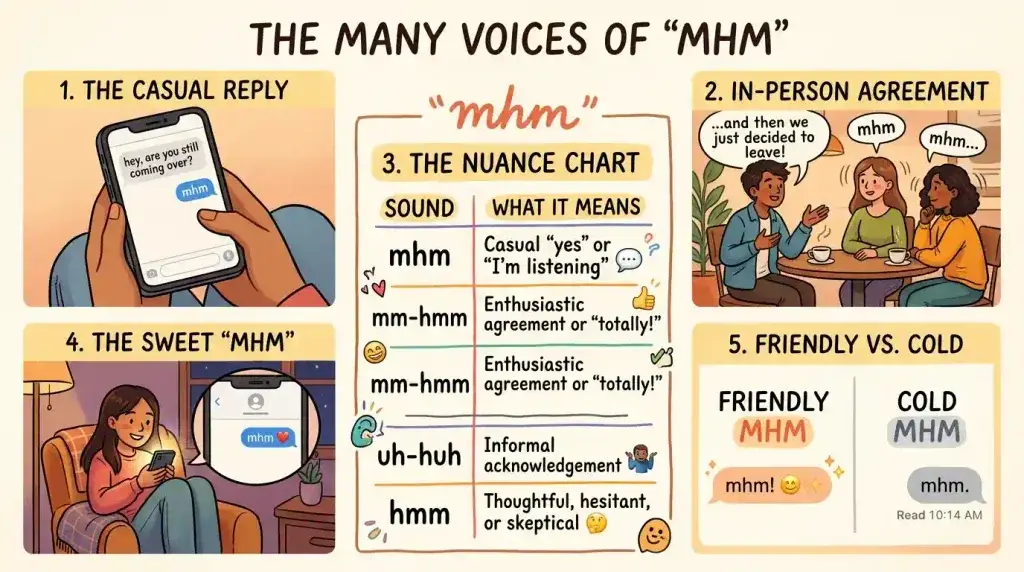
The same three letters can carry different meanings. The best way to understand them is to look at the situation. The table below shows the most common uses.
| How It Is Used | What It Means | Example |
| Saying yes | I agree or the answer is yes | “Did you eat?” “Mhm.” |
| Showing you are listening | Go on, I am following | “So then she told me…” “Mhm.” |
| Showing you understand | Got it, makes sense | “Meet at 5, not 4.” “Mhm.” |
| Agreeing with an opinion | I think so too | “That movie was great.” “Mhm!” |
| Playful or teasing | Sure you did… | “I’m not tired at all.” “Mhm.” |
| Cold or annoyed | I am done with this talk | “I said I was sorry.” “Mhm.” |
Notice how the last two rows have the same word but very different feelings. A teasing mhm is light and fun. A cold mhm can feel like a closed door. You will almost always need the rest of the conversation to know which one you are reading.
Mhm vs. Mm-Hmm vs. Uh-Huh vs. Hmm
Many people mix up these words, and that is understandable. They look and sound alike. But they are not always the same. Here is a simple side-by-side look.
| Word | Usual Meaning | Tone |
| Mhm | Yes, I agree, I am listening | Casual, quick |
| Mm-hmm | Same as mhm, spelled out more | Slightly warmer |
| Uh-huh | Yes, I hear you | Friendly or sometimes doubtful |
| Hmm | I am thinking or I am unsure | Thoughtful or confused |
| Mm | Soft agreement or enjoyment | Calm, gentle |
The biggest trap is mixing up mhm and hmm. Mhm says yes. Hmm says maybe, or let me think about that. If someone replies hmm to your idea, they are probably not sure yet. If they reply mhm, they most likely agree.
The spelling mm-hmm is the one most dictionaries use for the spoken sound. Mhm is the shorter texting version, and it is perfectly fine in casual chats.
How Tone Changes the Meaning
Here is the tricky part. Text has no voice. You cannot hear if someone sounds happy, bored, or upset. So readers look at small clues, and those clues can change how mhm feels.
Punctuation is the first clue. A plain mhm is neutral. Mhm! feels excited and warm. Mhm. with a period can feel flat or even cold, especially if the rest of the chat was long and friendly. Mhm… with three dots can sound unsure or like the person has something more to say.
Length is the second clue. If someone usually sends long, cheerful messages and suddenly sends only mhm, it may mean they are busy, tired, or upset. If they always send short replies, it probably means nothing at all.
Spelling stretches also matter. Mhmmm or mhmmmm can sound playful, dreamy, or sarcastic. Mhm mhm said twice can sound like nodding quickly, such as when you are encouraging someone to keep talking. It can also sound impatient, as if you want them to finish faster.
Emojis help a lot. A smile or a heart next to mhm makes it friendly right away. An eye roll does the opposite. When in doubt, look for the extra clues before you decide how someone feels.
Real-Life Examples of Mhm in Texting
Seeing the word in action makes it easier to understand. Here are a few short chats.
In the first one, a friend asks a simple question. “Are you coming to the party tonight?” The reply is “Mhm, I’ll be there at 8.” Here, mhm just means yes.
In the second chat, a friend is sharing a long story about a hard day. Between messages, you type “mhm” and “I get that.” This shows you are listening. You are not trying to take over the talk.
In the third one, someone says, “I totally cleaned my room.” You answer, “Mhm, sure you did 😏.” The emoji and the words around it show that you are teasing.
In the fourth, two people are having an argument. One person writes a long message about their feelings. The other replies, “Mhm.” That single word can feel dismissive. It may seem like they did not read or care about what was said.
The fifth chat is at work or school. A teacher writes, “Homework is due Friday.” A student replies, “Mhm, thank you.” This is polite enough, though a longer reply like “Okay, thank you!” would feel more respectful.
All five use the same word. The meaning comes from the setting, the people, and the mood.
How to Spell Mhm Correctly
Because mhm is slang, there is no single official spelling. Still, a few versions are very common. Mhm is the shortest and most popular. Mhmm and mmhmm are also used a lot. Mm-hmm is the spelling you will find in most dictionaries and in books. Mhmmm with extra letters adds a playful or dramatic feel.
Any of these is fine in a text. If you are writing a school paper, a work email, or anything formal, skip all of them. Use words like yes, I agree, or I understand instead.
Capital letters are optional. Most people type it in lowercase in chats. You only need a capital M when it starts a sentence in a more careful message.
Is Mhm Rude or Polite?
The honest answer is: it depends. On its own, mhm is not rude. It is a normal, friendly sound used by almost everyone. The problem is not the word. It is how short it is.
When someone shares something important, one tiny word can feel like too little. Imagine telling a friend about a big problem and getting only mhm in return. You might feel brushed off, even if they did not mean it that way.
On the other hand, mhm can feel kind and gentle during a story, because it keeps the flow going without interrupting. The key is matching your reply to the moment. Light chat gets a light reply. Serious chat deserves a little more effort.
Current Usage and Trends
Today, mhm is used across many apps, including text messages, social media comments, and chat apps. It is common among teens and adults alike, though younger people may use it more often in quick, playful ways.
Online, it also shows up as a sarcastic reply. When someone makes a claim that seems silly or hard to believe, another person might answer with a flat mhm. This can mean, Sure, if you say so. It works like a raised eyebrow in typed form.
Some people also feel that mhm has become a bit of a lazy reply. Others see it as a calm, comfortable way to talk. Neither view is wrong. It simply shows that tiny words can carry big feelings, and every group of friends may read them a little differently.
Common Mistakes People Make With Mhm
The first mistake is using it when someone needs real support. If a friend is sad, a quick mhm may sound careless. A short warm sentence works better.
The second mistake is confusing it with hmm. Remember that one means yes and the other means thinking. Mixing them up can send the wrong message.
The third is using it in formal writing. Emails to a boss, a teacher, or a client should use full words. Mhm belongs in friendly, relaxed chats.
The fourth mistake is reading too much into it. Many people send mhm just because they are busy, typing fast, or short on time. Before you assume someone is upset, think about their usual style and the rest of the chat.
The last mistake is answering a real question with only mhm. If someone asks, “Which day works for you?” a plain mhm does not help. They need a clear answer.
Tips for Using Mhm Well
Use mhm when the talk is casual and the other person is just sharing or checking in. It works well for quick yes answers, for showing you are following a story, and for light jokes with close friends.
Add a clue when you want to be clear. A short word like mhm, got it or mhm, sounds good makes your meaning plain. An emoji can also soften the tone.
Match the energy you receive. If the other person writes with excitement, reply with some warmth too. A cheerful mhm! fits better than a flat one.
Watch out in serious talks. When the topic is sad, tense, or important, take a few extra seconds to write a fuller reply. People remember when you made the effort.
Finally, know your audience. A close friend will read mhm easily. A new coworker or an older relative may not, so a clearer word is often safer.
Better Replies When Mhm Is Not Enough
Sometimes you want to say more than mhm but you do not know how. Here are a few easy swaps.
These small changes make your messages feel warmer and more thoughtful. You do not have to give up mhm completely. Just save it for the right moments.
FAQs
What does mhm mean in a text? It usually means yes, I agree, or I am listening. It is a typed version of the sound “mm-hmm.”
Is mhm the same as hmm? No. Mhm means yes or I understand. Hmm means you are thinking or you are not sure.
Can mhm be rude? It can feel rude if it is the only reply to a long or serious message. The word itself is not rude, but a very short answer can seem cold.
How do you spell mhm? There is no official spelling. Mhm, mhmm, mmhmm, and mm-hmm are all common. Dictionaries often list mm-hmm.
Is it okay to use mhm in an email? It is best to avoid it in formal emails. Use words like yes, I agree, or I understand for work and school.
What can I say instead of mhm? Try okay, get it, sounds good, I agree, or that makes sense. These feel a little warmer and clearer.
Conclusion
Now you know the mhm meaning in texting. At its heart, it is a quick way to say yes, I agree, or I am listening. It comes from a sound people have made in conversation for ages, and typing it just helps us keep that friendly nod alive on a screen.
Still, the feeling behind it can change. Punctuation, emojis, message length, and the mood of the chat all matter. A cheerful mhm! can feel warm, while a lonely mhm. After a long message I can feel cold.
Here is the simple advice. Use mhm in relaxed chats. When something matters, add a few more words. And when you receive one, look at the whole picture before you worry. Most of the time, someone just means, I hear you.

Hi, I’m Elias Monroe. I enjoy writing meaningful prayer content that helps people feel calm, hopeful, and spiritually strong. My goal is to share words that bring comfort during both joyful and difficult times.