Mean meaning in math is simple: the mean is the average of a group of numbers. You find it by adding all the numbers together and dividing by how many numbers there are. That’s it. Yet many students mix it up with words like median, mode, and range, and the confusion is real. If you have ever stared at a worksheet and wondered which one is which, you are not alone. People search for this topic because the mean shows up everywhere, from test scores and sports stats to weather reports and money.
In this guide, you will learn what the mean is, how to find it step by step, and when it works best. You will also see simple examples, common mistakes, a few helpful tables, and answers to questions students ask most often.
Mean Meaning in Math: The Simple Definition
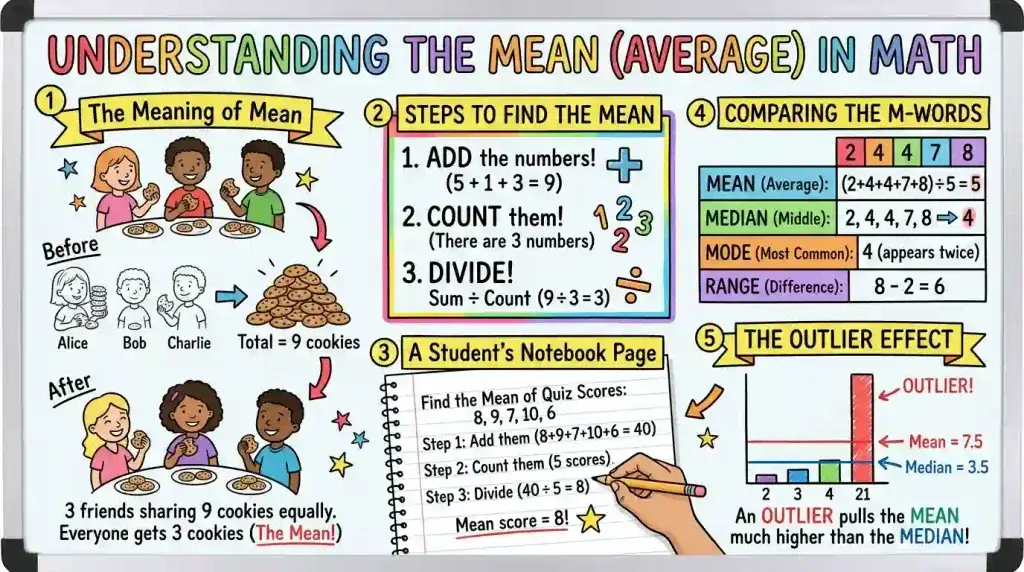
In math, the mean is a single number that stands for the “center” of a set of numbers. Think of it as a fair share. If everyone in a group put their numbers into one big pile and then shared that pile equally, each person would get the mean.
Here is a quick picture. Imagine three friends have 2 cookies, 4 cookies, and 6 cookies. That is 12 cookies in all. If they share equally, each friend gets 4 cookies. So the mean of 2, 4, and 6 is 4. Nobody had exactly the “average” amount at first, but the mean tells you what each person would have if things were made even.
Most of the time, when a teacher says “mean,” they mean the arithmetic mean. That is the kind you find by adding and dividing. Another word for it is the average. In everyday talk, people say “average” all the time. In math class, you will hear “mean” more often because the word “average” can be a little loose. Median and mode are also kinds of averages, so “mean” is the clearer word.
One more thing to know: the mean does not have to be a number in your list. In our cookie example, the mean was 4, and 4 was in the list. But if you had 2, 3, and 6, the mean would be about 3.67. That number is not in the list, and that is perfectly fine.
How to Find the Mean Step by Step
Finding the mean takes only three steps. Once you learn them, you can do it with any list of numbers, short or long.
First, add up all the numbers in your list. This total is called the sum. Second, count how many numbers are in the list. Third, divide the sum by that count. The answer is your mean.
The rule can be written as a tiny formula: mean = sum of the numbers ÷ how many numbers there are.
Let’s try it with the numbers 4, 6, 8, 10, and 12. The table below shows each step.
| Step | What You Do | Result |
| 1 | Add the numbers: 4 + 6 + 8 + 10 + 12 | 40 |
| 2 | Count the numbers in the list | 5 |
| 3 | Divide the sum by the count: 40 ÷ 5 | 8 |
So the mean is 8. A nice trick to check your work: the mean should always land somewhere between the smallest and largest numbers. Here, 8 sits between 4 and 12, so it makes sense. If you ever get an answer outside that range, you made a mistake somewhere, and it is time to go back and look.
Worked Examples You Can Try
Seeing the mean in action helps it stick. Here are a few examples, starting easy and getting a little harder.
Example 1: Test scores. Maya scored 80, 90, 70, 100, and 60 on five quizzes. Add them up: 80 + 90 + 70 + 100 + 60 = 400. There are 5 quizzes, so 400 ÷ 5 = 80. Her mean quiz score is 80.
Example 2: Money. Three snacks cost $2.50, $3.00, and $4.50. The total is $10.00. Divide by 3, and you get about $3.33. The mean price of a snack is $3.33. Notice that the answer was rounded. Many means come out as long decimals, so your teacher will often tell you how to round.
Example 3: Finding a missing number. This one shows up on tests a lot. The mean of five numbers is 12. Four of the numbers are 10, 12, 14, and 11. What is the fifth number? Start by working backward. If the mean is 12 and there are 5 numbers, the total must be 12 × 5 = 60. The four known numbers add up to 47. So the missing number is 60 − 47 = 13. You can check it: 10 + 12 + 14 + 11 + 13 = 60, and 60 ÷ 5 = 12. It works.
Example 4: Weighted mean. Sometimes numbers do not count equally. Say a class grade is made of homework (20%), quizzes (30%), and tests (50%). A student earns 90 on homework, 80 on quizzes, and 70 on tests. Multiply each score by its share: 90 × 0.20 = 18, 80 × 0.30 = 24, and 70 × 0.50 = 35. Add them: 18 + 24 + 35 = 77. The weighted mean is 77. Notice that a plain mean of 90, 80, and 70 would be 80, which is quite different. Weights matter.
Mean vs. Median vs. Mode vs. Range
These four words travel together in math class, and they are easy to mix up. Each one tells you something different about a set of numbers. Here is how they compare.
| Term | What It Tells You | How to Find It | Example with 2, 3, 3, 5, 7 |
| Mean | The average, or fair share | Add all, divide by the count | 20 ÷ 5 = 4 |
| Median | The middle number | Put in order, pick the middle | 3 |
| Mode | The number that appears most | Find the most common value | 3 |
| Range | How spread out the numbers are | Largest minus smallest | 7 − 2 = 5 |
A fun way to remember them is this. The median is like the middle of a road, because it sits right in the center. The mode sounds like “most,” because it is the number that shows up most often. The range tells how far the numbers stretch. And the mean is the one that needs the most math, so you can think of it as the “mean” one that makes you add and divide.
Notice that in this example, the mean is 4 but the median and mode are both 3. They do not have to match. Each one gives a different view of the same list, and a good math thinker knows which one to use for the job.
Why Is It Called the “Mean”?
The word “mean” has a long history, and it helps to know a little of it. In this sense, “mean” comes from an old word meaning “middle.” It traces back through Old French to the Latin word medius, which also means “middle.” That is the same root behind words like “medium” and “median.”
So when math people say “mean,” they are talking about a middle value. This has nothing to do with being unkind. English has two very different words that are spelled the same way. One means “cruel or unfriendly.” The other means “middle,” and that is the one used in math.
Ancient Greek mathematicians studied different kinds of means long ago, so the idea is very old. People have always needed a way to find a fair middle value, if they were dividing food, trading goods, or studying the stars. If you want exact details about who first used the word in writing, a good math history source or dictionary of word origins is the best place to look. It is better to check than to guess.
Symbols and Special Kinds of Mean
When you move on to higher grades, you will see the mean written with special symbols. Do not worry. They are just shortcuts. Here are the most common ones.
| Symbol | How to Say It | What It Means |
| x̄ | “x-bar” | The mean of a sample, which is a smaller group taken from a bigger one |
| μ | “mu” (say “myoo”) | The mean of a whole population, which is the full group |
| Σ | “sigma” | “Add them all up” |
| n | “n” | How many numbers are in your list |
A sample mean is useful because it is often too hard to measure everyone. If you want to know the average height of students in your country, you cannot measure every child. So you measure a smaller group, find x̄, and use it to estimate μ.
There are also other kinds of means, though you will not need them right away. The weighted mean, which you saw earlier, gives some numbers more importance than others. The geometric mean multiplies numbers and then takes a root. It is often used for growth rates, like how money grows over time. The harmonic mean is used for rates, such as average speed over equal distances. For most school math, the plain arithmetic mean is the star of the show.
One more small point may surprise you. In a proportion like 2 : 4 = 3 : 6, the two inner numbers, 4 and 3, are called the “means,” and the two outer numbers are called the “extremes.” This is a different use of the word, so watch for the context.
When the Mean Works Best (and When It Doesn’t)
The mean is a great tool, but it is not perfect for every job. It works best when your numbers are fairly close together and no single number is far away from the rest.
It runs into trouble when there is an outlier. An outlier is a number that is much bigger or much smaller than the others. Because the mean uses every number in its math, one extreme value can pull it far off.
Here is an example. Five people at a small company earn $30,000, $32,000, $35,000, $38,000, and $200,000. The total is $335,000. Divided by 5, the mean salary is $67,000. But four of the five people earn far less than that. The median, which is the middle number, is $35,000, and it gives a much better picture of what a typical worker earns.
So here is a good rule of thumb. If your data is fairly even, use the mean. If your data has a few very large or very small numbers, the median may tell the story better. Many news reports and government studies use the median for things like home prices and income for exactly this reason.
Common Mistakes to Avoid
Even strong students slip up on the mean. Here are the mistakes that happen most often, and how to dodge them.
The first mistake is dividing by the wrong number. Always divide by how many numbers are in the list, not by the biggest number or the sum. Count carefully, especially when a number appears more than once. If the number 5 shows up three times, it counts three times.
The second mistake is forgetting zeros. If a student got a 0 on a quiz, that zero still counts. Leaving it out would make the mean too high. Zero is a real number, and it belongs in your count.
The third mistake is mixing up mean, median, and mode. If you are asked for the mean, do not put the numbers in order and pick the middle. That is the median. Read the question slowly and match the word to the method.
The fourth mistake is rounding too early. If you round in the middle of your work, your final answer can be a little off. Wait until the very end to round.
The fifth mistake is not checking if the answer makes sense. As we said before, the mean has to be between the smallest and biggest numbers. Take two seconds to check. It can save you from careless errors.
Real Life Uses of the Mean
You may think the meaning is only a school thing, but you use it, or see it, almost every day.
In sports, a basketball player’s points per game is a mean. If a player scores 12, 18, and 15 points in three games, the mean is 15 points per game. Fans and coaches use that number to compare players.
At school, your grade point average is a kind of mean. Teachers also use the mean to see how a whole class did on a test.
In weather, the mean temperature for a day or a month helps people know what to expect. Farmers, travelers, and city planners all use it.
In shopping and money, the mean price helps you compare costs. A family may find the mean amount they spend on groceries each week so they can plan a budget.
In science, researchers measure things many times and then find the mean to get a more trustworthy result. One measurement might be a little off, but the mean of many measurements is usually closer to the truth.
Even your phone uses it. Fitness apps show your mean daily steps, and games show your mean score. Once you start looking, the mean is everywhere.
Tips for Remembering and Practicing the Mean
Learning the mean gets easier with a few smart habits.
Try the “fair share” idea whenever you feel stuck. Ask yourself, “If everything were made equal, how much would each one get?” That picture can help you remember why you add first and then divide.
Make up your own problems. Use numbers from your life, like the number of pages you read each night or the money you save each week. Real numbers feel more interesting than made-up ones.
Use a simple memory line: “Add them up, then share them out.” Say it a few times, and it will stick.
Always estimate first. Before you do the math, guess where the mean might land. If your list is 18, 20, 22, and 24, you can tell the mean will be around 21. If you get 210 or 2.1, you know right away that something went wrong.
Practice with different kinds of numbers, such as whole numbers, decimals, and money. Then try missing-number problems. They look tricky, but they use the same idea in reverse.
Finally, be kind to yourself. Everyone makes small math errors. What matters is checking your work and learning from it.
FAQs
What is the mean in math in simple words?
The mean is the average of a group of numbers. You add all the numbers and divide by how many numbers there are. It shows what each number would be if they were all made equal.
Is the mean the same as the average?
Usually, yes. When people say “average,” they most often mean the mean. But “average” can also mean the median or the mode, so “mean” is the more exact word in math.
What is the formula for the mean?
The formula is the sum of all the numbers divided by the count of numbers. In symbols, it is x̄ = Σx ÷ n. In plain words, add them all and divide by how many there are.
Can the mean be a decimal or a fraction?
Yes. The mean often comes out as a decimal or fraction, even when all the numbers in your list are whole numbers. For example, the mean of 2, 3, and 6 is about 3.67.
What is the difference between mean and median?
The mean is found by adding and dividing. The median is the middle number when the list is in order. The mean can be pulled by very large or very small numbers, while the median stays steady.
Why does one big number change the mean so much?
The mean uses every number in the list, so a very large or very small number has a strong pull. That is why the mean can look too high or too low when there is an outlier.
Conclusion
Now you know the mean meaning in math from start to finish. The mean is the average of a set of numbers, and you find it by adding them up and dividing by how many there are. It is a fair-share number that helps you understand a whole group at a glance. You also learned how it differs from the median, mode, and range, why one extreme number can throw it off, and where it shows up in sports, school, money, and science.
The most important habits are simple. Count carefully, include every number (even zeros), and check that your answer falls between the smallest and largest values. Practice with numbers from your own life, and the steps will soon feel natural. Keep this guide handy, and the next time you see the word “mean” on a worksheet, you will know just what to do.

Hello, I’m Clara Whitmore. I write daily prayers, devotionals, and faith-based reflections for readers seeking peace and encouragement. I believe prayer has the power to heal hearts and renew faith.