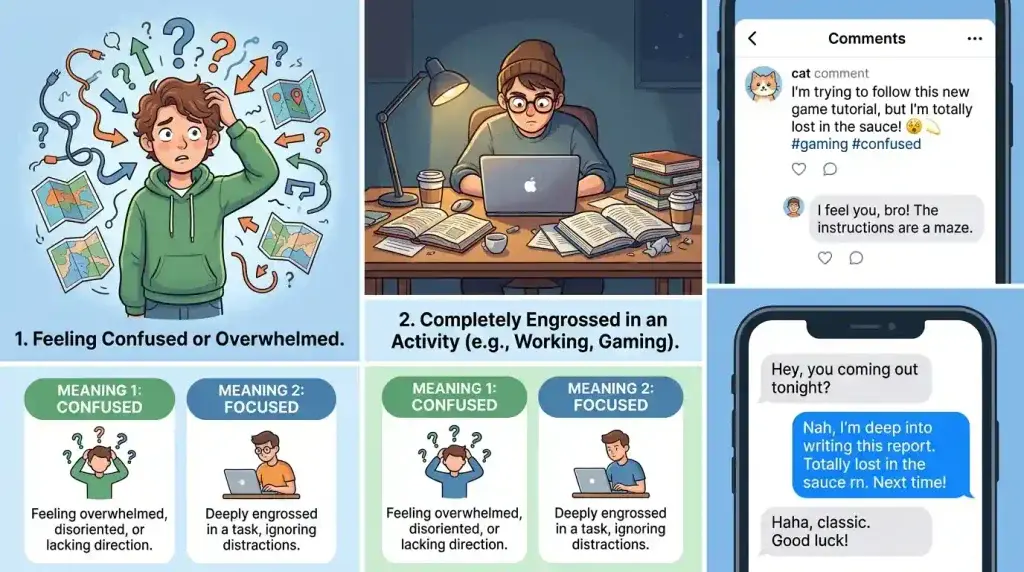
Have you seen someone say “lost in the sauce” online and wondered what it means? You are not alone. This phrase pops up a lot on social media, in text messages, and even in everyday talk. The lost in the sauce meaning is simple: it means being confused, distracted, or so caught up in something that you lose track of what is really going on. Sometimes it means being deep into a project or a moment.
Other times it means someone is out of touch with reality. In this article, you will learn exactly what this phrase means, where it came from, how to use it the right way, and how people use it today.
By the end, you will feel confident using “lost in the sauce” in your own conversations.
Quick Answer
If you only have a few seconds, here is the short version. “Lost in the sauce” means someone is confused, distracted, or unaware of what is happening around them. It can also mean someone is fully focused on a task, almost in a trance-like way. The meaning shifts a little depending on how it is used, but confusion and deep focus are the two main ideas. It is casual slang, mostly used online and among younger speakers, and it is not something you would use in a formal essay or business email.
Meaning or Definition
At its core, “lost in the sauce” is a slang phrase with two close meanings. The first meaning describes someone who is confused or out of the loop. For example, if your friend keeps asking questions that everyone already answered, you might say, “Bro is lost in the sauce.” This means they are behind, mixed up, or not paying attention.
The second meaning describes someone who is deeply focused on something, almost too focused. This could be a person working hard on a project, dancing at a party, or grinding through a video game. In this sense, “the sauce” represents a state of flow or intense concentration. Being “lost” in it means you are fully absorbed, sometimes to the point of losing awareness of everything else.
Here is a simple breakdown of both meanings:
| Meaning | Example Sentence | Feeling Behind It |
| Confused or unaware | “Why is he lost in the sauce? We already moved on from that topic.” | Frustration or mild teasing |
| Deeply focused or in the zone | “She’s lost in the sauce with her art project, she hasn’t looked up in hours.” | Admiration or amazement |
Context clues in a sentence usually tell you which meaning is being used. If the tone sounds negative or mocking, it likely means confused. If the tone sounds impressed or neutral, it likely means deeply focused.
Grammar or Correct Usage
“Lost in the sauce” works as an idiom, which means the words together create a meaning that is different from their individual definitions. Grammatically, it functions as an adjective phrase. It usually follows a form of the verb “to be,” such as “is,” “was,” “are,” or “were.”
Here are some correct usage patterns:
- “He is lost in the sauce right now.”
- “They were lost in the sauce during the meeting.”
- “Don’t get lost in the sauce.”
- “I felt lost in the sauce after missing the first half of the movie.”
You should avoid changing the phrase into other tenses in odd ways, like “he sauced” or “lost-in-the-saucing.” The phrase stays fixed as “lost in the sauce,” and only the surrounding verb changes tense. It is also common to add “in” or “about” a specific topic, such as “lost in the sauce about the new rules.”
Since this phrase is informal, it fits best in casual writing, text messages, social media captions, or spoken conversation. It is not appropriate for formal essays, business reports, or academic writing.
Origin or History
The exact origin of “lost in the sauce” is hard to pin down with full certainty, since slang often spreads through word of mouth and social media before anyone tracks its first use. However, language researchers and online slang trackers generally agree that the phrase grew out of hip-hop and internet culture, particularly gaining traction through African American Vernacular English (AAVE), which has shaped a large amount of modern slang used across the internet.
The word “sauce” itself has been used in slang for years to represent style, confidence, or flavor, as in phrases like “he’s got sauce,” meaning someone has swagger or skill. Over time, “the sauce” evolved to represent a broader idea, a state of being, a vibe, or a zone. Being “lost” in that state naturally came to mean being deeply immersed in it or, in a twist, completely unaware and out of sync with it.
Social media platforms like Twitter, TikTok, and Instagram helped the phrase spread quickly during the late 2010s and into the 2020s. Memes, comment sections, and short video captions used it constantly, which helped cement it as common slang among younger internet users.
Common Mistakes
Even simple slang phrases can be used incorrectly. Here are some common mistakes people make with “lost in the sauce” and how to fix them.
| Mistake | Why It’s Wrong | Correct Version |
| “He’s lost in sauce.” | Missing the article “the” | “He’s lost in the sauce.” |
| Using it in formal writing | Too casual for professional context | Use “confused” or “unaware” instead |
| Assuming it always means something negative | It can also mean focused or in the zone | Check the context before assuming tone |
| Overusing it in every sentence | Makes writing feel repetitive | Mix it with other expressions occasionally |
| Using it about serious or sensitive topics | Can come across as dismissive | Save it for casual, low-stakes situations |
One more mistake worth mentioning is confusing “lost in the sauce” with “lost in translation.” These phrases are completely different. “Lost in translation” refers to meaning that gets confused between languages or communication styles. “Lost in the sauce” is about personal confusion or deep focus, not language barriers.
Real-Life Examples
Seeing the phrase in real situations makes it easier to understand. Here are several examples across different settings.
In a group chat, someone might type, “Wait, are we still meeting at 6 or 7? I’m lost in the sauce.” This shows simple confusion about plans.
During a gaming stream, a viewer might comment, “He’s been lost in the sauce for two hours straight, he hasn’t blinked.” This shows deep focus and intensity.
At school, a student might whisper to a friend, “The teacher moved on three slides ago and I’m still lost in the sauce.” This shows falling behind and feeling confused.
On social media, a caption under a photo of someone painting might read, “Lost in the sauce creating something new tonight.” This shows creative focus and flow.
In sports commentary, someone might say about a player, “He was lost in the sauce out there, missing easy passes all game.” This shows a lack of awareness or poor performance due to confusion.
These examples show how flexible the phrase really is. The same three words can shift meaning slightly depending on tone, setting, and who is speaking.
Current Usage or Trends
“Lost in the sauce” remains a widely used phrase across social media, especially on platforms like TikTok, Twitter (X), Instagram, and Reddit. It often appears in comment sections when someone seems confused about a conversation or when a creator is deeply focused on a task in a video.
The phrase has also crossed into gaming communities, where it describes players who are either completely dialed in during a match or completely oblivious to what is happening around them. Streamers use it often when reacting to gameplay, both their own and their viewers’.
Music and pop culture references have kept the phrase alive as well. Artists sometimes use “sauce” in lyrics to represent style or confidence, which keeps the broader idea of “the sauce” relevant in youth culture. As a result, “lost in the sauce” continues to feel fresh rather than outdated, even years after it became popular.
It is worth noting that slang phrases like this one can fade or shift meaning over time. Right now, though, “lost in the sauce” shows strong staying power, especially among Gen Z and younger Millennial speakers online.
Tips or Best Practices
If you want to use “lost in the sauce” naturally, keep these tips in mind.
First, match the tone to the situation. If you are teasing a friend for being confused, keep it lighthearted. If you are describing someone’s intense focus, use it with a tone of admiration or surprise.
Second, avoid using it in professional or formal settings. Save it for texts, social media captions, casual conversations, or informal writing like blog comments.
Third, pay attention to context clues before using or interpreting the phrase. Since it has two possible meanings, the surrounding words will tell you If it means confusion or deep focus.
Fourth, do not force it into every sentence. Slang works best when it feels natural, not repetitive. Overusing any phrase, even a fun one, can make writing feel forced.
Finally, listen to how younger speakers or content creators use it online. Slang changes quickly, and staying aware of current usage helps you use phrases like this one correctly and confidently.
FAQs
What does “lost in the sauce” mean?
It means being confused or unaware of what is happening, or being deeply focused on something to the point of losing track of everything else.
Is “lost in the sauce” a compliment or an insult?
It depends on context. It can be a lighthearted insult about confusion, or a compliment about someone’s intense focus and dedication.
Where did “lost in the sauce” come from?
It likely grew from hip-hop and internet slang culture, where “sauce” already meant style or confidence, and later evolved to represent a state of flow or confusion.
Can I use “lost in the sauce” in formal writing?
No, it is considered casual slang and does not fit formal essays, emails, or professional documents.
Is “lost in the sauce” the same as “lost in translation”?
No, these phrases mean different things. “Lost in translation” refers to communication or language confusion, while “lost in the sauce” refers to personal confusion or deep focus.
Is this phrase still popular today?
Yes, it remains widely used across social media platforms, especially among younger audiences on TikTok, Twitter, and Instagram.
Conclusion
The phrase “lost in the sauce” captures two very human experiences: feeling confused and losing track of things, or becoming so focused on something that the rest of the world fades away. Understanding both meanings helps you use the phrase correctly and understand it when others use it around you. It started in hip-hop and internet culture and has grown into everyday slang, especially online.
Since it is casual, save it for text messages, social media, and relaxed conversations rather than formal writing.
Now that you know the full meaning, history, and correct usage, you can confidently drop “lost in the sauce” into your next chat without missing a beat.

Hi, I’m Sarah Mitchell. I love writing faith-based content that brings peace, hope, and encouragement to everyday life. Through prayers and devotionals, my goal is to help readers feel closer to God and stronger in faith.