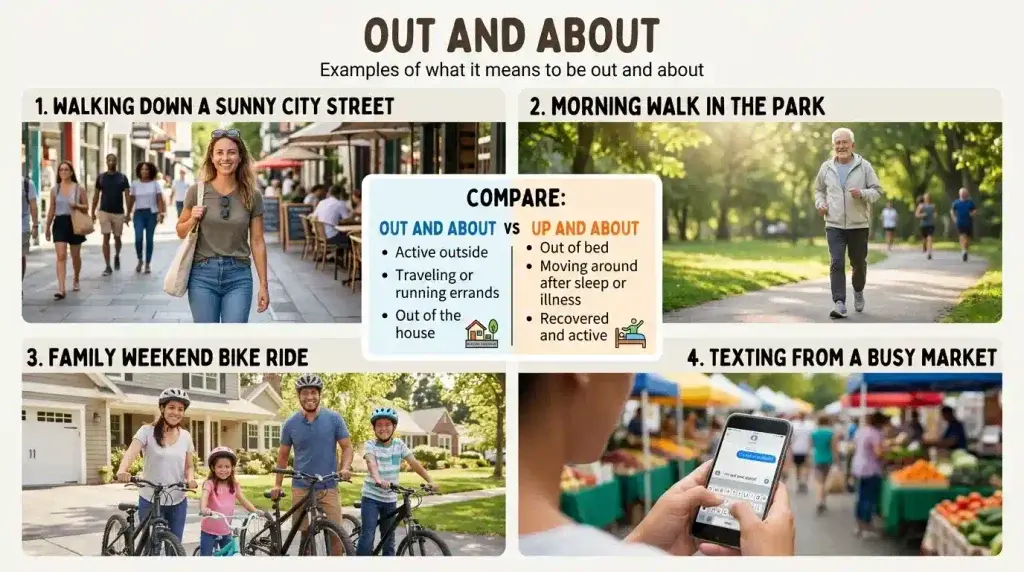
Have you ever heard someone say, “I’ll be out and about today”? The out and about meaning is simple: it describes a person who is away from home, moving around, and doing things outside. It can also mean a person who is active again after being sick.
Many people search for this phrase because it sounds casual but can feel a little unclear at first. You may see it in a text message, a news story, or a chat with a neighbor. In this guide, you will learn what the phrase means, how to use it in a sentence, where it may have come from, and which mistakes to avoid. You will also find easy examples, helpful tables, and clear answers to common questions. Let’s get started.
Out and About Meaning: The Quick Answer
Out and about means being outside your home and moving from place to place. A person who is out and about is not stuck indoors. They might be walking, driving, shopping, visiting friends, or running errands.
The phrase also tells us that the person is active and able to get around. If your grandfather says, “I’m out and about every morning,” he means he leaves the house and stays busy.
There is a second meaning too. After someone has been sick or hurt, friends may say, “It’s good to see you out and about again!” That means the person feels well enough to go places and live normally.
In both cases, the phrase sounds warm and relaxed. It is an easy way to talk about daily life outside the front door.
What Does “Out and About” Really Mean?
Let’s break the phrase into small parts. The word “out” means outside, away from a place. The word “about” here means “around” or “in different places.” Put them together, and you get the picture of someone going around outside.
Notice that the phrase does not tell you exactly where the person is. That is part of its charm. When someone says, “I’ve been out and about all day,” you know they were busy and on the move. You do not know if they were at the bank, the park, or the grocery store. The speaker is giving you the big picture, not the small details.
The phrase carries three ideas at once. The first is location, because the person is not at home. The second is activity, because the person is doing things. The third is health or energy, because being able to go out often means a person feels well.
This is why the same phrase can fit many moments. A busy parent can be out and about. A tourist can be out and about. A neighbor who just got over a cold can be out and about. The mood is almost always friendly and light, so people use it more in conversation than in serious writing.
How to Use Out and About in a Sentence
Using this phrase is easy once you see the common patterns. It usually follows a form of the verb “to be,” as in “I am out and about.” It also works with verbs like “get,” “go,” “see,” and “spot.”
Here is a quick table to show the most common patterns.
| Pattern | Example Sentence | What It Means |
| be out and about | “She is out and about this afternoon.” | She is outside and busy. |
| get out and about | “You should get out and about more.” | You should leave home and be active. |
| see someone out and about | “I saw Mr. Lee out and about today.” | I saw him in public, outside his home. |
| back out and about | “Mom is back out and about after her surgery.” | She is well enough to go places again. |
| out and about town | “We were out and about town all Saturday.” | We went around the town doing things. |
A few grammar notes can help. First, the phrase works like an adverb phrase. It tells us how or where someone is. You would not usually put it in front of a noun, so saying “an out and about person” sounds odd.
Second, it fits best in casual speech and friendly writing. It is fine in emails to coworkers you know well, in blog posts, and in news stories about local life. For a very formal letter, a plain phrase like “away from the office” may sound better.
Third, you can add a time or a place after it. “Out and about in the city,” “out and about this weekend,” and “out and about with the kids” all sound natural.
Real Life Examples of Out and About
Examples make a phrase stick. Here are common situations where people use it, along with what each one really says.
| Situation | Example | Hidden Message |
| A busy workday | “I’m out and about, so text me.” | I’m not at my desk. |
| Recovering from illness | “Glad to see you out and about!” | You look healthy again. |
| Weekend fun | “We were out and about all Sunday.” | We went to several places. |
| Travel | “Tourists are out and about in the old town.” | Visitors are walking around. |
| Pets and kids | “The kids are out and about on their bikes.” | They are playing outside. |
Now let’s look at a few short stories.
Maria works as a delivery driver. When her friend calls, she says, “Can I call you back? I’m out and about right now.” She means she is on the road and cannot sit and talk.
Mr. Johnson broke his leg in the winter. By spring, he was walking with a cane. His neighbor waved and said, “Look at you, out and about again!” Mr. Johnson smiled because the phrase felt like good news.
On the first sunny day of the year, a small town fills with people. A local reporter writes, “Families were out and about enjoying the warm weather.” No one needs a long explanation. Everyone pictures people strolling, eating ice cream, and chatting on the sidewalk.
These examples show how flexible the phrase is. It can describe work, health, fun, or travel, and it always points to a person who is outside and moving.
Where Does Out and About Come From?
People love to ask about the history of a phrase, but here the honest answer is that the exact first use is hard to pin down. Dictionaries list “out and about” as a long-standing English expression, and it has been in common use for a long time, with older examples found in writing from past centuries.
What we can say with confidence is this. The word “about” has long been used in English to mean “moving around” or “in action.” That is why older phrases like “up and about” appeared first in connection with people getting out of bed after an illness. The phrase “out and about” likely grew from this same idea. It stretched the meaning from “up from bed” to “out of the house.”
We should be careful, though. No single person is known to have invented the phrase, and no famous story explains it. If you see a website claiming a very specific origin with a date and a name, be careful. It is better to say the phrase grew naturally from everyday speech and was used widely over time.
For deeper research, trusted sources like the Oxford English Dictionary or Merriam-Webster can show early examples and how the meaning has changed.
Out and About vs. Up and About
Many readers also search for “up and about,” and the two phrases are close cousins. They sound alike, and people sometimes mix them up. The main difference is where the focus lies.
“Up and about” often means a person is awake, out of bed, and moving around, usually after sleep or sickness. “Out and about” often means a person is outside the home and active in public.
| Feature | Out and About | Up and About |
| Main idea | Outside the home, going places | Out of bed, moving around |
| Common setting | Streets, shops, parks, town | Home, bedroom, kitchen |
| Used after illness? | Yes, when a person leaves the house | Yes, when a person leaves the bed |
| Example | “He’s out and about again.” | “She’s up and about early today.” |
| Feeling | Social and active | Awake and energetic |
Here is an easy way to remember it. “Up” is about getting out of bed. “Out” is about getting out of the house.
Both phrases can describe recovery. A person may first be “up and about” in the living room. A week later, they may be “out and about” at the grocery store. That is a nice, simple way to show the two stages of getting better.
Words and Phrases With a Similar Meaning
Sometimes you want a fresh way to say the same thing, especially if you use the phrase often. The table below shows other options and when each one fits best.
| Phrase | Example | Best Used When |
| on the go | “I’m on the go all day.” | You are busy and moving fast |
| running errands | “I’m running errands in town.” | You have small tasks to finish |
| around town | “We were around town all day.” | You are visiting local places |
| getting around | “Grandma is getting around well.” | Talking about movement or health |
| out and around | “She’s out and around again.” | Casual speech, less common |
| away from home | “He’s away from home this week.” | A more formal tone |
Each phrase has its own flavor. “On the go” sounds rushed. “Running errands” sounds like a to-do list. “Out and about” feels softer and more open. It lets the listener imagine many small activities without a strict plan.
Using a mix of these phrases can keep your writing from sounding repetitive. Still, “out and about” has a warm feel that the others do not always match.
British vs. American English
Is “out and about” more British or more American? The truth is that people in both places know it and use it. The meaning does not change from one side of the ocean to the other.
You may notice small habits in how it is used. In travel and tourism writing, “get out and about” is a popular call to action in many English-speaking countries. Local guides, city websites, and community groups often use it to invite people to explore. In both American and British English, “out and about” also appears in news stories about weather, health, and local events.
There is no special spelling difference, and the grammar rules are the same. If you are writing for an American audience, you can use the phrase freely, as long as the tone is casual or friendly.
Be careful with claims that one country uses the phrase far more than the other. Without strong data, it is safer to say it is common in both. What matters most is that your reader understands you.
Common Mistakes to Avoid
Even simple phrases can trip people up. Here are the mistakes that show up most often.
The first mistake is mixing it up with “up and about.” Some writers use the two as if they always mean the same thing. They often overlap, but “out” points to leaving the house, and “up” points to leaving the bed. Pick the one that matches your message.
The second mistake is using it in very formal writing. In a legal paper, a business contract, or a school report, the phrase may sound too relaxed. Choose a more direct phrase there, such as “away from the premises” or “traveling.”
The third mistake is changing the order of the words. “About and out” or “out about and” does not work. The phrase is fixed, so keep the order as it is.
The fourth mistake is using it for things instead of people. You would not say, “The mail is out and about.” It describes people, and sometimes animals, like “The cat is out and about tonight.” For objects, it sounds strange.
The fifth mistake is thinking it must mean something exciting. Being out and about can be plain and ordinary. Taking a short walk to the corner store counts. The phrase simply says you are outside and active.
Last, avoid stretching the phrase to mean something negative, such as “out and about causing trouble,” unless the context is clear. Most of the time, the phrase sounds friendly and neutral.
How People Use Out and About Today
Today, “out and about” shows up in many places beyond casual talk. Knowing these uses can help you spot it and use it in your own writing.
On social media, people use it in photo captions. A picture of a coffee cup and a sunny street might say, “Out and about this morning!” It tells friends that the person is enjoying the day outside. You will also see it as a hashtag on posts about travel, shopping, hiking, and city life.
In text messages and calls, it is a handy way to say you are busy and on the move. “I’m out and about, can I call you later?” is a polite way to pause a chat without giving every detail.
Local news and community websites use it often. Reporters write that “residents were out and about after the storm” or that “shoppers were out and about on the first day of the sale.” It paints a quick picture without needing more words.
Health stories use it too. When a public figure returns after an illness, writers may say that the person was “seen out and about” for the first time in weeks. This use matches the older meaning of recovery.
Businesses also love the phrase. Small shops, tour groups, and city programs may use titles like “Out and About Saturdays” or “Get Out and About This Summer.” It sounds friendly and invites people to step outside.
One small trend is worth noting. As more people work from home, the phrase has taken on a new flavor. Telling someone you are “out and about” can now mean you left your home office for a break, a walk, or a day of errands. It suggests a change of scenery as much as a change of place.
Tips for Using Out and About Naturally
If you want to use this phrase like a native speaker, a few easy habits will help.
Start with the right mood. Use it when the tone is light, friendly, or neutral. It fits chats, emails to friends, blog posts, and community news.
Add a little detail when it helps. “I’ll be out and about this afternoon” is fine, but “I’ll be out and about this afternoon, so I may miss your call” gives the listener useful information.
Pair it with a time or place. Phrases like “out and about this weekend” or “out and about downtown” make the sentence feel complete and natural.
Do not overuse it. If you say it three times in one paragraph, it will sound odd. Mix in other phrases, such as “on the go” or “running errands,” to keep your writing fresh.
Match it to your reader. If you are writing for children or English learners, add a short example right after it. A quick line such as “That means she is outside and busy” makes the meaning clear.
Finally, trust your ear. Say the sentence out loud. If it sounds like something a friendly neighbor might say, you are probably using it well.
FAQs
What is the simple out and about meaning?
It means being outside your home and moving around, doing normal things like shopping, walking, or visiting. It can also mean being well enough to leave home after an illness.
Is “out and about” an idiom?
Yes. An idiom is a phrase whose meaning is more than its single words. Here, “out” and “about” together describe a person who is active outside, and that meaning is understood as a whole.
Can I say “out and about” in formal writing?
It is better in casual or friendly writing. For formal papers, reports, or legal documents, a plainer phrase usually works better. In a friendly business email, it is usually fine.
What is the difference between “out and about” and “up and about”?
“Out and about” points to being outside the home and active. “Up and about” points to being out of bed and moving. Both can describe someone getting better after being sick.
Does “out and about” always mean someone was sick before?
No. Most of the time, it just means a person is outside and busy. The illness meaning only applies when the context makes it clear, such as “good to see you out and about again.”
What are some other ways to say “out and about”?
You can say “on the go,” “running errands,” “around town,” or “getting around.” Each one has a slightly different feel, so pick the one that fits your sentence best.
Conclusion:
The out and about meaning is easy to remember once you see the picture. It describes a person who is outside the home, moving around, and doing everyday things. It can also describe someone who feels well enough to go out again after being sick or hurt. The phrase is friendly, casual, and flexible, which is why people use it in texts, news stories, and social media posts.
We also learned that it is close to “up and about,” but not exactly the same. “Up” is about leaving the bed, and “out” is about leaving the house. Keep the words in the right order, avoid using it in very formal writing, and add small details to make your sentences clear.
Now it is your turn. Try using the phrase in a message to a friend this week. Say it out loud, keep it natural, and enjoy getting out and about.

Hello, I’m Clara Whitmore. I write daily prayers, devotionals, and faith-based reflections for readers seeking peace and encouragement. I believe prayer has the power to heal hearts and renew faith.