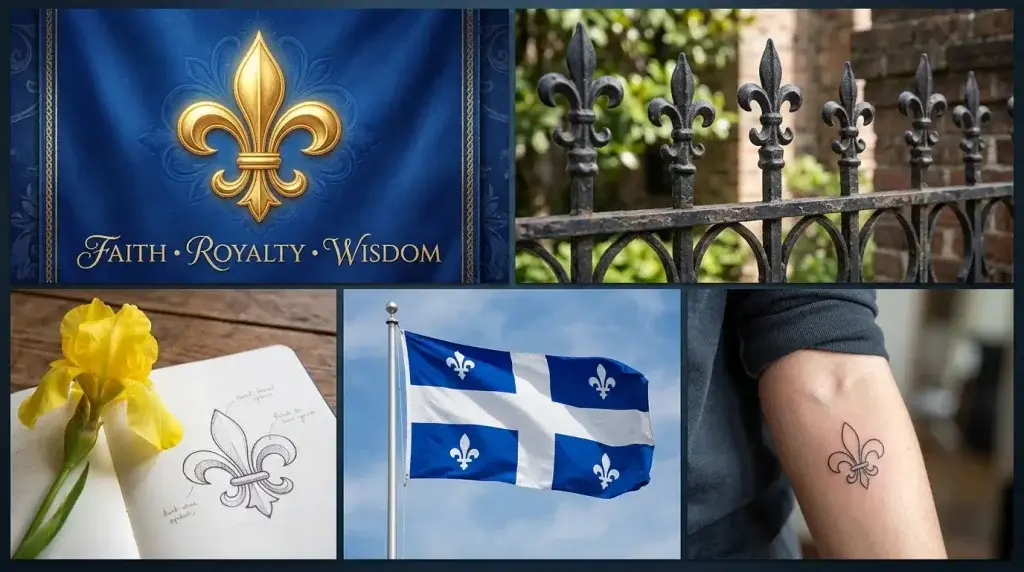
The fleur de lis meaning is simple at its core. This pretty symbol stands for royalty, purity, faith, and honor. It looks like a lily flower with three petals, and people have used it for hundreds of years. You have probably seen it on flags, iron gates, jewelry, and football helmets. But why is it everywhere, and what is it really saying? Many people search for the fleur de lis meaning because they spotted it in a city, on a gift, or in a tattoo design.
They want a clear answer without a long history lecture. This guide gives you that. You will learn what the words mean, where the symbol may have started, what the three petals stand for, and where people use it today. We will also look at the harder parts of its past, because the full story matters.
Fleur de Lis Meaning: The Quick Answer
In short, the fleur de lis is a symbol of royalty, purity, faith, and honor. It began as a symbol of French kings. Over time, it also became linked to the Christian faith, the French people, and many groups around the world.The meaning can change a little depending on who is using it.
So there is no single meaning. There is a core idea, which is honor and royal power. Then there are layers that people have added over the years.
What Does Fleur de Lis Mean in French?
The words come from French. Fleur means “flower.” Lis means “lily.” Put together, fleur de lis means “flower of the lily.” Some people write it as fleur-de-lis with dashes, and that is fine too. When you talk about more than one, you say fleurs-de-lis.
How do you say it? Most Americans say “flur-duh-LEE.” Some say “flur-duh-LEES.”
You may also see the spelling fleur-de-lys. This version shows up often in British writing and in books about heraldry, which is the study of coats of arms. In the United States, fleur de lis is the more common spelling. They mean the same thing.
Here is a fun twist. Even though the name says “lily,” many experts think the shape looks more like an iris. The yellow iris grows wild along rivers in France. Its flower has three upright petals and three drooping ones, which looks a lot like the symbol. Still, the name stuck, and the lily is the flower most people connect with it.
What the Three Petals Stand For
The classic fleur de lis has three main parts. One petal stands straight up in the middle. Two petals curl out to the sides. A band ties them together near the bottom. That simple shape is easy to spot and easy to draw, which is one reason it has lasted so long.
Over the years, people have given each petal a meaning. Some of these ideas come from old traditions and not from proven facts. Even so, they are a big part of why the symbol feels so rich. Here are the most common ones.
| Idea | What it stands for | Where the idea comes from |
| Royalty | Power, the right to rule | French kings used it on shields, crowns, and robes |
| Purity | Goodness, innocence | The white lily has long meant purity in Christian art |
| The Trinity | Father, Son, and Holy Spirit | The three petals match the Christian idea of three-in-one |
| Faith, wisdom, and chivalry | Three good qualities of a knight or ruler | A popular medieval explanation |
| Three groups of people | Church leaders, nobles, and common people | An old explanation of French society |
| Direction | Leading the way | Used on compasses and by Scouts |
Notice that these meanings do not fight each other. A symbol can mean many things at once. Most of them rest on the same simple thread: something noble, good, and worth honoring.
Fleur de Lis Origin and History
Here is where we need to be careful. Nobody knows for sure where the fleur de lis began.
First, flower shapes like this are very old. Lily-like designs appear in the art of ancient places such as Egypt and Mesopotamia. People in many cultures found beauty in this shape long before France was a country. So the fleur de lis did not appear out of nowhere.
Second, there is a famous legend about Clovis. He was a king of the Franks, and he became a Christian around the year 496. One story says a lily was given to him as a sign from heaven after he turned to the faith. Another tale says his old symbol was three toads, and a holy man swapped them for lilies. These are nice stories, but they are legends.
Third, there is the river idea. Some people think the symbol came from the yellow iris that grows near rivers in France. One tale says a king used the flower to find a safe place to cross water. Again, it is a story, and it is hard to prove.
What we do know is clearer once we reach the 1100s. King Louis VII, who ruled France from 1137 to 1180, is the first king strongly linked to the flower as a royal sign. Some people suggest that “fleur de Louis,” or “flower of Louis,” slowly turned into “fleur de lis.” This is a popular idea, but experts still debate it.
The Fleur de Lis and the French Kings
After Louis VII, the symbol grew more and more important to the French crown. By the 1200s and 1300s, French royal shields were often decorated with many small golden fleurs-de-lis on a blue background. Blue and gold became the colors people connected with the French kings.
Then something changed. Around 1376, King Charles V cut the number of fleurs-de-lis on the royal shield down to three. Many people at the time saw this as a nod to the Holy Trinity. The three-flower shield stayed a part of French royal identity for a very long time.
The symbol also stood for more than power. It said that the king’s right to rule was blessed by God. That was a big deal in the Middle Ages. A king who could say “God is on my side” had a strong claim, and the lily helped him say it without a word.
You can see the fleur de lis in the story of Joan of Arc too. She was a teenage girl who helped lead French armies in the 1400s. Her banner, which carried religious images, also used lilies. For many French people, the flower stood for their country and their hope.
The kingdom’s royal families passed the symbol to other places as well. Branches of the Bourbon family ruled in Spain and other lands, and the three fleurs-de-lis still show up in some royal coats of arms today. So the symbol spread through family ties as well as through trade and travel.
Then came the French Revolution, which began in 1789. Many people wanted to wipe out signs of the old kings, and the fleur de lis was a clear target. It was chipped from buildings, torn from flags beautifully, and removed from official use. The monarchy briefly returned in the early 1800s, and the symbol came back with it for a while. Today, France is a republic, and the fleur de lis is not an official national symbol. Still, it remains a strong sign of French history and culture.
Religious and Christian Symbolism
Long before the French kings used it, the lily had deep meaning in Christian art. The white lily was often shown with Mary, the mother of Jesus. It stood for purity, and many painters placed a lily in her scenes, especially the moment an angel brings her news. When people saw a lily in a church painting, they knew what it meant.
Because of this, the fleur de lis picked up a holy feel. The three petals fit the idea of the Trinity. The upright petal in the middle can stand for God above, and the two curling ones can stand for the other parts. This is a way of reading the symbol, and not every historian says it was the original plan. But it became a popular view, and many churches still use it.
Saints are sometimes shown with lilies as well. Because the flower is linked to goodness and a clean heart, it fits scenes of holy people. In this way, the fleur de lis lives in both the world of kings and the world of faith.
Where You See the Fleur de Lis Today
The fleur de lis is a favorite of designers and city leaders. It is stylish, easy to spot, and full of history. That is why it turns up in so many places.
| Place or group | How it uses the fleur de lis | What it shows |
| Quebec, Canada | Four white fleurs-de-lis on the provincial flag | French heritage and culture |
| New Orleans, Louisiana | City flag, signs, gates, and team logos | French roots and local pride |
| New Orleans Saints | Gold symbol on helmets and logo | City identity and team spirit |
| Scouting groups | Part of the Scout badge | Leadership and showing the way |
| St. Louis, Missouri | A feature of the city flag | The city was named for King Louis IX of France |
| Florence, Italy | A red lily on city symbols | A different but related lily tradition |
| Home and garden design | Gates, fences, wallpaper, and rugs | Style, elegance, and classic charm |
Beyond this list, you will see the symbol on book covers, wedding decor, clothing, and old coins. It also appears on the badges of many schools, clubs, and families. Few shapes have traveled so far.
The Fleur de Lis in New Orleans and Quebec
Two places stand out for their love of the fleur de lis: New Orleans and Quebec. Both have French roots, and both wear the symbol with pride.
New Orleans was founded by the French in 1718. The city grew into a mix of French, Spanish, African, Caribbean, and American cultures. The fleur de lis became a way to tie the city to its early days. Three of them appear on the city flag. You can also spot them on fences, doors, and street signs.
The symbol took on even deeper meaning after Hurricane Katrina struck the city in 2005. Many residents used the fleur de lis to show their love for home and their will to rebuild. It appeared on shirts, stickers, and yards. For many people there, it means “we are still here.”
Quebec tells a different story. The province’s flag, often called the Fleurdelisé, was adopted in 1948. It has a white cross on a blue background, with a white fleur de lis in each of the four sections. For many people in Quebec, it speaks of French language, culture, and identity in a mostly English-speaking part of the continent. You will see it everywhere in the province, from government buildings to homes.
The Fleur de Lis and the Scouts
Many people are surprised to learn that the Scouts use the fleur de lis. The link goes back to old maps and compasses. For a long time, mapmakers marked the north point with a fleur de lis shape. The founder of the Scout movement, Robert Baden-Powell, picked up this idea. A Scout is meant to help others find the right path, much like the north arrow on a compass.
Scouts often explain the three petals as the three parts of their promise. These are duty to faith and country, duty to others, and duty to oneself. That is a Scouting tradition, and it gives the old symbol a fresh and friendly meaning. It shows how a shape from royal shields can be reborn for young people around the world.
A Hard Part of the Story
Any honest look at the fleur de lis meaning has to include its darker side. For hundreds of years, French authorities also used the symbol to brand people. People found guilty of certain crimes could be marked with a hot iron in the shape of a fleur de lis. It was a cruel punishment meant to leave a mark for life.
The symbol was also used in the French colonies. A set of rules called the Code Noir, issued in 1685, controlled the lives of enslaved people in French lands. Under these rules, an enslaved person who tried to escape could be branded with a fleur de lis. That is a painful part of the history.
This does not mean everyone who loves the symbol today is celebrating those things. Most people who wear or display it have never heard of this side of the story. But some people do see the symbol with mixed feelings, and it helps to know why. Learning the whole history lets you use the symbol with open eyes.
Fleur de Lis Tattoos and Jewelry
The fleur de lis is a popular pick for tattoos, necklaces, rings, and charms. It looks good in small and large sizes, and it fits many styles. But what does it say when someone wears it?
For many people, it is a sign of family roots. A person with French or Cajun ancestors may choose it to honor their past. Others pick it for its meaning of purity, faith, or noble character. Some people wear it as a symbol of a city they love, such as New Orleans. Others simply like the shape.
If you plan to get a tattoo, think about what the symbol means to you. Ask yourself why you want it. Is it for your family, your faith, your home, or your style? A personal reason will keep the design meaningful for years. It also helps to look at the symbol’s history, so you can explain it with confidence when someone asks.
Common Mistakes People Make
Even people who love the fleur de lis often get a few things wrong. Here are the most common slips, and how to avoid them.
One mistake is thinking it is only a lily. The name says lily, but many experts think the shape is closer to an iris. It is smart to say the symbol is “based on a lily or iris” if you want to be safe.
Another is treating the origin as settled. As we saw, the Clovis legend and the river story are interesting, but they are not proven. It is better to say “one story says” than to state them as fact.
A third mistake is thinking the symbol is only French. It is deeply tied to France, but it also lives in Italy, Spain, Canada, the United States, and Scouting groups worldwide. Similar flower shapes also appear in much older art.
People also mix up the spelling and sound. You may see “fleur-de-lies” or “flower de lee” online, and these are not correct. The best forms are fleur de lis or fleur-de-lys.
Finally, some people forget the full history. It is a lovely symbol with a rich past, but that past includes harder chapters. Knowing both sides makes you a more informed and respectful user of the symbol.
Tips for Using the Fleur de Lis
If you want to use the fleur de lis in your home, your writing, or your style, a few simple tips can help.
First, match the style to the mood. A thin, gold fleur de lis feels fancy and old-world. A bold, black one on a gate feels strong and classic. A soft one on a baby blanket feels gentle.
Second, know the setting. If you use it for a business in New Orleans or Quebec, people may connect it with local pride. If you use it on a school badge, people may link it with tradition and honor. Think about what message your audience will take from it.
Third, do not overdo it. A single fleur de lis can look elegant. A room covered in them may feel crowded. Use it as an accent so it keeps its special feel.
Fourth, if you are writing about it, be clear about what is fact and what is legend. Readers trust writers who say “historians are not sure” when that is the truth.
FAQs
What does the fleur de lis symbolize?
It mainly symbolizes royalty, purity, faith, and honor. In France, it stood for the power of the kings. In Christian art, it is linked to Mary and the Trinity. Today, it can also stand for heritage, pride, and leadership.
Is the fleur de lis a lily or an iris?
The name means “flower of the lily,” but many experts think the shape looks more like an iris. The truth is that people have blended the two for centuries. Either answer can be defended, so it is fine to say it is based on a lily or iris.
Why is the fleur de lis important in New Orleans?
New Orleans was founded by the French in 1718, and the symbol ties the city to that past. It also became a sign of strength and pride after Hurricane Katrina in 2005. Today, it appears on the city flag and on the helmets of the Saints.
What do the three petals of the fleur de lis mean?
Traditional ideas say they stand for faith, wisdom, and chivalry, or for the Holy Trinity. Some also link them to three groups in old society. These are traditional readings, not proven facts, but they are a big part of the symbol’s charm.
Is the fleur de lis still a symbol of France?
It is not an official national symbol today, because France is a republic. But many French people still see it as a sign of their history and royal past. You can find it on old buildings, in museums, and in cultural art across the country.
Can anyone use the fleur de lis in a tattoo or design?
Yes, it is a widely used symbol, and people choose it for many reasons. It helps to learn its history first, including the hard parts. Then you can pick it for a reason that feels right and respectful to you.
Conclusion
The fleur de lis meaning blends power, purity, faith, and pride into one graceful shape. It began as a sign of French kings, but it grew far beyond them. Today it speaks for churches, cities, families, and Scouts. It reminds us that a simple symbol can carry many stories at once.
Some of those stories are warm and proud. Others are painful and still need to be remembered. Some parts of its origin remain a mystery, and that is okay. Good history admits when it does not have every answer.
If you plan to use the fleur de lis, take a moment to think about what it means to you. Choose it for a clear reason, and share its story with care. That way, the fleur de lis meaning stays alive in a way that is honest, respectful, and meaningful.

Hi, I’m Rebecca Hayes. I write faith-filled articles, healing prayers, and daily devotionals to encourage people in every season of life. My passion is helping readers find peace, hope, and strength through prayer.