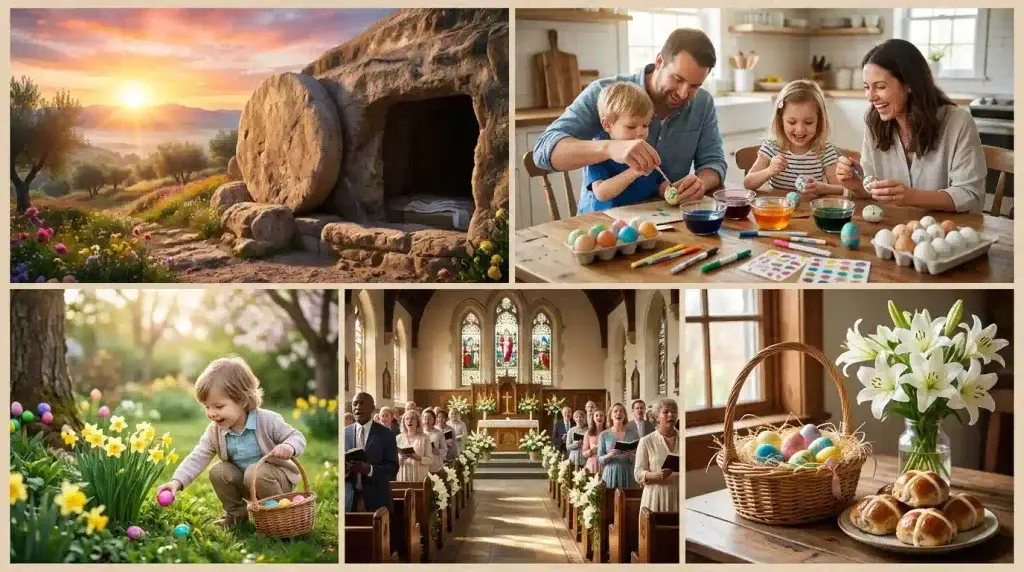
Every spring, stores fill up with candy, baskets, and pastel colors. Churches fill up too. So it is no surprise that many people stop and ask, what is the meaning of Easter? The short answer is that Easter is the Christian holiday that celebrates Jesus Christ rising from the dead.
For Christians, it is the most important day of the year. But Easter has also grown into a happy spring holiday for families, with eggs, bunnies, and big meals. In this guide, you will learn what Easter means in the Christian faith, what happened during Holy Week, where the name came from, and why people hide eggs. You will also see how Easter is celebrated around the world and how to explain it to kids.
Quick Answer: What Is the Meaning of Easter?
The meaning of Easter is the celebration of Jesus rising from the dead three days after he was crucified. Christians believe this shows that love is stronger than death and that new life and forgiveness are possible. Outside of church, Easter is also a spring holiday about new beginnings, family, and joy.
That is the heart of it. Everything else, from the songs to the sunrise services to the chocolate, grows out of that one big idea. Easter is about hope. It tells a story where the darkest moment is not the end.
Easter Meaning in the Christian Faith
For Christians, Easter is called the Feast of the Resurrection. The word resurrection means rising again to life. Christians believe that Jesus was killed on a cross, was buried in a tomb, and then came back to life on the third day. They believe this happened on a Sunday morning, which is why Easter is always on a Sunday.
This story is told in the four Gospels of the New Testament: Matthew, Mark, Luke, and John. In each one, women who followed Jesus go to his tomb early in the morning. They find the stone rolled away and the tomb empty. Angels tell them that Jesus is alive. Soon after, Jesus appears to his friends and followers.
The Apostle Paul also wrote about it in one of his letters, 1 Corinthians 15. He said that if Jesus had not risen, the Christian faith would have no point. That tells you how central Easter is. Christmas gets more attention in stores, but many Christians say Easter is the bigger holiday, because it sits at the center of what they believe.
So what does the resurrection mean to believers? There are a few main ideas. First, it shows that Jesus is who he said he was, the Son of God. Second, it means sins can be forgiven, because Christians believe Jesus gave his life for the wrongs of others. Third, it gives hope that death is not the final word. Many Christians say ‘He is risen’ on Easter morning, and others answer, ‘He is risen indeed.’
The Story Behind Easter: What Happened During Holy Week
Easter is the end of a longer story. The week before Easter is called Holy Week. Each day has its own meaning, and many churches hold special services all week long. Here is a simple look at the days.
| Day | What Christians Remember |
| Palm Sunday | Jesus rides into Jerusalem while crowds wave palm branches and cheer. |
| Maundy Thursday | Jesus eats a last meal with his twelve disciples. He washes their feet and teaches them to serve others. |
| Good Friday | Jesus is arrested, put on trial, and crucified. Many churches hold quiet, serious services. |
| Holy Saturday | Jesus lies in the tomb. It is a day of waiting and silence. |
| Easter Sunday | The tomb is found empty. Christians celebrate that Jesus is alive. |
You may wonder why the Friday before Easter is called Good Friday when it is such a sad day. There is no single answer that everyone agrees on. Some say ‘good’ once meant ‘holy.’ Others say it is called good because Christians believe the death of Jesus led to something good for the world. Either way, it is a day to think and to be quiet.
Before Holy Week comes Lent. Lent is a 40-day season of prayer and giving things up, such as sweets or social media. It starts on Ash Wednesday. Lent is like getting ready for a big party. The quiet time before makes the joy of Easter feel even bigger.
Why Easter Matters So Much to Christians
It is fair to ask why one morning, long ago, still matters to so many people today. For Christians, Easter is not just a story from the past. They see it as something that changes how they live now.
The first big idea is hope. Life can be hard. People lose jobs, get sick, and say goodbye to those they love. Easter tells Christians that pain and loss do not get the last word. That message brings comfort to people at funerals, in hospitals, and in hard seasons of life.
The second idea is forgiveness. Christians believe that because of what Jesus did, they can start fresh. This is why Easter is a popular day for baptism, which is a ceremony that uses water to show a new start in faith. Many churches hold baptisms on Easter weekend for this reason.
The third idea is love. Christians believe that Jesus gave himself out of love for others. Many try to follow that example by helping neighbors, giving to those in need, and being kind. So Easter is not only about what happened. It is also about how people try to treat one another afterward.
Of course, not everyone believes the Easter story. Millions of people do not, and that is okay. You can still learn what the day means to those who celebrate it. Knowing the meaning helps us understand our neighbors, friends, and coworkers a little better.
Where Did the Name Easter Come From?
The origin of the word Easter is a little bit of a mystery, and it is best to be honest about that. The most common idea comes from an English monk named Bede, who lived over 1,300 years ago. He wrote that the Old English name for the month of April was Eosturmonath, named after a goddess called Eostre. He said people once held feasts in her honor, and the name later passed to the Christian holiday.
The trouble is that Bede is the only early writer who mentions Eostre. Because of that, scholars still debate how much of the story is true. Some think she was a real local goddess. Others think the word simply comes from an old word for dawn or for the east, where the sun rises. Nobody can say for sure.
Many other languages use a very different word. In Spanish, Easter is Pascua. In French, it is Paques. In Italian, it is Pasqua. In Greek, it is Pascha. All of these come from the Hebrew word Pesach, which means Passover. That points to a very old link between the two holidays, which we will look at in a moment.
How Is the Date of Easter Chosen?
Unlike Christmas, which is always December 25, Easter moves from year to year. That can be confusing, but the rule is simple once you see it. In most Western churches, Easter falls on the first Sunday after the first full moon that comes on or after March 21. Because of this rule, Easter can land anywhere between March 22 and April 25. In 2026, for example, Western churches celebrated Easter on April 5.
The rule goes back to a church meeting called the Council of Nicaea in the year 325. Church leaders wanted all Christians to celebrate on the same Sunday. They tied the date to the spring season and the moon because the first Easter happened around the time of the Jewish Passover, which follows the moon.
Eastern Orthodox churches often celebrate on a different day. They use an older calendar, called the Julian calendar, to figure out the date. Because of that, Orthodox Easter is sometimes the same day as Western Easter and sometimes one to five weeks later. In 2026, Orthodox Easter was on April 12.
Easter and Passover: A Close Connection
To understand Easter, it helps to know about Passover. Passover is a Jewish holiday that remembers how God freed the Israelites from slavery in Egypt. The Gospels say that Jesus was in Jerusalem for Passover during the week he was arrested. His last meal with his disciples, often called the Last Supper, took place around that time.
Christians often see a picture here. In the Passover story, a lamb was part of the meal, and the Israelites were set free. Christians sometimes call Jesus the Lamb of God and see Easter as another kind of freedom. This is why lambs show up in Easter art, in church songs, and on many Easter dinner tables.
The two holidays are not the same, and they are celebrated in different ways. But they share themes of rescue, hope, and new beginnings. Knowing this helps explain why the word for Easter in so many languages comes from the word for Passover.
Easter Symbols and What They Mean
Easter has many symbols. Some come straight from the Bible story, and some grew over hundreds of years as traditions mixed together. Here is a quick guide.
| Symbol | What It Means |
| Empty tomb and cross | The center of the Christian story. The empty tomb shows that Jesus rose. |
| Easter eggs | An egg looks still, but new life comes out of it. It is a sign of new life and of the tomb opening. |
| Easter bunny | A friendly spring figure that stands for new life. It was not part of the early church. |
| Lilies | White flowers that stand for purity, hope, and new life. |
| Lamb | Reminds Christians of Jesus as the Lamb of God and of the Passover story. |
| Hot cross buns | Sweet buns marked with a cross, often eaten on Good Friday. |
| Sunrise | Because the empty tomb was found at dawn, many people gather at sunrise services. |
Eggs have a long history. For centuries, eggs were among the foods many Christians did not eat during Lent. By Easter, families had lots of eggs saved up, so eggs became a natural part of the feast. Some Christian groups in Eastern Europe and the Middle East dyed eggs red to remind them of the blood of Jesus and the joy of new life. Decorated eggs are still a big tradition in countries like Ukraine, Poland, and Greece.
The Easter bunny is newer. Stories about an egg-laying hare called the Osterhase appeared in Germany a few hundred years ago. German settlers brought the tradition to Pennsylvania in the 1700s. Children made nests for the hare, and in the morning they found colored eggs inside. Over time, the nests turned into baskets, and the eggs turned into candy.
Easter Traditions in the USA and Around the World
In the United States, Easter is a mix of faith and fun. Many families start the day at church, with music, flowers, and special clothes. Some go to a sunrise service outdoors. After that, they often share a big meal with ham, lamb, potatoes, or other family favorites. Kids look for eggs in the yard, at the park, or inside the house. Many children wake up to an Easter basket with chocolate and small toys.
One famous American tradition is the Easter Egg Roll at the White House. Children roll hard-boiled eggs across the lawn with big spoons. The event goes back to 1878, when President Rutherford B. Hayes opened the grounds to children. It has been a springtime tradition, with a few breaks, ever since.
Other countries have their own ways of celebrating. In Greece, families crack red eggs against each other in a friendly game. In Spain and parts of Latin America, big parades carry statues through the streets during Holy Week. In Australia, some people hand out chocolate bilbies, which are small animals, instead of rabbits, because rabbits are seen as a pest there. In Sweden and Finland, children dress up like friendly witches and go door to door for treats. In Poland, families bring food baskets to church to be blessed on Holy Saturday.
In many countries, the Monday after Easter is a day off from work. In the United States, Easter Sunday is not a federal holiday, but most schools and many businesses close or change hours around that time.
Easter as a Spring and Family Holiday
Not everyone who enjoys Easter is religious, and that is part of why the holiday has such a wide reach. For many families, Easter is simply a happy day in spring. The weather gets warmer, flowers bloom, and baby animals are born. It feels natural to celebrate new life at this time of year.
The idea of new beginnings fits well with the season, and it is one reason the holiday matches so many symbols. A chick coming out of an egg, a flower coming up from the dirt, and a person coming back to life are all different pictures of the same idea. Life starts again.
For families, Easter is also about time together. People dye eggs, bake treats, wear their best clothes, and gather around a table. Those small moments become memories that last for years. So if someone tells you Easter means family to them, that is a real and common meaning too. It sits next to the religious meaning and does not erase it.
Common Mistakes and Misunderstandings About Easter
Because Easter mixes so many traditions, a few myths float around. It helps to clear up the most common ones.
The first mistake is thinking Easter and Christmas are about the same event. Christmas celebrates the birth of Jesus. Easter celebrates his resurrection. They are two different parts of one story.
The second mistake is thinking the Easter bunny and eggs come straight from the Bible. They do not. The Bible never mentions rabbits or decorated eggs. These customs grew later and became linked to Easter over time. Many Christians enjoy them as fun traditions, while keeping the church service as the heart of the day.
The third mistake is believing that every claim online about the roots of Easter is proven. You may have seen posts saying every Easter tradition was borrowed from an ancient goddess. The truth is more careful than that. Some customs have unclear origins, and historians do not all agree. It is better to say ‘we are not sure’ than to repeat a story that sounds exciting but cannot be shown.
The fourth mistake is thinking Easter always falls on the same date. As you learned above, the date moves each year, and Orthodox churches may celebrate on a different day.
Finally, some people mix up Good Friday and Easter Sunday. Good Friday remembers the crucifixion and is a serious day. Easter Sunday celebrates the resurrection and is a joyful day.
Tips for Explaining Easter to Kids
If you are a parent, teacher, or grandparent, you may need to explain Easter in a way a child can follow. A few simple ideas can help.
Start with the basic story in short, calm words. You might say, ‘Jesus was a teacher who loved people. He died on a cross, and his friends were very sad. But on the third day, the tomb was empty, and Jesus was alive again. Christians celebrate that on Easter.’ Kids can handle more than we sometimes think, but short and gentle works best.
Link the story to things children already see. A seed looks dead in the ground and then grows into a flower. A caterpillar becomes a butterfly. These pictures help young minds see the idea of new life.
Explain the fun traditions as well. You can say that eggs show new life and that the bunny is a happy sign of spring. This helps children enjoy the baskets and egg hunts without mixing up the main meaning.
Finally, invite questions. Children often ask big ones, such as why Jesus died or what happens after we die. It is fine to say, ‘That is a great question. Different people believe different things.’ You can then share what your family believes.
FAQs About the Meaning of Easter
1. What is the simple meaning of Easter?
Easter is the day Christians celebrate Jesus rising from the dead. It stands for hope, forgiveness, and new life. For many people, it is also a spring holiday about family and new beginnings.
2. Why is it called Easter?
Nobody knows for sure. One old explanation says it came from Eostre, a goddess named by the monk Bede. Another idea is that it comes from an old word for dawn. Scholars still debate it.
3. Why does the date of Easter change every year?
Western churches set Easter on the first Sunday after the first full moon on or after March 21. Since the moon follows its own cycle, the date moves between March 22 and April 25.
4. Why do we have Easter eggs and the Easter bunny?
Eggs are a sign of new life, and Christians once saved eggs during Lent and ate them at Easter. The bunny comes from a German story about an egg-laying hare that German settlers brought to America.
5. Is Easter more important than Christmas?
Many Christians say yes, because the resurrection is the center of their faith. Christmas celebrates the birth of Jesus, while Easter celebrates his rising. Both matter, but Easter is often called the most important Christian holy day.
6. Can people who are not Christian celebrate Easter?
Yes. Many people enjoy Easter as a family day with food, eggs, and spring fun. Others like to learn about it to understand their friends and neighbors. What matters is respecting what the day means to those who hold it sacred.
Conclusion
So, what is the meaning of Easter? At its core, Easter is the Christian celebration of Jesus rising from the dead, a day that stands for hope, forgiveness, and new life. It comes after Lent and Holy Week, moves around the calendar each spring, and is shared with songs, church services, and family meals. Along the way, it has picked up fun customs like decorated eggs, baskets, and the Easter bunny, which add joy without changing the main story.
If you want to get more from the holiday, try this. Learn the story behind it, ask a friend what Easter means to them, and take a quiet moment on Good Friday or Holy Saturday. Then enjoy the celebration on Sunday, if that means a sunrise service, a big family dinner, or an egg hunt in the yard. The more you understand the meaning, the more special the day becomes.

Hello, I’m Clara Whitmore. I write daily prayers, devotionals, and faith-based reflections for readers seeking peace and encouragement. I believe prayer has the power to heal hearts and renew faith.